
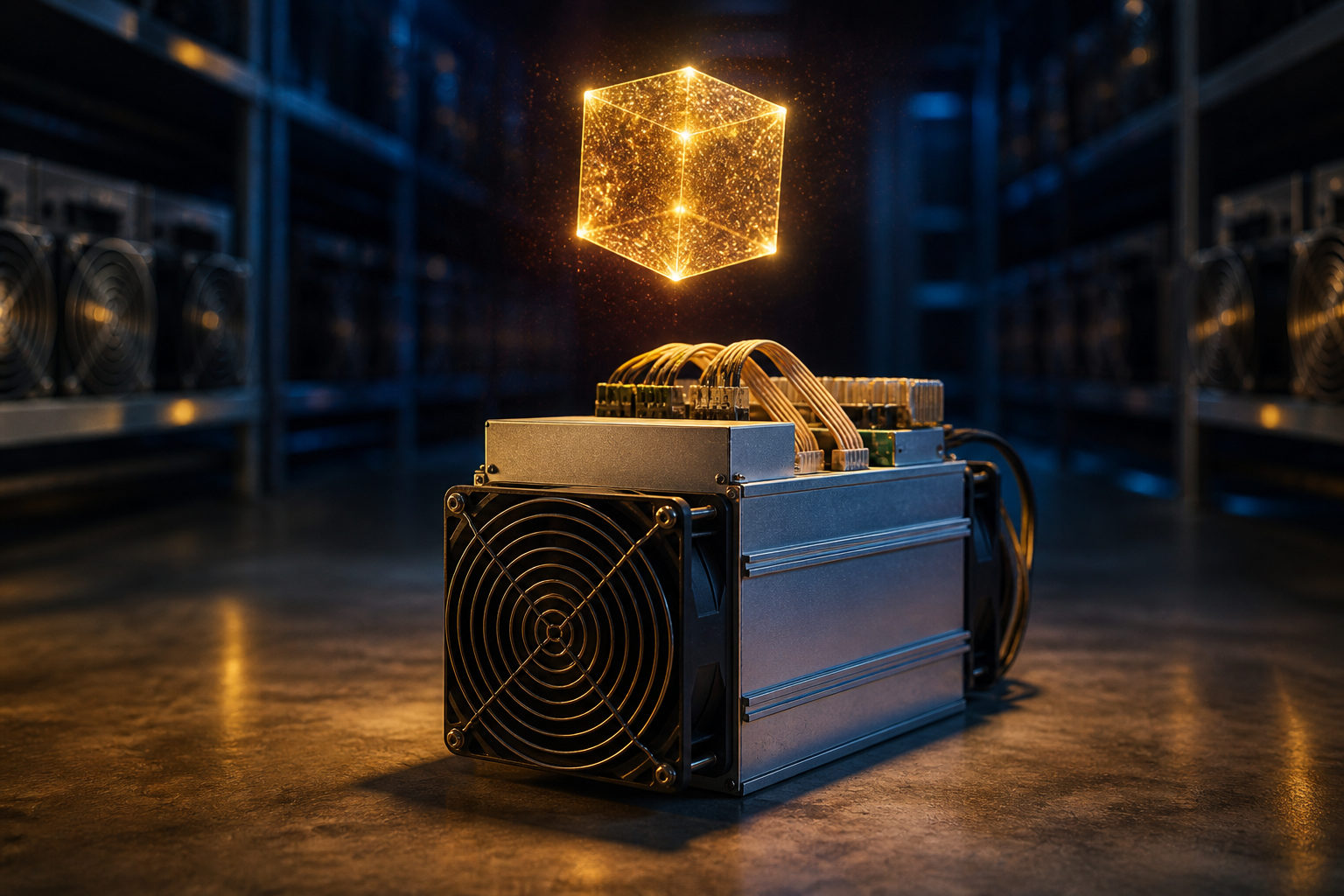
Bitcoin miners work by joining a nonstop race to record transactions. They gather pending payments, try to produce a valid block under Bitcoin's rules, and the winner can add that block to the chain and collect the 3.125 BTC block reward plus transaction fees.
What bitcoin miners actually do
The word mining can be misleading. Miners are not digging coins out of a hidden pool. Their job is to package valid transactions into a candidate block and then perform huge numbers of calculations to find a hash that meets the network's difficulty target.
When a miner finds a valid result, that block is broadcast to the network. Other nodes check the transactions, the block structure, and the proof-of-work itself. If everything matches the rules, the block is accepted and added to the blockchain.
This process gives Bitcoin a way to keep a shared ledger without a central bookkeeper. Miners supply computing power and electricity, and in return they get a chance to win the right to write the next page of the ledger.
Why mining is often described as a ledger race
Think of Bitcoin as a public ledger that anyone can inspect but no one can rewrite at will. Roughly every 10 minutes, the system aims to add one new block. Miners all compete for that single opening at the same time, which is why the process feels like a race rather than a queue.
No one is manually grading their work. The network sets a target, and miners keep trying different inputs until someone gets a qualifying hash first. More hash power usually means more attempts in the same period, so the probability of finding a block goes up. Even so, there is no guarantee that any specific machine, farm, or pool will win the next block.
Bitcoin also adjusts difficulty so block production stays near the target pace. If more miners join, the challenge gets harder over time. If enough miners leave, the challenge can ease. The point is to keep the issuance schedule and confirmation rhythm from drifting too far.
| Stage | What miners do | What happens next |
|---|---|---|
| Collect transactions | Select valid pending transactions | A candidate block is built |
| Run calculations | Try many input variations to find a valid hash | Compete for the next block |
| Broadcast the block | Send the winning block to the network | Nodes begin verification |
| Network validation | Check proof-of-work and transaction rules | The block is accepted on-chain |
| Receive rewards | The winning miner gets the block reward and fees | New BTC enters circulation |
Where the mining reward comes from
Miners are paid in two ways. First, the miner that produces a valid block receives the block reward. Second, that miner also collects the transaction fees included in the block. The current block reward is 3.125 BTC following the halving on 2024-04-19, and that figure is expected to stay in place until the next halving around 2028.
Bitcoin cuts the block reward in half every 210,000 blocks, which works out to about every 4 years. The completed halvings took place on 2012-11-28, 2016-07-09, 2020-05-11, and 2024-04-19. This schedule is central to Bitcoin's supply design. The total supply is capped at 21,000,000 BTC, with issuance expected to continue until about 2140.
At the current reward level and with about 144 blocks per day, the network adds about 450 BTC per day in total. That figure belongs to the whole network, not to any single miner or mining company. A beginner who treats that number as a personal output estimate will get the economics badly wrong.
| Rule | Current fact | What it means for miners |
|---|---|---|
| Target block time | About 10 minutes per block | New chances to win appear on a steady rhythm |
| Halving cycle | Every 210,000 blocks, about 4 years | New BTC issuance drops over time |
| Current block reward | 3.125 BTC | The fixed reward between the 2024 and next halving |
| Network-wide new BTC per day | About 450 BTC | A network total, not a personal daily result |
| Total supply cap | 21,000,000 BTC | There is a hard issuance ceiling |
Can individuals still mine bitcoin today
They can, but the practical answer depends on what kind of participation they mean. In Bitcoin's early period, after the genesis block on 2009-01-03, the network was much smaller and the barriers were lower. Today, mining is a specialized business with real operational demands.
An individual miner has to think beyond buying a machine. Electricity supply, cooling, noise, uptime, maintenance, internet stability, and hardware replacement all matter. A mining setup that runs poorly or overheats can lose effectiveness fast, and a machine that is offline earns nothing while still tying up capital and space.
That is why many participants choose a mining pool instead of solo mining. A pool combines the hash power of many miners and distributes rewards according to its payout method when the pool finds blocks. This usually smooths the timing of payouts, but it also means the miner must understand the pool's rules, fee structure, and reliability.
| Participation method | Main traits | Best fit |
|---|---|---|
| Solo mining | Full control, but block wins depend on your own hash power | Operators with strong infrastructure and technical skill |
| Pool mining | Combined hash power with shared payouts | People who want less variance in payout timing |
| Learning only | No hardware or power burden | Readers who want to understand how mining works |
The cost reality people often miss
The hardest part of mining is often not switching the machine on for the first time. It is keeping the operation efficient and stable over time. Hardware ages, fans fail, heat builds up, and power conditions matter. Mining is closer to infrastructure management than to a simple side hustle.
There is also a common mistake in the way people ask about results. They want one fixed answer to how much a miner earns per day, but there is no universal figure. The outcome depends on hash power share, pool terms, uptime, machine efficiency, electricity cost, and fee conditions at the time.
If your question is really about value, mining output still has to be judged against the live bitcoin price, and that price changes with market supply and demand. The network decides how coins are issued; the market decides what they trade for. That is why any serious mining decision starts with operating conditions, not with a fantasy of automatic income.
FAQ
Do bitcoin miners get paid every day
Not in a fixed or universal way. The network adds about 450 BTC per day at the current reward level, but individual miners only receive a share based on their hash power, pool setup, and operational uptime.
Can I mine bitcoin with a home computer
You can take part in the process at a technical level, but that is very different from mining competitively. In current conditions, home computers usually cannot match specialized mining hardware on efficiency or scale.
Does joining a mining pool guarantee income
No. A pool changes how rewards are distributed and can make payouts feel more regular, but it does not remove mining risk. Your result still depends on pool rules, fees, your machine performance, and the broader competition.
What is the link between mining and transaction verification
Miners place transactions into blocks and then use proof-of-work to compete for the right to publish that block. Once a valid block is accepted by the network, those transactions become part of Bitcoin's on-chain record.
Why does halving matter to miners
Halving reduces the number of new coins paid per block. After the halving on 2024-04-19, the block reward became 3.125 BTC, so miners have to pay even closer attention to efficiency and operating costs.
If you want the short answer to whether and how bitcoin miners work, it is this: they secure the network by competing to add blocks, and they are paid under a fixed issuance schedule plus transaction fees. Before trying to mine yourself, check the practical side first: power, cooling, maintenance, uptime, and whether you are ready to run it as an operation rather than a casual experiment.
Disclaimer: This article is for informational and educational purposes only and is not investment, financial, or legal advice. Crypto assets are highly volatile and you could lose your entire investment. Do your own research and decide carefully.