
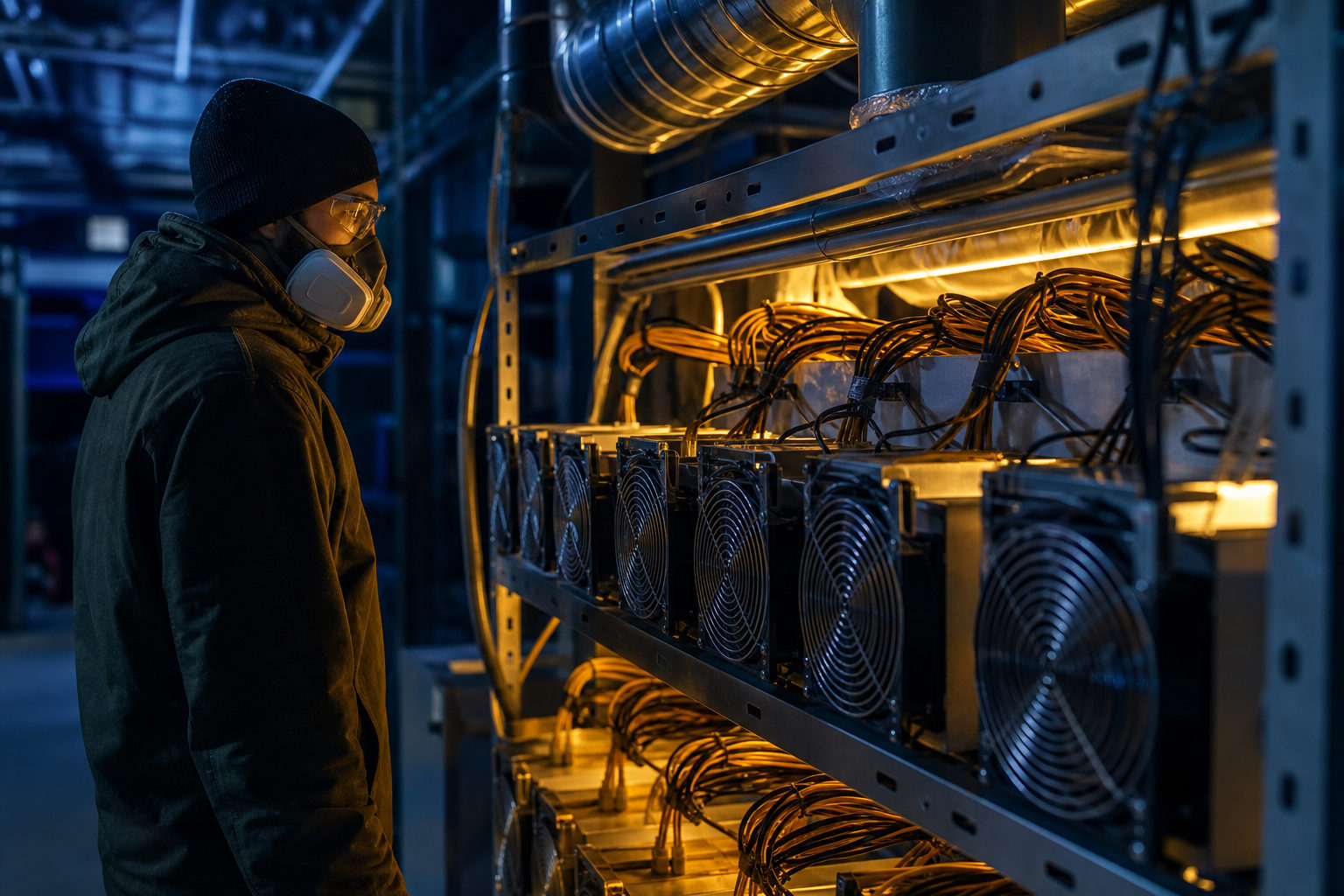
Bitcoin mining can be dangerous, but the main hazards are practical ones: electricity load, heat, noise, hardware wear, and the risk of spending money on an operation that may not suit your setup.
Think of mining as a race to write the next page of the ledger
Bitcoin runs on a public ledger. People can inspect transactions, but adding the next block is not assigned by a manager or a bank. Miners compete for that role by running specialized machines that keep calculating until one produces a valid result under the network rules.
This is proof of work. The network produces a block about every 10 minutes, and the accepted block becomes the next confirmed page in that shared record. In plain terms, mining is less like digging and more like entering a nonstop accounting contest where computing power decides who gets to submit the next batch of entries.
That framing matters because it strips away a common misunderstanding. When people ask whether bitcoin mining is dangerous, they often focus on the coin itself. The first layer of risk usually comes from the real-world demands of joining the contest: power supply, cooling, machine upkeep, and the fact that idle equipment earns nothing.
Where the danger actually shows up
| Risk area | What can happen | Why beginners miss it |
|---|---|---|
| Electrical load | Overheated wiring, unstable power delivery, tripped protection | People look at the machine first and the building second |
| Heat management | Thermal stress, throttling, shutdowns, shorter hardware life | Cooling sounds simple until machines run nonstop |
| Noise | Constant fan noise that can disrupt homes and workspaces | Product pages rarely convey what full operation feels like |
| Hardware wear | Continuous heavy use raises maintenance needs | New miners may treat a mining rig like a regular PC |
| Capital risk | Upfront spending with no guaranteed payback path | “It works” is often confused with “it makes sense” |
| Operational complexity | Network issues, firmware setup, pool configuration, downtime | The process looks more passive than it really is |
Start with power. Bitcoin mining machines draw sustained load for long periods, which is very different from occasionally using a desktop computer. If a location was never planned for that kind of demand, the weak point may be the outlet, the wiring, the extension setup, or the protection hardware. That is a physical safety issue, not a market opinion.
Heat comes next. Mining hardware depends on constant airflow, and poor ventilation can turn a room into a hot box quickly. Once temperatures climb, machines may slow down, shut off, or wear out faster. Even if nothing dramatic happens on day one, a bad cooling setup tends to punish operators over time.
Noise is another factor people underestimate. Dedicated mining equipment is built to run hard, and that means aggressive fan activity. In a residential setting, the sound and hot exhaust often become a bigger problem than the software side of mining.
Then there is financial danger. Mining is an equipment-heavy activity with ongoing power and maintenance needs. Buying a machine is only the start. Whether the setup remains sensible depends on your operating conditions, the wider level of competition on the network, and how well you handle downtime and repairs.
Different ways to participate carry different risks
| Method | How it works | Who it may suit | Main risk |
|---|---|---|---|
| Home operation | You buy hardware and run it yourself | People with suitable space and electrical planning | Power, heat, noise, and maintenance land on you |
| Hosted mining | Your machine runs at a third-party site | People who want to avoid on-site handling | Dependence on the operator and service terms |
| Mining pool participation | Many miners combine hash power and share outcomes | Operators seeking smoother results | Does not remove equipment and cost issues |
| Cloud mining contracts | You pay for access to promised mining capacity | Beginners drawn to low visible effort | Hard-to-check claims and opaque contract structures |
Running miners at home gives you direct control, but it also concentrates the hazards. A house or apartment is rarely designed around nonstop high-load industrial-style hardware. Even if the machine powers on, that does not mean the location is a good long-term fit.
Hosted mining removes some on-site headaches, especially noise and ventilation, yet it introduces a trust problem. You need to understand what happens if the machine goes offline, how maintenance is handled, and how transparent the operator is about performance and access. The danger shifts from your wiring to someone else’s management.
Mining pools are often misunderstood. A pool can smooth out the randomness of block discovery by sharing results among participants, but it does not erase your power bill, your hardware risk, or your need to keep the machine online. It changes distribution, not the underlying operating burden.
Cloud mining may look simpler because you do not touch hardware at all. That convenience can hide the hardest question: what exactly are you buying, and can you verify it in any meaningful way? When the machines, site conditions, and operating details are invisible, risk assessment gets much harder.
What to check before you get involved
| Checkpoint | What to verify | What goes wrong if ignored |
|---|---|---|
| Power setup | Circuit capacity, outlet quality, protective equipment | Instability, overheating, shutdowns |
| Cooling path | Airflow, exhaust space, dust conditions, room heat | Throttling, failures, faster wear |
| Noise tolerance | Impact on family, neighbors, or workspace | Forced shutdown or relocation |
| Technical handling | Ability to manage firmware, networking, and pool settings | Minor issues turn into long downtime |
| Cost awareness | Whether you include power, maintenance, and idle time | Unrealistic expectations |
| Coin storage | Where mined bitcoin will be held and who controls the keys | Operational effort is lost to custody mistakes |
If you are still at the curiosity stage, do not rush into hardware. Learning how mining works and running a mining operation are very different commitments. Many people discover too late that their space, power access, or tolerance for noise was the real barrier all along.
It also helps to understand the network rules that shape competition. Bitcoin has a hard cap of 21 million coins. The genesis block was created in January 2009. The block subsidy schedule changes through halvings about every 4 years, or every 210,000 blocks, with past halving years in 2012, 2016, 2020, and 2024. Those facts do not tell you what your own setup will achieve, but they explain why mining is a long-running contest with changing economics.
If your goal is simply to gain bitcoin exposure, mining is only one path. Some people are better suited to studying machine management, power planning, and site operations. Others are better off focusing on wallets, custody, and how to buy and hold safely. The danger depends heavily on which path you choose.
FAQ
Is it unsafe to run a bitcoin miner at home?
It can be unsafe if the location is not prepared for continuous electrical load and constant heat output. The biggest home risks are wiring limits, ventilation problems, and noise that makes the setup impractical.
Can a normal computer mine bitcoin?
In theory, any machine that performs the required calculations can participate. In practice, bitcoin mining is dominated by specialized hardware, so a normal computer is better for learning than for serious operation.
Does joining a mining pool make bitcoin mining safe?
A pool can reduce the randomness of outcomes by sharing results across participants. It does not remove heat, power, maintenance, or equipment risk from your setup.
Is cloud mining safer than buying a miner?
It avoids the physical issues of running hardware yourself, but it creates a different problem: verifying the service. If you cannot inspect the operation or clearly understand the contract, judging the risk becomes harder.
Where should mined bitcoin be stored?
That depends on how you plan to use it, but control matters. If a third party holds the keys, you take on that party’s custody risk instead of controlling the asset directly.
Before spending money, make a checklist for power, cooling, noise, maintenance, and storage. If you also want the live price, check a mainstream market data platform that day rather than basing a mining decision on assumptions.
Disclaimer: This article is for informational and educational purposes only and is not investment, financial, or legal advice. Crypto assets are highly volatile and you could lose your entire investment. Do your own research and decide carefully.