
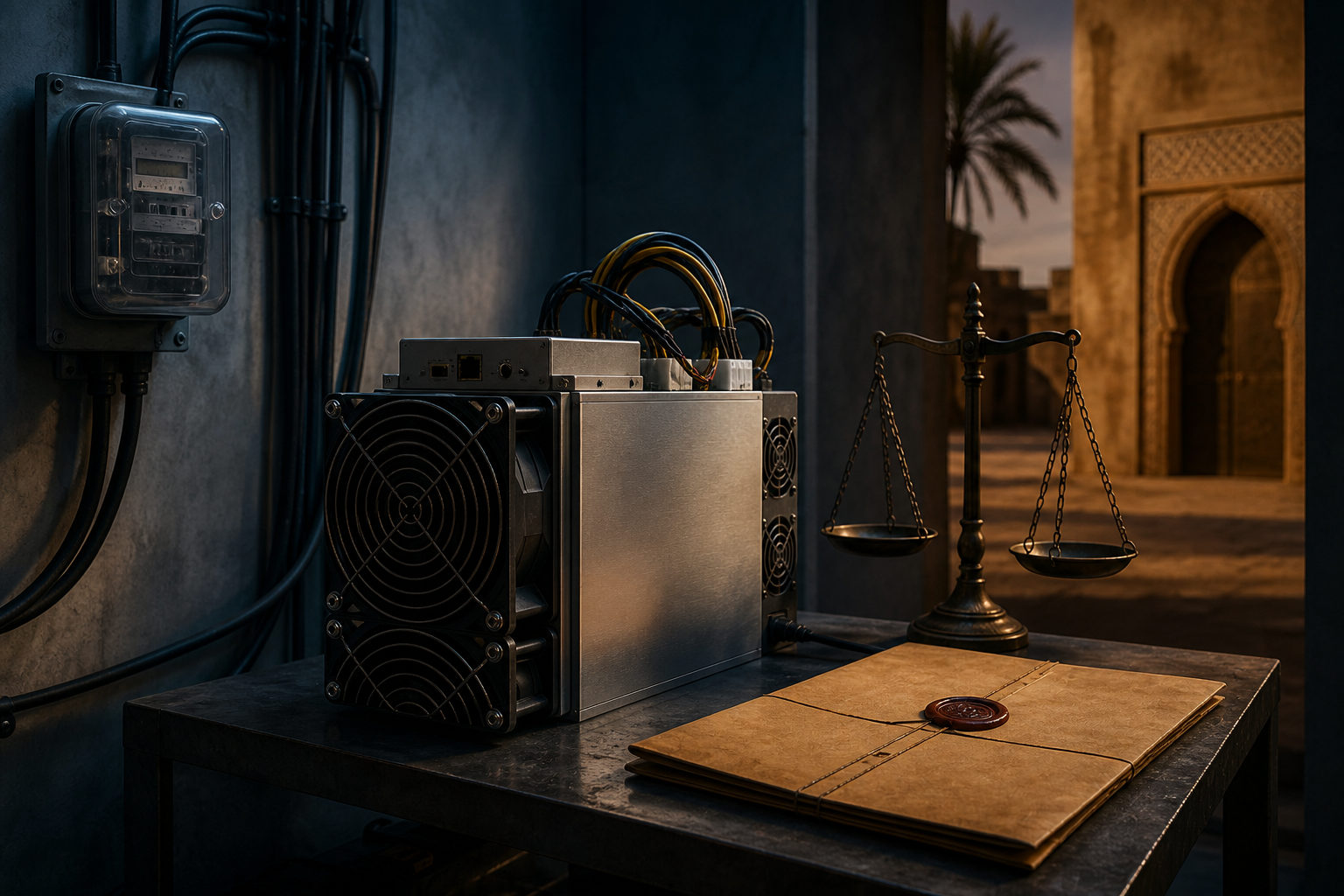
Is bitcoin mining legal in Algeria in 2026? The careful answer is that it should not be treated as a clearly low-risk activity. Mining is a technical process, but in Algeria the legal exposure may extend beyond the machine itself to crypto possession, transfer, and any later attempt to cash out.
Many beginners picture bitcoin mining as buying a machine, plugging it in, and waiting for coins to appear. That misses the hard part. The machine is only one layer. The bigger questions are how local authorities view crypto-related activity, how the equipment is imported and used, what kind of electricity setup is involved, and what happens after mined bitcoin reaches a wallet.
Bitcoin mining is best understood as a bookkeeping race
A simple way to explain bitcoin mining is to compare it to an open bookkeeping contest. The Bitcoin network works like a public ledger that anyone can verify. Participants compete to add the next block of transactions to that ledger. The winner gets the chance to append the block and, under the network rules, receive the block reward and transaction fees.
Bitcoin began with the genesis block in January 2009. Its creator used the name Satoshi Nakamoto, though the real identity remains unknown. The total supply is capped at 21 million coins. A new block is produced about every 10 minutes, and the block reward is cut in half about every 4 years, or every 210,000 blocks. The halving years include 2012, 2016, 2020, and 2024.
That framework matters because mining is not the same as inventing tokens out of thin air. It is a process tied to network security and transaction ordering. In practice, this race is no longer something most people do with a standard home computer. Competition is intense, so participation usually means specialized hardware and, in many cases, joining a mining pool.
A mining pool combines the computing power of many users and distributes earnings according to pool rules. This makes results less random for individuals. It does not remove legal or operational risk. You still control the wallet, you still receive the asset, and you still have to deal with local rules where you live.
In Algeria, legality is not just about turning on a miner
When people ask whether bitcoin mining is legal in Algeria in 2026, they often focus only on the act of running hardware. That is too narrow. Mining usually connects to a longer chain of actions: buying equipment, importing it, powering it, connecting it to a pool, receiving bitcoin, storing it, and possibly moving or selling it later. Risk can appear at any step in that chain.
That is why a useful analysis has to be layered. First, there is the technical act of running mining equipment and contributing hash power. Second, there is the asset question: how mined bitcoin is treated under local rules tied to crypto use or possession. Third, there is the money flow question: whether converting mined bitcoin into fiat currency, sending it to an exchange, or using it in payment could trigger extra exposure. Fourth, there are side issues such as customs treatment, electricity contracts, business licensing, and tax reporting.
For that reason, broad claims should be treated with caution. Saying that home mining must be fine because a miner is “just a computer” is too simplistic. Saying it is harmless if the user never sells the coins is also too simplistic. In a place where crypto-related activity may face restrictions, authorities may look at the wider activity chain rather than isolating the machine from the asset it produces.
Why the concept is easy but the real-world setup is not
The basic idea of bitcoin mining is easy to grasp. The real setup is not. Before anyone considers participating, four practical issues deserve attention: hardware, electricity, heat, and the handling of mined coins.
Hardware: Modern bitcoin mining is usually done with specialized machines built for hashing. These devices can be loud, hot, and demanding on the environment around them. They are not like ordinary consumer electronics that sit quietly in a room. If a user runs them at home, power load, noise, cooling, and maintenance all become real concerns.
Electricity: Mining is a continuous process rather than a casual one. Stable power matters. Repeated outages, voltage instability, or frequent shutdowns can reduce uptime and may affect equipment life. There is also a compliance side. If the electricity arrangement does not match the permitted use of the property or service contract, legal issues may come from that angle as well.
Heat and ventilation: This part is easy to ignore until the machine is operating. Mining hardware generates steady heat, and heat management affects both performance and reliability. A poor environment may lead to throttling, shutdowns, or equipment stress.
Handling the output: Mined bitcoin is not cash in a bank account. It is a digital asset received on-chain. That means the user needs a wallet, needs to understand private key security, and needs a plan for storage and transfer. If the long-term plan involves sending the asset to a trading platform, the legal and account review questions begin there, not only at the point of sale.
Common ways to participate in bitcoin mining
There are several ways people try to enter bitcoin mining. None of them should be judged only by convenience. For someone in Algeria, the first question is whether the legal and practical risk is acceptable, not which route looks easiest.
Running your own machine locally
This gives the user the most direct control over the setup, the wallet destination, and the runtime. It also puts all responsibility on the user. Equipment sourcing, installation, cooling, noise, maintenance, and downtime all fall on one person. If local rules are restrictive toward crypto activity, full control does not mean low risk.
Joining a mining pool
This is the most common route for individual miners. Instead of waiting for one machine to find a block on its own, users combine hash power and receive a share of pool distributions. Pool participation changes the earnings pattern, but it does not change the local legal questions. The user still chooses to receive bitcoin and still has to manage it.
Hosted mining
Some users place machines in a third-party facility that provides electricity, space, and maintenance. This can reduce the noise and heat problem at home, but it adds trust and contract risk. The user has to rely on the host’s honesty, uptime practices, reporting, and jurisdiction. A bad host can create problems even before any legal issue appears.
Cloud mining
Cloud mining may look simple on the surface because the user does not handle hardware directly. It also raises the most questions about transparency. It can be difficult to verify whether the buyer is getting real computing capacity, a rental arrangement, or only a marketing promise wrapped in mining language. For users in Algeria, payment processing, account review, and receipt of mined bitcoin can all add another layer of uncertainty.
The practical risks matter more than the slogan answer
Most people searching for “is bitcoin mining legal in Algeria 2026” are really asking whether taking part could create trouble. That question cannot be answered with a single slogan, but the main risk areas are easy to map.
- Regulatory risk: Even if mining is presented as a purely technical activity, authorities may look at the broader connection to crypto possession, transfer, or sale.
- Import and equipment risk: Mining devices are purpose-built. Purchasing, shipping, customs handling, and replacement support may all become difficult.
- Power and property risk: Continuous heavy electricity use can raise questions under service contracts, building rules, or business-use standards.
- Platform and account risk: Receiving bitcoin does not guarantee that a later exchange deposit or withdrawal will be smooth. Platforms may ask where assets came from or apply extra review.
- Custody risk: Control of bitcoin depends on private keys. If a wallet is compromised or backup phrases are exposed, losses may be permanent.
These are not only “large operator” problems. A small home setup can still run into the same categories of trouble. Bitcoin is global, but every miner still lives inside a local legal, electrical, and financial system.
If you only want to understand the workflow, start with this
The basic mining workflow is straightforward on paper. A user gets mining hardware, checks that power and cooling are adequate, connects the machine to a pool or other setup, creates a bitcoin wallet to receive payouts, and keeps monitoring uptime and hardware condition. After that comes the question many people leave to the end: what local rules apply once bitcoin has been received and possibly moved elsewhere.
That last step is where many mistakes begin. A setup can be technically functional while still being legally exposed. Anyone in Algeria who is thinking beyond pure curiosity should examine local rules on crypto activity, equipment import, electricity use, and possible reporting obligations before buying hardware.
FAQ
Is home bitcoin mining in Algeria automatically allowed?
No. The fact that a machine is running inside a home does not settle the legal question. Local treatment of crypto-related activity, electricity use, and asset handling all matter.
If I mine bitcoin but never sell it, is that safer?
Not necessarily. Some people assume that avoiding a sale removes the main risk, but possession and transfer can matter too. A technical ability to hold bitcoin is not the same as clear legal safety.
Can a regular PC still mine bitcoin?
In theory, any device can attempt the computation. In practice, bitcoin mining is highly specialized, and ordinary computers usually do not offer a realistic competitive position. Understanding costs and risks should come before any experiment.
Is mining bitcoin the same as buying bitcoin?
No. Mining means contributing computing power to the network and receiving bitcoin under protocol rules. Buying bitcoin means acquiring it through a market transaction. The technical setup, risk profile, and compliance issues are different.
Where can I check the live bitcoin price instead of relying on an article?
You can check major market data services, exchange price pages, or blockchain market tools. It is smart to compare more than one source and pay attention to quote timing and market depth.
If you are based in Algeria, the sensible first step is not ordering a miner. It is checking local rules on crypto activity, equipment import, electricity use, and tax obligations; if any of those points remain unclear, bitcoin mining should not be treated as a casual side project.
Disclaimer: This article is for informational and educational purposes only and is not investment, financial, or legal advice. Crypto assets are highly volatile and you could lose your entire investment. Do your own research and decide carefully.