
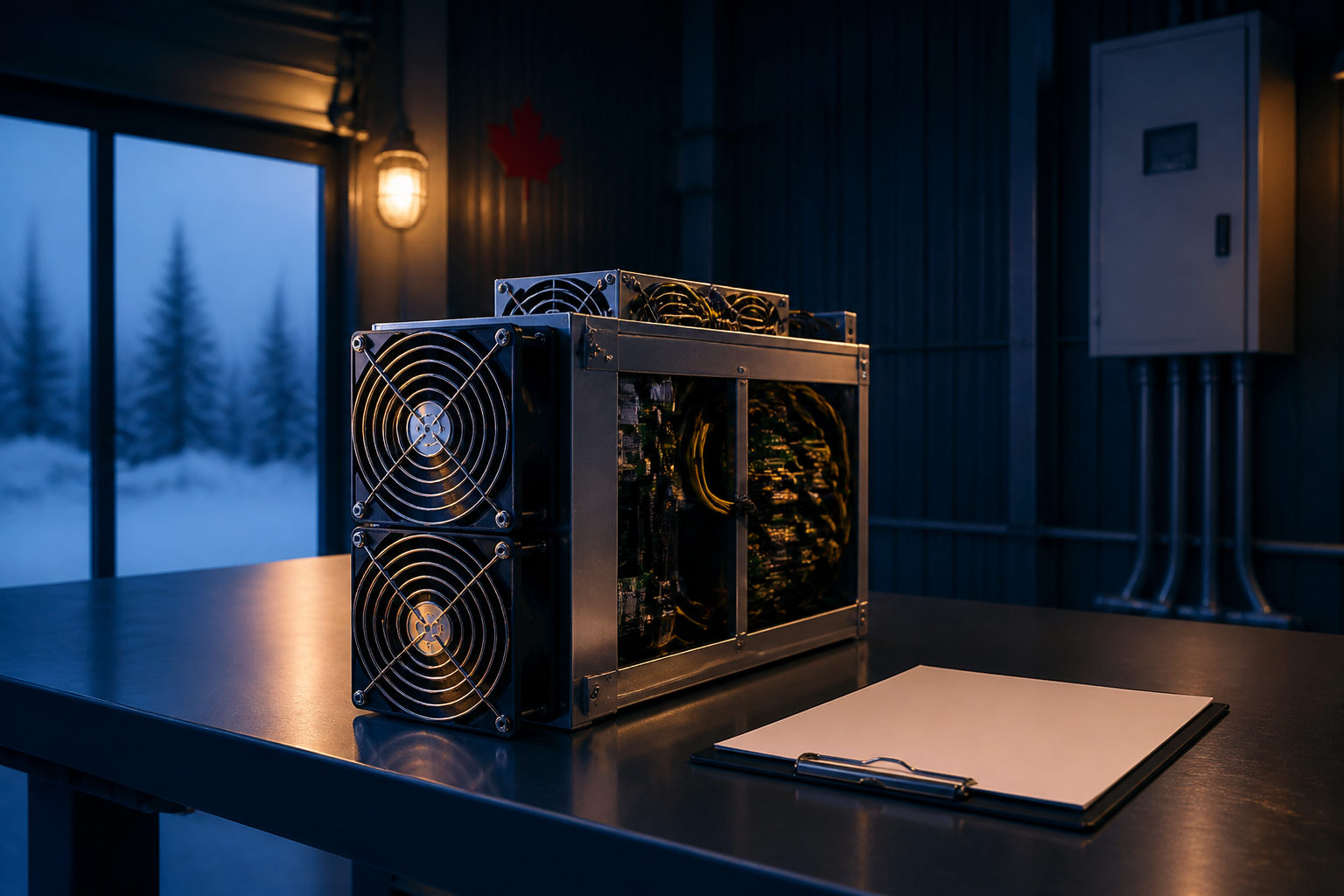
Bitcoin mining is generally legal in Canada, but that does not mean every setup is allowed. The real answer depends on power use, site rules, contracts, business structure, and record-keeping.
People often ask this question as if there should be one clean yes-or-no reply. In practice, the legal side starts with the Bitcoin network and then moves straight into ordinary rules about electricity, leased space, noise, heat, insurance, and taxes. That is why two miners in the same country can face very different outcomes even if both are mining the same asset.
What Bitcoin mining actually does
A simple way to picture mining is to think of Bitcoin as a public ledger that anyone can inspect but no one can edit at will. New transactions need to be grouped, checked, and added to the next block. Miners compete to earn the right to write that next page of the ledger.
This competition runs on computing power. A new block is produced about every 10 minutes, and the winning miner can receive the block reward plus transaction fees. Bitcoin has a fixed supply cap of 21 million coins, and the block reward is cut in half about every 4 years, or every 210,000 blocks. Those rules matter because mining is not casual background computing; it is a structured contest with long-term economic pressure built into the protocol.
That distinction helps answer the legal question. At the network level, mining is participation in transaction validation and block production. In the physical world, it also means buying power, running specialized hardware, managing heat, and keeping financial records. Most legal and compliance issues show up in that second category.
Why legality in Canada has more than one layer
The first layer is the activity itself. Running mining hardware and contributing hash power to the Bitcoin network is generally not treated as illegal just because it involves cryptocurrency. Mining is different from theft of electricity, intrusion into computer systems, or fraud involving payment instruments.
The second layer is how you access real-world resources. Mining hardware draws significant power, and the terms for residential service, commercial service, and industrial connections are not the same. If someone uses electricity in a way that breaks a service agreement, bypasses metering, or ignores site restrictions, the problem shifts away from Bitcoin and into contract breaches or other legal exposure.
The third layer is local administration. Canada is one country, but local conditions still matter. High-load electrical use, building rules, ventilation changes, fire safety, noise, and utility approvals can vary by place and by property type. A setup that works in one location does not automatically transfer cleanly to another.
The fourth layer is business form. A person running a small operation on owned property faces a different compliance burden from a company leasing space, entering into long-term power arrangements, or using hosted infrastructure. Once you move into business activity, issues such as accounting records, invoices, asset ownership, and tax treatment become much more important.
Different ways to mine come with different legal and practical risks
There is no single model for participation. Some people buy their own machines and run them directly. Some ship equipment to a hosting provider. Others join a mining pool so their hash power is combined with that of other miners and rewards can be distributed more steadily. A pool does not change the Bitcoin protocol, but it does create dependence on a third party for payout rules, account access, and operational transparency.
Home mining is often where new entrants underestimate reality. Specialized mining machines produce sustained heat and noticeable noise. That creates questions about wiring capacity, ventilation, insurance conditions, and the terms of a lease or condo arrangement. Even where no law says “you may not mine Bitcoin here,” a property contract or building rule may still make the setup unworkable.
Hosted mining changes the risk profile rather than removing it. You may avoid direct management of heat and power, but now you need to examine equipment custody, downtime terms, repair authority, billing rules, and exit rights. Many first-time miners ask whether hosting is allowed without first asking what happens if the provider stops service, changes terms, or delays access to the machines.
Pool participation can look simpler because the hardware side may be handled elsewhere, yet the account side still matters. You should know how rewards are calculated, what identification may be required, how withdrawals are handled, and what records you will keep. Mining income can be digital, while many operating costs remain in fiat terms, and that mismatch affects bookkeeping.
Cost reality matters as much as legality
For many readers, the question behind “is bitcoin mining legal in canada” is really whether mining is worth doing. A legal activity can still be a poor fit if the cost structure is weak. Electricity is only one line item. Hardware wear, cooling changes, maintenance, shipping, hosting fees, insurance, and downtime can all shape the outcome.
Mining is a competitive business. Network difficulty changes over time, and older machines become less efficient relative to newer hardware. A setup that seems workable at the start may lose its edge if power terms are average, repairs are slow, or replacement parts are hard to source. That pressure exists even when the legal side is clear.
Cash flow is another issue people skip. Mining may produce bitcoin, but rent, repairs, labor, and many operating costs still need to be paid in ordinary currency. If you do not think through equipment resale, contract exit options, and what happens during extended downtime, you are leaving out part of the decision that matters most.
| Area to review | What to check first | What can go wrong if ignored |
|---|---|---|
| Power | Service agreement, load limits, connection terms | Breach of contract, unstable operation, forced shutdown |
| Site | Lease terms, noise limits, ventilation, building rules | Complaints, removal orders, higher retrofit costs |
| Hardware | Warranty, repair access, parts availability | Long downtime, uncontrolled maintenance expense |
| Hosting or pool | Payout terms, custody, exit process, account rules | Disputes over rewards, hard-to-recover equipment, weak visibility |
| Tax and records | Income tracking, cost records, ownership structure | Messy reporting, difficult audits, unclear responsibility |
What to verify before you start
Start with documents, not marketing. Read the electricity agreement for the place where the machines will run. Read the lease. Read the insurance terms. Check whether the property allows high-load equipment, prolonged noise, or ventilation changes. “Other people do it” is not a reliable compliance standard.
Next, define who is actually participating. Is it you as an individual, a separate business entity, or a company operating with partners? That affects where income is received, who owns the equipment, who pays the bills, and how records should be kept. It is far easier to build a clean paper trail from day one than to reconstruct one later.
Then review every third-party relationship. If you use a pool, a host, or a hardware seller, know the service boundaries. Who can authorize repairs? What happens during downtime? Can the provider move your machines? How do you withdraw or terminate the service? If you cannot answer those questions before payment, you do not yet understand the arrangement.
Security deserves its own pass. Mining operations often involve dashboards, firmware updates, remote management tools, and payout accounts. If one outside party controls every credential, you may discover too late that you own the machines on paper but do not control them in practice.
FAQ
Can you mine Bitcoin at home in Canada?
Sometimes, yes, but home mining is limited by more than the law itself. Wiring capacity, lease terms, building rules, noise, and ventilation can block a setup even when mining is not banned as an activity.
Is joining a mining pool legal in Canada?
Joining a pool is generally just one way to participate in mining. The important questions are how the pool handles payouts, what account checks it requires, and whether your overall operation is documented properly.
Is hosted mining easier than running machines yourself?
It can reduce on-site headaches, but it adds contract risk. You should confirm equipment ownership, downtime responsibility, repair authority, and retrieval rights before sending machines to a host.
Do Bitcoin mining activities need tax records in Canada?
If mining creates income, expenses, equipment purchases, or asset disposals, keeping records is the safer approach. The exact treatment can depend on how you participate, so clear documentation matters from the start.
What should a beginner check before buying mining hardware?
Check power terms and site rules first. If the location cannot support the electrical load or the contract does not allow the setup, researching machine specs comes too early.
If you are considering Bitcoin mining in Canada, the practical first move is to verify power access, site rules, contract terms, and record-keeping responsibilities before you decide between home mining, hosting, or pool-based participation.
Disclaimer: This article is for informational and educational purposes only and is not investment, financial, or legal advice. Crypto assets are highly volatile and you could lose your entire investment. Do your own research and decide carefully.