
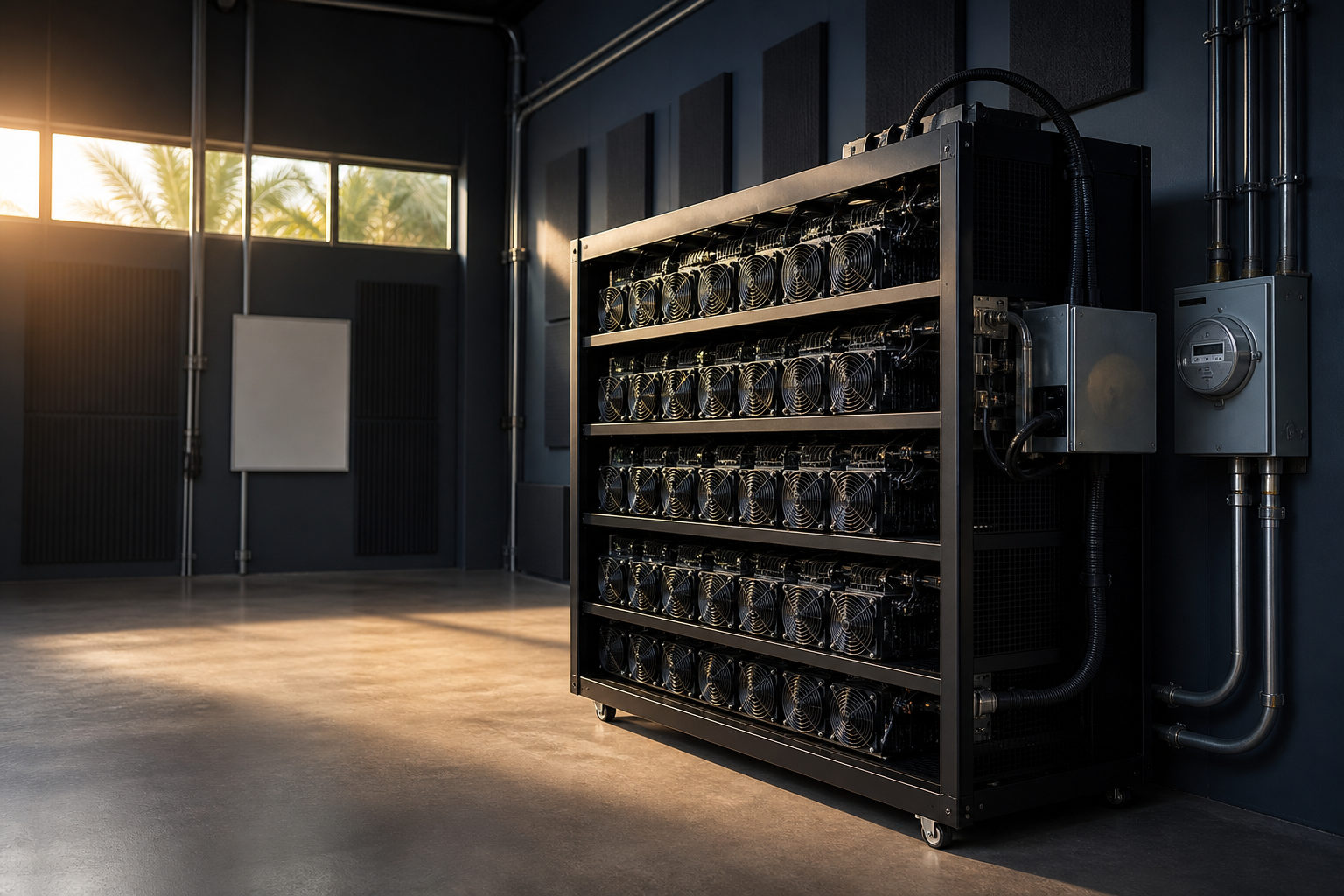
Bitcoin mining is generally legal in Florida in the sense that it is not automatically illegal to run mining hardware there. The real question is whether your setup complies with power agreements, property rules, noise limits, safety requirements, and any business obligations tied to how you operate.
Start with the basics: mining is a bookkeeping race
A simple way to picture Bitcoin mining is to think of a public bookkeeping race. Transactions wait to be confirmed, miners run specialized machines, and the participant that finds a valid result first gets the chance to add the next block to the blockchain and receive the protocol reward tied to that block.
This does not mean miners are printing money at will. They are spending computing power to help secure the network. Bitcoin began with the genesis block in 2009, has a fixed supply cap of 21 million coins, produces a block about every 10 minutes, and cuts the block subsidy roughly every 4 years, or every 210,000 blocks.
That framing matters for the legal question. Many beginners hear “mining” and assume it must be treated like a regulated act of issuing currency. In practice, the first legal issues are often much more ordinary: electricity use, equipment operation, building safety, contracts, heat, and noise.
What “legal in Florida” really means
If someone asks whether Bitcoin mining is legal in Florida, a one-line answer is too thin to be useful. Even if the activity is not broadly prohibited, your actual compliance picture changes based on where the machines are, who owns the space, how the electricity is billed, and whether you are mining for yourself or running a service for others.
| Issue | What to check | Why it matters |
|---|---|---|
| Property type | Whether the site is a home, rental unit, garage, warehouse, or dedicated room | Each setting comes with different limits on equipment use, heat, and noise |
| Power arrangement | Utility terms, load limits, and any restrictions on unusual or commercial use | Mining can trigger problems through contract terms even when the activity itself is not banned |
| Lease or HOA rules | Clauses on alterations, loud equipment, extra ventilation, or high power draw | You can face a lease dispute without violating a criminal law |
| Building safety | Wiring, ventilation, overheat risk, and fire precautions | Mining hardware runs hard for long periods, which raises the stakes |
| Business status | Whether you are mining for yourself or offering hosting or managed services | Operating for others can add more compliance duties |
| Neighbor impact | Noise, hot exhaust, vibration, and shared-space disruption | Real-world trouble often starts with complaints, not a headline legal ban |
So the practical answer is this: Bitcoin mining in Florida is usually possible, but it is not something you judge in the abstract. A single machine in a detached space, a room full of machines in a warehouse, and a hosting business for third parties are three very different compliance situations.
Home mining, self-run sites, and hosting are not the same thing
People new to mining often focus on the machine and forget the operating model. Yet the setup itself changes the risk profile. A home miner usually runs into circuit limits, heat buildup, and noise concerns. A self-run commercial site shifts the burden toward facility management and operations. A hosted setup removes some physical work from your plate, but adds contract risk and service-provider dependence.
| Approach | Typical setup | Main concerns | Best fit |
|---|---|---|---|
| Home mining | House, spare room, garage | Circuits, heat, noise, lease terms | People learning the process firsthand |
| Self-run commercial space | Warehouse or dedicated room | Power design, fire safety, insurance, ongoing maintenance | Operators ready to manage infrastructure |
| Third-party hosting | Your machine runs at someone else’s site | Contract terms, downtime responsibility, equipment access | People who do not want to manage cooling and power directly |
| Mining pool participation | Your machine points its hash power to a pool | Pool rules, payout method, account security | Miners who want smoother reward distribution |
A mining pool does not replace your site obligations. It changes how mining rewards are shared, but it does not solve your wiring, ventilation, or landlord issues. If you combine hosting with a pool, you now have two separate relationships to review: where the machine runs, and how the mining output is accounted for.
There is also a mistake that shows up again and again: treating “legal” as if it means “sensible.” Those are separate questions. A setup may be lawful in broad terms and still be a poor fit for your property, budget discipline, or ability to manage hardware over time.
The hard part is often cost reality and day-to-day operation
Mining is hardware-heavy, power-heavy, and maintenance-heavy. Buying a machine is only the start. You still need to handle airflow, dust, firmware management, network uptime, restart procedures after outages, fan wear, replacement parts, and account protection. Any weak point can lead to unstable performance or forced downtime.
Florida conditions can make cooling more of a practical concern. Mining machines throw off a steady stream of heat. If the room traps that heat, performance can suffer and hardware stress can rise. If hot exhaust or loud fan noise spills into nearby living space, the legal issue may arrive through property conflict long before any regulator enters the picture.
| Area | Common beginner mistake | Better approach |
|---|---|---|
| Machine choice | Looking only at marketing specs | Also weigh noise, repairability, and site compatibility |
| Electrical prep | Treating a miner like a normal appliance | Check circuit capacity and continuous load handling first |
| Cooling plan | Assuming air conditioning alone solves it | Plan intake, exhaust, dust control, and room airflow together |
| Network and accounts | Using the easiest setup with shared access | Separate device access, pool credentials, and payout control |
| Service contracts | Assuming the provider handles every risk | Read downtime, damage, fee change, and exit terms line by line |
If your goal is to learn how mining works, it often makes more sense to validate the environment before spending on equipment. A clear review of lease language, property rules, power constraints, and safety conditions can save far more trouble than chasing a machine first and asking questions later.
A practical checklist before you switch anything on
Start with the site, not the hardware. Confirm that the space can support long-running high-load equipment. Then review any written rules that govern your use of that space. Only after those basics are clear should you compare machines, pools, or hosting options.
- Identify the property context: owner-occupied home, rental, shared space, or commercial site.
- Read the documents: lease terms, HOA rules, and electricity conditions matter more than verbal assumptions.
- Check infrastructure: wiring, breakers, ventilation paths, and heat management need a real plan.
- Separate personal mining from business activity: offering services to others can change your obligations.
- Secure your accounts: device control, pool login, and payout destination should not all sit behind one weak setup.
- Prepare for shutdowns: overheating, connectivity loss, and abnormal equipment behavior need a response plan.
This order helps because it screens out bad environments early. Many people think the barrier is technical complexity inside the Bitcoin protocol. In reality, they often hit a wall much sooner through a lease term, a power limit, or a room that cannot handle the heat and sound.
FAQ
Can I mine Bitcoin from my house in Florida?
In many cases, yes, but that does not mean every home setup is acceptable. You still need to check circuit limits, lease terms if you rent, community rules, ventilation, and the effect of noise and heat on the people around you.
Does joining a mining pool change the legal side?
Not much at the property level. A pool affects how mining rewards are distributed, but your compliance duties around electricity, equipment, and site conditions still depend on where and how the machine operates.
Is renting a warehouse safer than mining at home?
It can be more workable for power and cooling, but it also brings a heavier facility burden. A warehouse is not a free pass; you still need to review contract terms, safety measures, and the practical cost of keeping hardware running there.
If I use a hosting provider, am I in the clear?
No setup is automatic. Hosting can remove the need to manage heat and power yourself, but it adds reliance on a provider’s contract, operating standards, and access rules for your equipment.
Should I check Bitcoin price before deciding to mine?
Price matters to miners, but this article does not give live market figures. If you want that part of the picture, check a major market data platform that day and compare it with your power setup, hardware reliability, and site constraints rather than relying on price alone.
If you are thinking about mining Bitcoin in Florida, the first move is not ordering hardware. Review the property rules, power setup, noise impact, and written contracts first; after that, you can decide whether home mining, a self-run site, or third-party hosting makes sense for your situation.
Disclaimer: This article is for informational and educational purposes only and is not investment, financial, or legal advice. Crypto assets are highly volatile and you could lose your entire investment. Do your own research and decide carefully.