
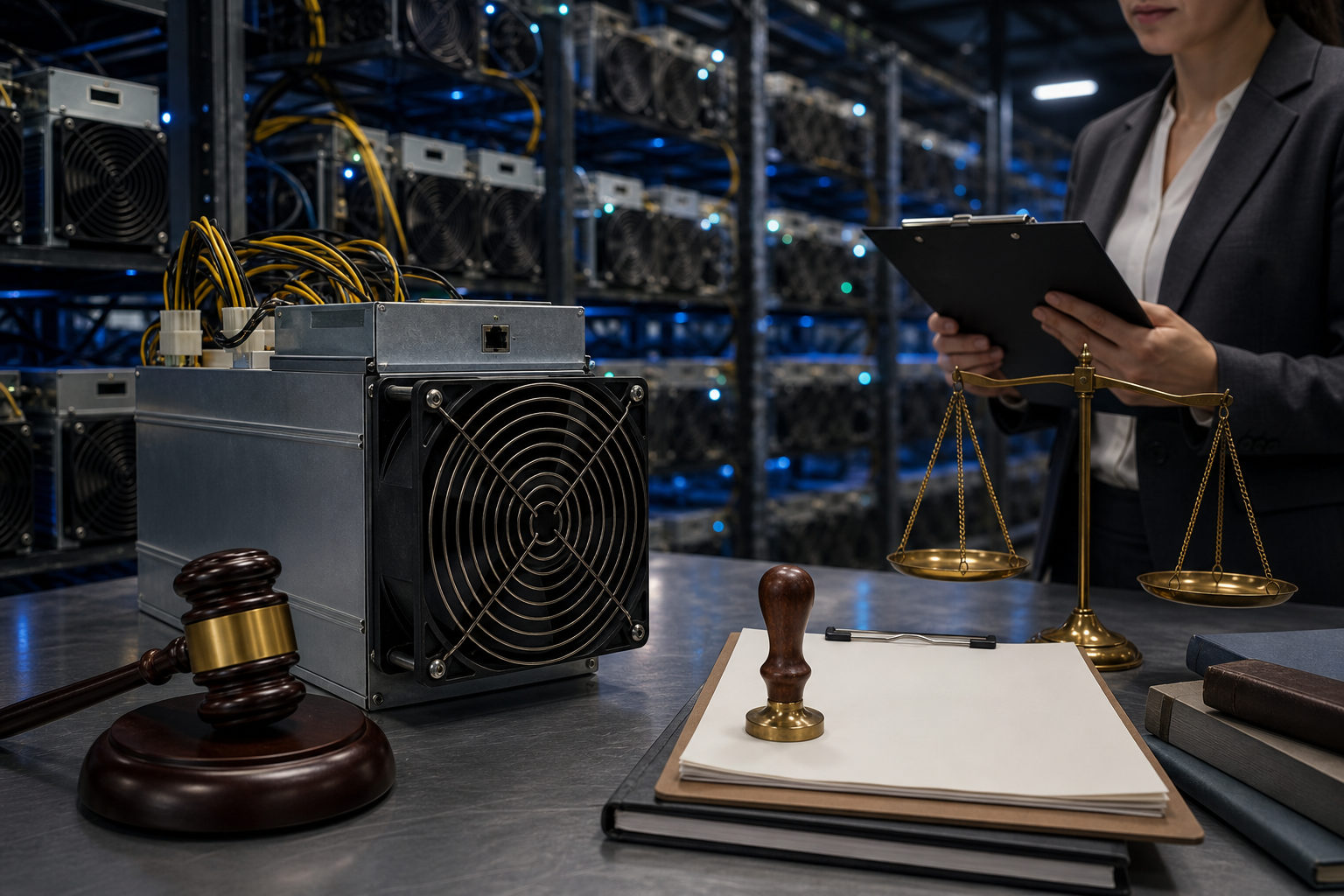
Is bitcoin mining legal? There is no single worldwide answer. Whether it is legal depends on where you are and how local rules treat electricity use, property use, business activity, equipment operation, and tax reporting.
Many people ask this question as if mining were only about machines and potential rewards. That misses the first step. Before thinking about hardware, hosting, or costs, you need to know what bitcoin mining actually is in legal and practical terms: a process that uses specialized machines and a steady power supply to compete for the right to add blocks to the Bitcoin network.
Start with the basic idea of bitcoin mining
A simple way to picture mining is to think of it as an ongoing bookkeeping contest. Participants around the world compete to package transactions into a new block. The participant that first finds a valid result under Bitcoin's rules gets the chance to add that block to the blockchain and receive the block reward plus transaction fees.
This is not manual bookkeeping, and it is not the same as running an ordinary computer task in the background. Mining hardware performs a large volume of calculations over and over again. Bitcoin produces a new block about every 10 minutes, and the network adjusts the mining difficulty so block production stays near that pace over time.
Bitcoin began with the genesis block in January 2009. Its creator used the name Satoshi Nakamoto, though that person's identity remains unknown. The total supply cap is 21 million coins. The block reward is cut in half about every 4 years, or every 210,000 blocks, with halving years including 2012, 2016, 2020, and 2024. Those rules matter because mining is shaped by a fixed monetary design, changing block rewards, and constant competition for efficiency.
That last point is where many legal questions begin. Mining is not just a digital activity. It also involves physical machines, sustained electricity use, heat, noise, maintenance, networking, and sometimes a commercial setup. Law often reaches mining through those real-world elements, even where local rules do not mention Bitcoin in one clean sentence.
What “legal” really means in practice
When someone searches for “is mining bitcoin legal,” they are usually asking several different questions at once. Can you legally own mining equipment? Can you run high-power machines in your home or rented space? Can you buy and use electricity for that purpose under your local contract? If the activity is organized or commercial, do you need permits, registrations, or a business structure? If you receive bitcoin from mining and later sell it, are there tax consequences?
That is why a simple yes-or-no answer is rarely enough. In many places, the key issue is not a direct ban or approval of mining itself. The real issue is whether your setup complies with general rules on electricity usage, zoning, property leases, fire safety, noise, imports, consumer contracts, and taxes.
For example, using mining hardware at home can raise questions that have nothing to do with the Bitcoin protocol. A landlord may restrict high-load equipment. A building may have noise limits. A utility contract may treat residential and commercial usage differently. A local authority may care about wiring, ventilation, and fire risk. None of that changes how Bitcoin works, but all of it can affect whether your mining operation is lawful where you live.
Another point matters just as much: Bitcoin is global, but law is local. A setup that is acceptable in one country, state, or city may face restrictions in another. Rules can also change. So if you are trying to answer whether bitcoin mining is legal, you have to tie that answer to a specific jurisdiction rather than copying what someone else said online.
Legal checks that matter before you begin
- Electricity terms: Your power contract may limit certain types of sustained high-load use.
- Property rules: Homes, apartments, offices, warehouses, and industrial sites are not treated the same.
- Fire and ventilation standards: Mining machines run hot and need proper airflow and safety planning.
- Business status: Running your own machine is different from hosting machines for others or offering mining services.
- Tax treatment: Mining activity and any later sale of mined bitcoin may trigger reporting duties.
- Import and equipment compliance: Cross-border hardware purchases may involve customs and product requirements.
If you cannot answer those points with confidence, you are not ready to plug in machines yet.
How people usually participate in bitcoin mining
The most direct route is self-mining. You buy the hardware, find a place for it, arrange power, manage cooling, keep the internet connection stable, and deal with maintenance yourself. This gives you the most control, but it also puts the most responsibility on you. If temperatures rise, a machine fails, or neighbors complain about noise, the problem lands on your side.
Another path is hosted mining. In that setup, your machine is placed at a third-party facility that handles power, cooling, and part of the operational work. That can reduce day-to-day effort, but it adds a different group of risks. You need to know who controls the machine, what happens during downtime, how repairs are approved, whether you can remove the machine, and whether the hosting operator is following local rules. A hosted setup does not remove risk. It shifts where the risk sits.
People also ask whether an ordinary computer can mine bitcoin. In theory, any device doing the required calculations can try to participate. In practice, bitcoin mining is highly specialized. Competition is intense, and ordinary computers usually do not make sense for real participation. The issue is not just raw computing ability. It is also efficiency, heat, durability, and the reality of running hardware continuously.
If your main goal is education rather than immediate entry, that distinction helps. “Can this device mine” is a technical question. “Is this setup sensible and lawful” is a much broader one.
The real barrier is usually cost, operations, and compliance
Many beginners focus on output and ignore everything that has to keep working around the clock. Mining is not a low-attention background process. It is an operational activity that depends on reliable power, cooling, airflow, maintenance, and monitoring. Machines that run under constant load generate heat and noise. If the environment is poorly managed, performance can drop and hardware can wear faster.
Electricity is often the first cost people think about, and for good reason, but it is not the only one. Hardware procurement, shipping, installation, ventilation changes, maintenance, downtime, and network stability all shape whether a mining setup is workable. Bitcoin's reward schedule also changes over time because of halving events, while the mining environment stays competitive. A setup that looks acceptable on paper can become hard to justify once real operating conditions show up.
A common mistake is treating mining like an automatic income machine. It is not. A miner is a tool for joining the block-building contest. It does not guarantee results, and it does not make regulatory duties disappear. If someone promotes mining with easy language about passive returns or effortless hosting, slow down and inspect the details first: contract terms, machine ownership, withdrawal control, repair authority, downtime handling, and tax treatment.
Some readers asking this topic are really asking about price. Without live market data, no responsible article should make up a current bitcoin price. What matters here is the principle: bitcoin's market price is driven by supply and demand, liquidity, macro sentiment, regulation, and industry events. If you want the live price, check a major market data platform or a large trading service's public quote page instead of relying on screenshots or chat messages.
A practical checklist before you decide
The most useful way to answer the legal question is to turn it into a checklist. If one item is unclear, pause there.
- Check your jurisdiction: Review public guidance from local authorities, power providers, tax agencies, and property managers.
- Check your electricity setup: Make sure your intended use is allowed and your wiring and capacity are suitable.
- Check the site: Home, office, rented unit, and industrial property can each come with different restrictions.
- Check your role: Personal experimentation, long-term self-operation, and hosting for others are not the same activity.
- Check the exit path: Think about resale, shutdown, storage of mined bitcoin, and what happens if the setup no longer works for you.
This may sound less exciting than shopping for hardware, but it is the part that prevents expensive mistakes. In mining, trouble often starts before the machine is ever turned on.
FAQ
Can I legally mine bitcoin at home?
Maybe, but it depends on local rules and your housing situation. Residential electricity terms, lease restrictions, noise limits, and fire safety standards can all affect whether a home setup is allowed.
Does buying a mining machine make the activity legal by default?
No. Owning equipment and operating it lawfully are separate issues. You still need to check property rules, power usage terms, tax obligations, and whether your activity is personal or business-related.
Does joining a mining pool change the legal answer?
Not by itself. A mining pool changes how rewards are shared and how participation is organized, but it does not override local rules on electricity, location, business activity, or taxes.
Can a normal PC still mine bitcoin?
In principle, any machine can attempt the required calculations. In practice, bitcoin mining is highly specialized, so a normal PC is usually not competitive or practical for real mining activity.
Where should I check the live bitcoin price?
Use a major market data platform or the public quote page of a large trading service. Look for regularly updated prices and clear data sources rather than screenshots, social posts, or informal messages.
If you are seriously considering bitcoin mining, contact the relevant local parties first: your electricity provider, property manager, and tax adviser or local tax authority. Once those rules are clear, then you can judge whether buying hardware makes sense at all.
Disclaimer: This article is for informational and educational purposes only and is not investment, financial, or legal advice. Crypto assets are highly volatile and you could lose your entire investment. Do your own research and decide carefully.