
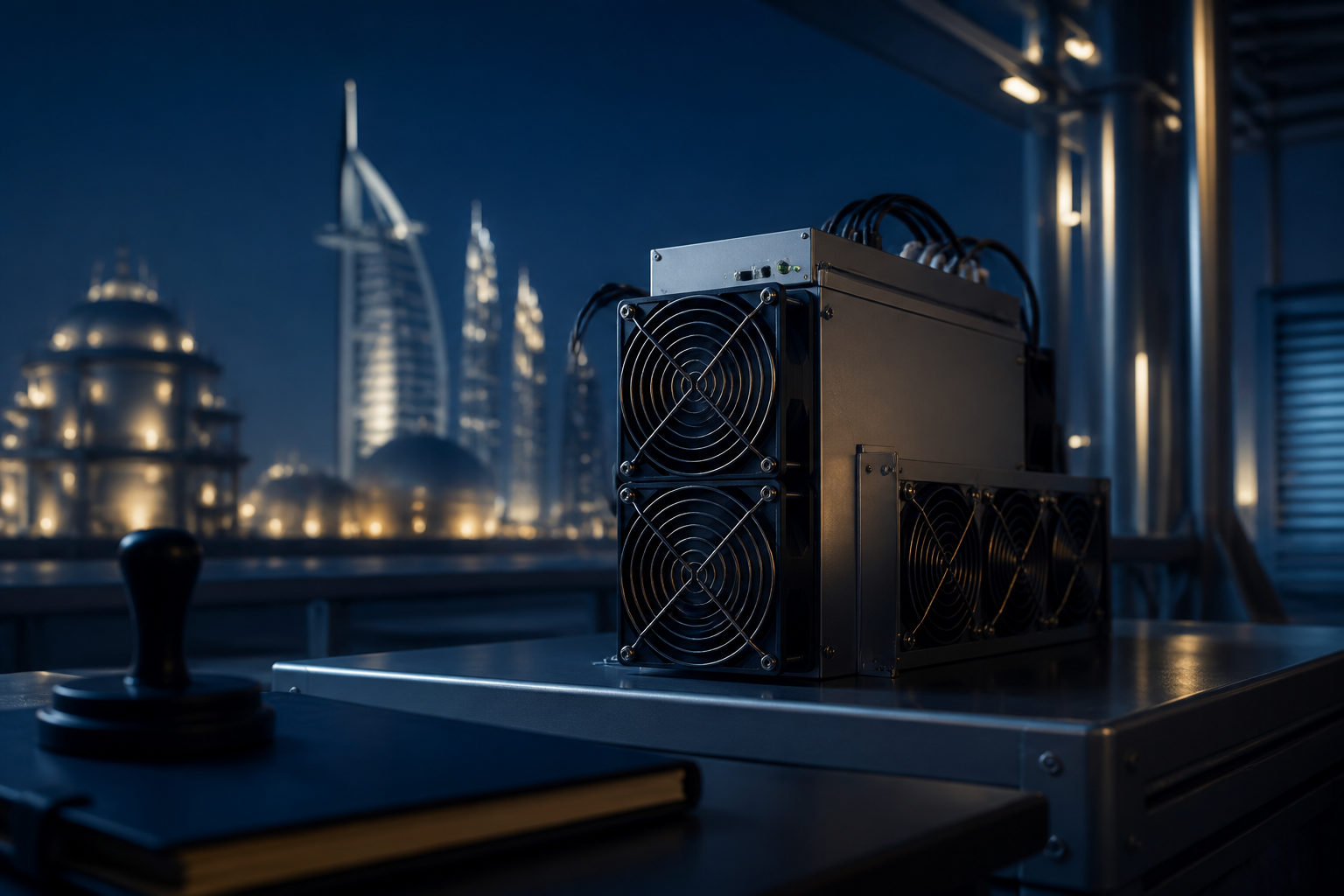
In the UAE, bitcoin mining is not a one-line yes-or-no question. Mining may be possible if the setup is compliant, but whether it is lawful for you depends on where the machines run, how power is arranged, and whether your operation fits local business and property rules.
Bitcoin mining is a bookkeeping race, not a magic income button
A simple way to picture mining is as a nonstop contest to write the next page of a shared ledger. Mining machines perform calculations, and the participant that finds a valid result gets the right to add a new block to the Bitcoin network.
That process is tied to Bitcoin's issuance rules. The total supply is capped at 21,000,000 BTC, with issuance expected to continue until about 2140. The network targets a new block roughly every 10 minutes, and the block subsidy is cut in half every 210,000 blocks, or about every 4 years.
Those halvings took place on 2012-11-28, 2016-07-09, 2020-05-11, and 2024-04-19. After the 2024 halving, the current block reward is 3.125 BTC, and the next halving is expected around 2028. At the network level, daily new issuance is about 450 BTC. That figure describes the whole network, not what any one miner, home setup, or mining company produces.
Mining is physical infrastructure: machines, heat, sound, airflow, networking, maintenance, and uninterrupted power.
What “legal in the UAE” actually depends on
The real issue is whether a specific setup can operate within local rules. A machine placed in a suitable industrial environment is one thing; the same machine plugged into a residential unit can raise very different problems.
| Area to check | Why it matters | What to review |
|---|---|---|
| Property use | Residential, office, and industrial spaces usually have different permitted uses | Lease terms, building rules, noise limits, ventilation restrictions |
| Power arrangement | Mining equipment runs continuously and draws serious power | Capacity limits, billing terms, approval requirements, circuit safety |
| Operating structure | A personal test setup and a commercial operation are not viewed the same way | Business registration, licensing, recordkeeping, counterparties |
| Equipment logistics | Purchase, delivery, import handling, and hosting create separate obligations | Invoices, ownership records, service terms, maintenance responsibility |
| Funds handling | What happens to mined BTC can create later compliance and account issues | Wallet control, exchange account review, source-of-funds documentation |
If your question is, “is bitcoin mining legal in uae,” the careful answer is that lawful operation depends on the full setup rather than on the machine alone. Buying mining hardware does not automatically mean your operation is cleared from a site, utility, or business standpoint.
Many beginners focus on crypto rules and overlook ordinary rules that affect any high-load equipment project: leases, building policy, electrical safety, cooling changes, noise complaints, service access, and accounting records.
Common ways to take part, and how the legal risk changes
There are several ways to take part, and the compliance burden changes depending on which one you choose.
| Approach | Who it suits | Main advantage | Main caution |
|---|---|---|---|
| Small home test | People learning the basics | Helps you understand wallets, pools, and machine management | Residential power, heat, and noise limits are often the first obstacle |
| Self-managed hosted site | People comfortable with operations | More control over hardware and wallet decisions | You carry the burden of site terms, maintenance, and downtime handling |
| Third-party hosting | People who do not want to manage a facility directly | Someone else handles rack space, power, and on-site work | You must review ownership, reporting, downtime terms, and payout rules |
| Buying BTC instead of mining | People focused on exposure to bitcoin itself | No hardware noise, airflow planning, or machine upkeep | It is a different activity with a different risk profile |
A small test setup can be useful for education. It shows how a wallet address receives payouts, why miners usually join a pool, and how tiny balances are tracked. Bitcoin's smallest unit is 1 satoshi, equal to 0.00000001 BTC, so pool payouts are one of the easiest ways for a newcomer to see how small fractions of bitcoin work in practice.
Once you move beyond learning, the project becomes operational. Stable uptime, temperature control, dust management, internet reliability, machine failures, replacement parts, and response time all start to matter.
Do not start with profit claims; start with cost reality
This article does not give mining income figures. Without live electricity pricing, exact machine efficiency, uptime assumptions, and network competition, a fixed return number would be misleading. A better way to judge mining is to break the project into cost centers and execution risks.
| Cost or challenge | Why it matters | What to inspect before starting |
|---|---|---|
| Electricity | Usually the most sensitive long-run variable | Rate structure, sustained load tolerance, approval conditions |
| Cooling and airflow | Heat affects stability and can force shutdowns | Air path, exhaust plan, dust control, room layout |
| Noise | Noise can make a location unusable even if power is available | Building tolerance, nearby occupants, isolation options |
| Maintenance | Broken machines do not earn while waiting for attention | Spare parts, on-site access, repair turnaround, remote monitoring |
| Wallet security | Mined BTC still has to be stored safely afterward | Private key control, withdrawal procedures, permission separation |
The overlooked cost is often everything around the machine: cabling, racks, ventilation changes, monitoring, service calls, downtime tracking, and payout handling.
The network targets a block about every 10 minutes, but a single machine does not receive rewards on a schedule like a salary. That is why many miners join pools and receive smaller, more regular distributions instead of waiting to solve a block alone.
A practical checklist before you switch on a machine
Start with the site. Confirm that the property can actually host high-load equipment with constant sound and clear heat exhaust. If the lease, landlord, or building management is not comfortable with that setup, the project is weak before it starts.
Then review power and internet conditions. Repeated power trips, unstable networking, or strict load limits can turn a workable plan into a constant interruption. If you plan to use a hosting provider, get downtime responsibility, machine damage handling, maintenance authority, and payout terms into writing.
Only after that should you settle wallet control and exit routes. Decide where mined BTC will be stored, who controls the keys, and what records you may need later if you move coins to an exchange account. Bitcoin has operated under the same core chain logic since its genesis block on 2009-01-03; the hard part for most users is not the protocol, but their own process discipline.
FAQ
Can I run a bitcoin miner from my apartment in the UAE?
You need to check the apartment rules, lease terms, and power limits first. A residential unit may be a poor fit because of constant load, heat, ventilation needs, and machine noise.
Is hosted mining safer from a legal perspective than running my own site?
Hosting can reduce the burden of on-site operations, but it does not remove the need for due diligence. You still need clear terms on machine ownership, reporting, outages, maintenance, and payouts.
How long does it take to mine 1 bitcoin?
There is no fixed answer. It depends on machine performance, network competition, pool structure, and how much downtime the setup experiences.
Do I need a company to mine bitcoin in the UAE?
A casual test and a continuing commercial setup should not be treated the same way. If you are renting space, drawing sustained power, hosting equipment, or working with service providers, review the business and compliance side before deployment.
Should I sell mined BTC right away?
That is a treasury decision rather than a mining rule. Some people hold, some convert on a schedule, but either way you should settle wallet control and account documentation before coins start arriving.
If you want a realistic next step, do not begin by shopping for machines. Begin with a written checklist covering site permission, power conditions, contract terms, and wallet control. Once those four pieces are clear, you can tell whether mining in the UAE fits your situation or whether simply buying BTC makes more sense.
Disclaimer: This article is for informational and educational purposes only and is not investment, financial, or legal advice. Crypto assets are highly volatile and you could lose your entire investment. Do your own research and decide carefully.