
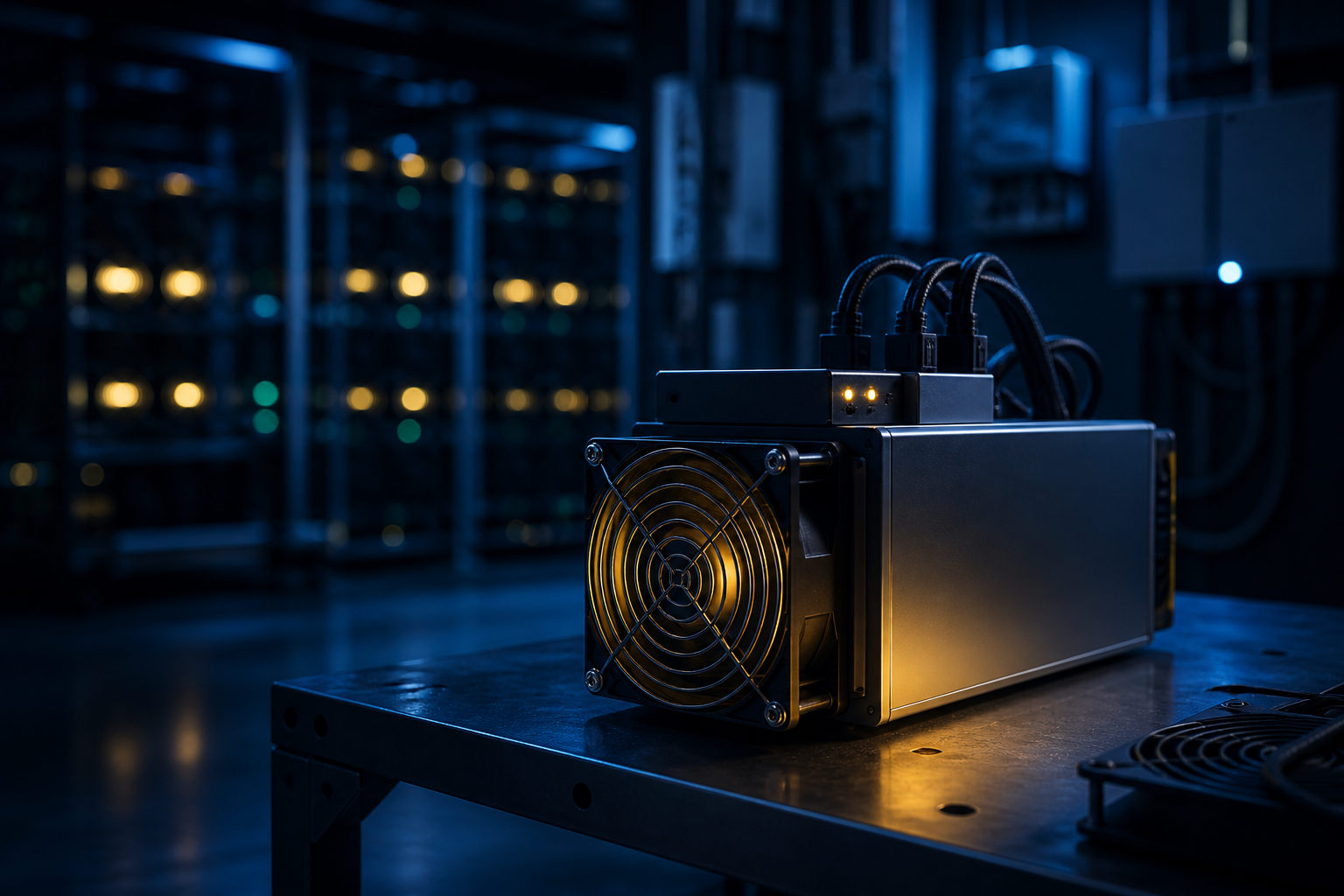
For the average person in 2026, bitcoin mining is usually not an easy path to profit. The real test is not whether you can switch on a machine, but whether you can manage power costs, hardware efficiency, heat, noise, downtime, and day-to-day operations better than the competition.
Think of bitcoin mining as a nonstop bookkeeping race
A simple way to understand bitcoin mining is to picture a public ledger that many participants check together. Miners compete to add the next batch of valid transactions to that ledger. When one participant finds a valid result under the network rules, that participant can produce a block and receive the block reward plus transaction fees.
That sounds random at first, but it works more like an ongoing competition with clear rules. Bitcoin produces a block about every 10 minutes, and the network adjusts mining difficulty so block production stays near that pace. As more computing power joins, the race gets tougher, and any single machine has a smaller chance of doing well on its own.
This framing matters because many beginners still imagine mining as a home setup that quietly prints coins in the background. In practice, you are competing against professional operators, lower-cost power environments, and teams that already know how to keep thousands of machines running with minimal interruption.
Why profitability is hard for average miners
If you are asking whether bitcoin mining is profitable for an average person in 2026, the first question is not how much bitcoin a machine can produce. The first question is whether your total cost structure is strong enough to survive continuous competition.
Electricity is usually the biggest hurdle
Mining turns electricity into hash power, and hash power into a share of the opportunity to earn block rewards and fees. That means your power cost sits at the center of the entire business. A home miner often pays more for power than a large operator, and that disadvantage can shape everything that follows.
Many newcomers focus on the purchase price of the machine and treat electricity as a secondary issue. That is backwards. A miner that runs all day and all night creates a steady power bill, and if your local rate is not competitive, your margin can disappear even if the hardware itself looks strong on paper.
There is also the physical side of running mining hardware. Home wiring, breaker limits, ventilation, and safety protections matter. A setup that seems fine for ordinary consumer electronics may not be a good fit for high-load equipment that is expected to stay on continuously.
Hardware ownership is only the beginning
Buying a machine does not mean the operation is under control. Bitcoin mining hardware needs stable power, reliable cooling, regular cleaning, and frequent monitoring. Dust, fan wear, thermal stress, and connection issues can all reduce effective performance.
Beginners often treat startup success as proof that the plan works. The real challenge starts after the first day. Can you keep the machine online? Can you spot a fault quickly? Can you limit downtime when temperatures rise or a component fails? Those operational details often decide whether a small miner lasts long enough to matter.
You are not competing against hobbyists alone
Bitcoin mining is open to anyone, but the field is not level. Large and experienced operators usually have advantages in power sourcing, facility design, spare parts, monitoring systems, and maintenance workflows. They can often respond faster when something breaks, and they may run more efficiently even with similar hardware.
That means matching someone else's machine does not mean matching their business results. The same miner in two different environments can lead to very different outcomes once power pricing, uptime, and operating discipline are factored in.
Halving raises the pressure on weaker setups
Bitcoin has a supply cap of 21 million coins. The first block, known as the genesis block, appeared in January 2009, and the system was introduced in the 2008 white paper Bitcoin: A Peer-to-Peer Electronic Cash System by the pseudonymous creator Satoshi Nakamoto. New issuance is reduced through halving events, which happen about every 4 years, or every 210,000 blocks. Halvings took place in 2012, 2016, 2020, and 2024.
For miners, halving matters because it cuts the new bitcoin issued in each block. When that happens, inefficient operators tend to feel more pressure. A setup that already lacked a cost edge before a halving does not suddenly become easier to justify after one.
How average people can participate in bitcoin mining
There is more than one way to join mining, and each path comes with different trade-offs. The key is to understand what you control, what you outsource, and what new risks appear when convenience increases.
Running your own machine at home or in your own space
This is the most direct route. You own the hardware and can inspect it yourself. You do not have to rely on a third party to tell you whether the machine exists or whether it is online.
Still, the drawbacks are obvious. Mining machines are loud, they produce significant heat, and they need an environment that can handle long periods of continuous operation. For many people, the issue is not technical knowledge. It is that a normal home is simply not designed for this kind of equipment.
Using a hosted setup
Some people buy hardware and place it with a specialist facility. This can reduce noise and cooling headaches and may offer better infrastructure than a residential space. For someone without a suitable location, hosting may seem like the practical option.
But hosting does not remove risk. You need clarity on fees, service terms, maintenance duties, machine access, shutdown procedures, and what happens if the provider performs poorly. If the agreement is vague, the convenience can come at the cost of transparency and control.
Joining a mining pool
A single machine has very low odds of finding blocks by itself, so many miners join a pool. Pools combine hash power and distribute proceeds according to their rules. This usually makes payouts smoother over time.
That does not mean a pool makes an uncompetitive setup profitable. A pool can change the pattern of returns, but it cannot erase high electricity costs, weak uptime, or poor hardware efficiency. It makes outcomes less lumpy, not automatically better.
Cloud mining deserves extra caution
Cloud mining services often sell convenience. They may promise an easy entry point, no hardware handling, and no need to think about cooling or maintenance. That can sound ideal to beginners.
The hard part is verification. If you cannot confirm that the machines are real, that the fee structure is clear, and that the operating terms are understandable, then you are depending almost entirely on the provider's claims. For inexperienced users, that can be a difficult position to judge well.
A practical checklist before you spend anything
Instead of asking only whether bitcoin mining can be profitable, it helps to test whether your own situation fits the activity at all. A lot of weak decisions come from treating mining as a passive side hustle rather than an operating business.
- Power cost: Is your electricity pricing competitive enough to give you a chance?
- Electrical safety: Can your location handle continuous high-load equipment safely?
- Cooling and noise: Do you have a space where heat and sound will not create constant problems?
- Maintenance ability: Can you detect faults, clean equipment, and respond to downtime quickly?
- Time commitment: Are you ready to monitor an active setup rather than ignore it after purchase?
- Risk tolerance: Can you accept hardware depreciation, operational issues, and changing network competition?
- Capital discipline: Are you using money you can afford to tie up without harming everyday finances?
If several answers are weak, that does not mean you can never learn mining. It does mean you should slow down. Start by understanding wallets, private keys, pool mechanics, hosting terms, and the basic economics of power and uptime before you buy anything.
What “profitable” really means in this context
Many people use the word profit loosely. In mining, profit is not the same as producing bitcoin. A machine can generate output and still fail as a business decision if operating costs, downtime, and hardware wear absorb too much of the value.
That distinction matters because beginners often celebrate activity instead of results. If your setup is noisy, hot, expensive to power, and difficult to maintain, the fact that it is hashing does not say much by itself. The relevant question is whether the operation leaves enough value after all costs and headaches are counted.
There is also an opportunity-cost angle. Time spent chasing a difficult home mining setup could have been spent learning wallet security, understanding how the Bitcoin network works, or studying custody and transaction management. For many people, that knowledge may be more useful than forcing a mining operation that never had a cost edge.
FAQ
Can an average person still mine bitcoin at home in 2026?
Yes, participation is still possible, but that does not mean it makes sense for most households. The common limits are power cost, heat, noise, wiring constraints, and the need for regular maintenance.
A home setup can work only if the environment and operating discipline are a good fit. For many people, that fit is weaker than expected.
What should I calculate first before trying bitcoin mining?
Start with electricity cost, then look at hardware efficiency, cooling, and expected downtime. New miners often put the machine price first, but ongoing power and operating conditions usually shape the outcome more than the initial purchase.
If your cost structure is unclear, talking about output alone is not very useful. Generating bitcoin is not the same as running a profitable setup.
Does joining a mining pool make mining profitable?
Not by itself. A pool mainly smooths returns by sharing proceeds across participants under its rules.
If your electricity is expensive or your machine spends too much time offline, a pool will not fix those weaknesses. It changes payout variance, not the underlying economics.
Is cloud mining a good option for beginners?
It can look simple, but simplicity on the surface can hide a lack of transparency. If you cannot independently verify the hardware, fees, and service terms, you may be taking on risks you do not fully understand.
For beginners, convenience should never replace verification. If the structure is hard to inspect, caution is the better starting point.
If I do not buy a miner, how else can I learn about Bitcoin?
You can begin with wallet setup, private key handling, transaction basics, and the way blocks are produced and verified. Learning how the network works often gives more lasting value than rushing into hardware.
If your goal is exposure to Bitcoin rather than operating equipment, mining may not be the most suitable first step. It is capital-intensive, operationally demanding, and much less passive than many people assume.
Before taking action, do three things: confirm your power and space conditions, read pool or hosting terms line by line, and prepare your own wallet backup process. If any of those areas still feel unclear, pause before buying hardware.
Disclaimer: This article is for informational and educational purposes only and is not investment, financial, or legal advice. Crypto assets are highly volatile and you could lose your entire investment. Do your own research and decide carefully.