
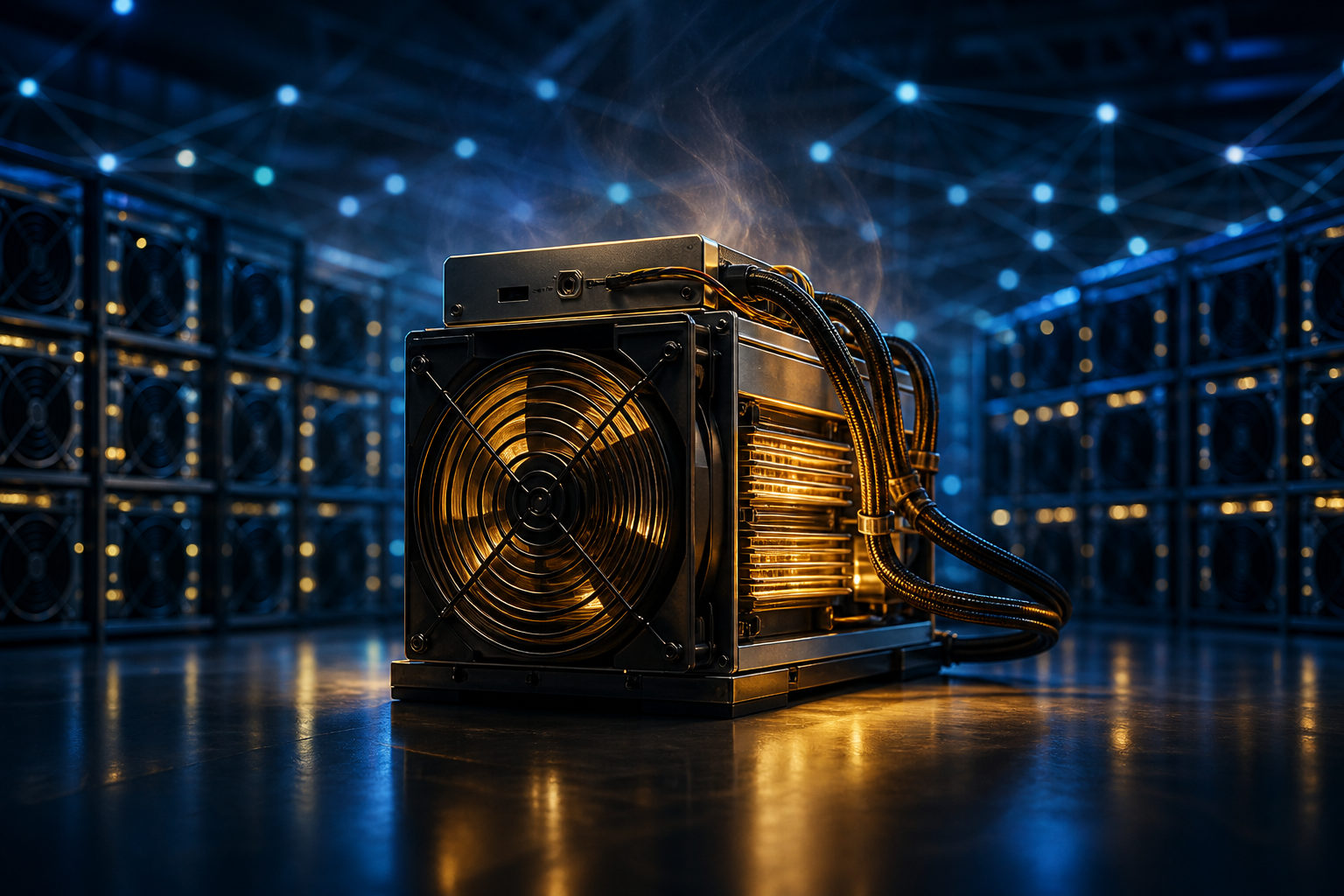
Bitcoin mining is still possible in 2026, but for most people it is no longer a casual activity done on a spare computer. It is a constant race for bookkeeping rights, where electricity costs, hardware efficiency, and day-to-day operations decide whether participation makes sense.
A simple way to picture it is to think of Bitcoin as a public ledger shared across the network. Mining is the process where many participants compete to add the next page to that ledger. The first miner to produce a valid result under Bitcoin's rules gets the chance to add a new block and receive the block reward plus transaction fees. So the answer to the headline question is yes. The harder question is whether it is practical for you.
What Bitcoin mining actually does
The word “mining” can be misleading. It sounds as if miners are digging coins out of a digital ground. In reality, miners are performing a public, rule-based task: they collect pending transactions, package them into a block, and compete through proof of work to win the right to publish that block.
You can think of it as a nonstop puzzle race. Every miner is trying to find a valid block hash that meets the current network requirement. When one miner succeeds, that block is broadcast to the network. Other nodes verify it, and if it passes validation, the block is added to the blockchain. Bitcoin produces a new block about every 10 minutes, so the race resets again and again.
This competition is also part of what makes Bitcoin hard to tamper with. Changing old records is not like editing a file on one machine. An attacker would have to outcompete honest miners in ongoing proof-of-work activity. That is why mining is not just a side feature. It is part of the system's security model.
How people can still participate in 2026
There is more than one way to take part, but the practical barriers are very different depending on the route you choose.
Buying and running your own mining machine
This is the most direct path. In practice, Bitcoin mining now relies on specialized machines built for that purpose rather than ordinary home computers. The reason is simple: mining has become highly specialized, and general-purpose hardware usually cannot compete on efficiency.
Running your own machine means handling much more than the purchase itself. You need stable power, cooling, acceptable noise conditions, reliable internet access, pool configuration, and a wallet address that you control. You also need a plan for maintenance when a machine overheats, drops offline, or develops hardware issues. What looks like a simple hardware purchase often turns into a small operational setup that needs constant attention.
Joining a mining pool
For many individual miners, a mining pool is the usual choice. A pool combines the computing power of many participants so they can compete together. When the pool finds a valid block, rewards are divided according to the pool's rules.
This does not make your machine faster in a physical sense. What it changes is variance. Solo mining can mean very uneven results, with long stretches and no block found by your own hardware. Pool mining usually smooths that out. When comparing pools, the useful points are the payout structure, fee policy, transparency, connection stability, and account security rather than marketing language.
Hosted or managed mining
Some people place their machines in a professional facility that handles power, cooling, and routine maintenance. This can remove the problem of heat and noise at home, and it may be the only realistic route for someone without suitable space.
Still, hosted mining adds another layer of risk. You need clarity on whether the machine is actually online, how downtime is reported, how charges are calculated, and how easy it is to move or reclaim your equipment. If you cannot independently verify what is happening with your machine, convenience may come at the cost of control.
Why “still possible” is not the same as “worth doing”
Many people asking whether Bitcoin mining is still possible in 2026 are really asking a different question: does it still make economic sense? That answer depends less on a headline and more on your cost structure.
Power cost is usually the first filter
Mining converts electricity into hashpower. Because the process runs continuously, the price and reliability of electricity have an outsized effect on viability. Two people using the same machine can face very different outcomes if one has far cheaper power than the other.
That is why mining discussions keep circling back to electricity. It is not a side issue. It is often the main issue. Without favorable power costs, even good hardware can struggle to remain competitive over time.
Machine efficiency and wear matter
Buying a miner is only part of the equation. Hardware ages. Fans wear out. Dust builds up. Heat affects performance. A machine that powers on is not automatically a machine that runs well under sustained load.
Many newcomers focus on the upfront purchase and ignore the operating reality. A loud machine may not be workable in a home setting. Poor cooling can cause throttling or shutdowns. Maintenance is not an edge case; it is part of normal mining life. When evaluating whether Bitcoin mining is still possible in 2026 for an individual, these practical details matter as much as the machine itself.
The halving changes the operating environment
Bitcoin has a hard cap of 21 million coins. The protocol also reduces the block subsidy about every 4 years, or every 210,000 blocks. The halving years so far are 2012, 2016, 2020, and 2024. A halving does not stop mining. It changes the issuance schedule and can make operating conditions tighter for miners, especially those with weak cost control.
By 2026, anyone looking at mining is doing so after the 2024 halving. That does not mean mining is off the table. It means inefficient setups have less room for error, and transaction fees may matter more in the miner revenue mix than many beginners expect.
Competition is mature and professional
Bitcoin began with the genesis block in January 2009 and has grown far beyond its early hobbyist phase. Mining today is a specialized activity with strong competition around equipment, facility quality, uptime, and operational discipline.
So if you ask whether Bitcoin mining is still possible in 2026, the technical answer is straightforward: yes, the network still relies on miners. The practical answer is narrower: participation only makes sense when your electricity, hardware, and operating setup are strong enough to handle that competition.
Common mistakes beginners make
- Mistake one: assuming a home PC is enough. In theory, any machine can attempt work. In practice, ordinary consumer hardware usually lacks the efficiency needed for real competition.
- Mistake two: treating the miner as a plug-and-play product. The machine is only the starting point. Power, cooling, noise, connectivity, and maintenance all shape the result.
- Mistake three: assuming hosted mining removes risk. It removes some hands-on work, but it can introduce visibility and control issues.
- Mistake four: treating mining and buying bitcoin as the same bet. Buying bitcoin is mainly price exposure. Mining combines that exposure with operating costs, hardware risk, and uptime management.
- Mistake five: judging the idea from a single day's market mood. Mining is not a one-day trade. It is an ongoing operation.
If you want to try in 2026, start with this checklist
- Check your electricity conditions first. If power is too expensive or unreliable, other calculations may not matter.
- Look at space, heat, and noise. Mining machines are not subtle household devices. The environment around them matters.
- Verify equipment source and condition. Be careful with vague descriptions and missing operational details.
- Study the mining pool rules. Focus on payout methods, fees, security, and dashboard clarity.
- Use a wallet you control. Even if someone hosts the machine, control over the receiving wallet should stay with you.
- Plan for downtime. Any hardware that runs continuously can fail. Assume maintenance is part of the process, not an exception.
There is one more point that often gets missed. If your real goal is simply to gain exposure to Bitcoin, mining and buying are different decisions. Buying bitcoin is closer to an asset allocation choice. Mining is closer to operating a hardware business with ongoing overhead.
FAQ
Can an individual still mine Bitcoin in 2026?
Yes, an individual can still participate. The challenge is that mining now requires far more attention to electricity, machine efficiency, and operations than it did in the early years.
Do you need a mining pool in 2026?
Not in an absolute sense, but most individual miners use one. A pool usually makes rewards less uneven than trying to mine alone.
Can I mine BTC with a regular home computer?
You can technically run software that attempts the work, but that is different from being competitive. In real conditions, home computers usually do not offer practical mining performance for Bitcoin.
Is mining better than buying bitcoin for beginners?
That depends on what you want. If you do not want to deal with hardware, heat, noise, and maintenance, buying bitcoin directly is often easier to understand than operating mining equipment.
What should I evaluate before buying a miner?
Start with power cost, machine efficiency, cooling conditions, noise tolerance, and after-sales support. Looking at advertised specs alone can give a very distorted picture.
Before you spend anything, make sure you can handle the power setup, cooling, noise, pool rules, wallet control, and maintenance routine for the long run. If even one of those pieces does not fit your situation, Bitcoin mining may be possible in theory but impractical for you in reality.
Disclaimer: This article is for informational and educational purposes only and is not investment, financial, or legal advice. Crypto assets are highly volatile and you could lose your entire investment. Do your own research and decide carefully.