
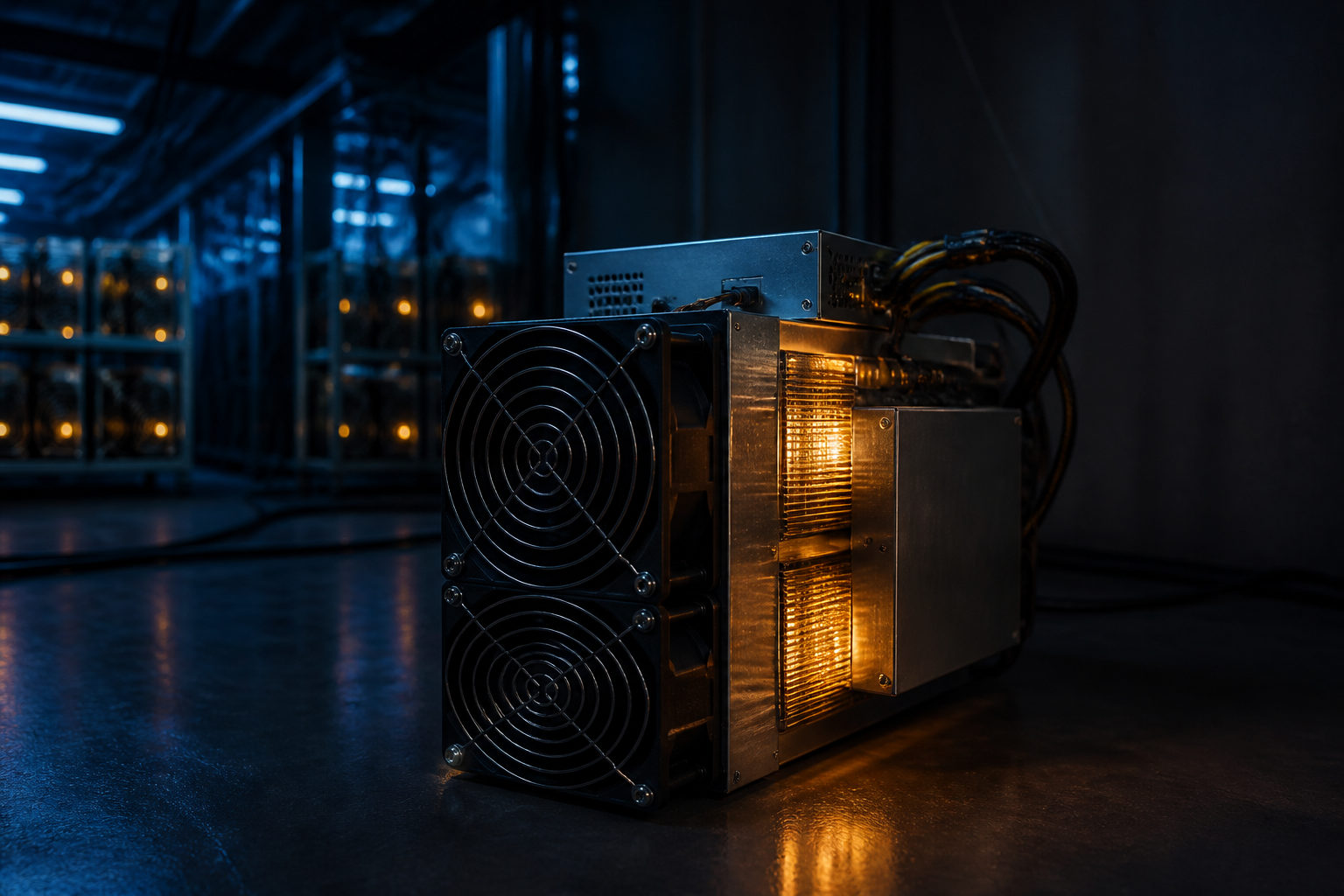
Bitcoin mining is still a thing, and it remains central to how the Bitcoin network stays secure and keeps transactions in order. What changed is the level of competition: mining is no longer a casual hobby for a standard home computer.
What bitcoin mining actually does today
The easiest way to picture bitcoin mining is to think of it as a bookkeeping race. New transactions keep entering the network, and miners compete to package a batch of them into a new block. The miner that finds a valid block first gets to add it to the chain.
That winning miner can receive the block reward plus transaction fees from that block. Bitcoin targets a new block about every 10 minutes. Mining is not just about issuing new coins. It also makes rewriting transaction history expensive and helps the network agree on which transactions came first.
So if the question is whether bitcoin mining still exists, the answer is yes, because Bitcoin still relies on proof of work. As long as blocks continue to be produced under that system, miners still have a job.
Why mining has not gone away
Bitcoin has a hard supply cap of 21,000,000 BTC, with issuance expected to continue until around 2140. Until then, newly created bitcoin is still distributed through block rewards. The current block reward is 3.125 BTC, set after the 2024-04-19 halving, and it is expected to remain at that level until the next halving around 2028.
The halving schedule is built into the system: every 210,000 blocks, the reward is cut in half, which works out to roughly every 4 years. The previous halvings took place on 2012-11-28, 2016-07-09, 2020-05-11, and 2024-04-19. At the current reward and target block pace, the network adds about 450 BTC per day in total. That figure is for the entire network, not for any one miner, mining farm, or machine.
Mining continues because transactions still need to be confirmed and blocks still need to be built. What becomes tighter over time is the business model: power costs, machine efficiency, uptime, and operations matter more with each cycle.
| Item | Current rule | What it means |
|---|---|---|
| Block reward | 3.125 BTC | New bitcoin is still being issued to miners |
| Block interval | About 10 minutes | Mining is an ongoing competition |
| Halving schedule | Every 210,000 blocks | Miner revenue structure changes over time |
| New BTC per day | About 450 BTC network-wide | This is not a personal daily output figure |
| Supply cap | 21,000,000 BTC | Bitcoin issuance is limited by design |
Can ordinary people still take part?
Yes, but the better question is whether participation makes sense for your situation. In Bitcoin’s early years, people mined with regular computers, and later with graphics cards. Today, mainstream bitcoin mining is dominated by specialized ASIC machines because the contest is about computational efficiency and electricity economics.
For an individual, there are usually three broad ways to get involved: run your own machine, run your own machine while connected to a mining pool, or pay for a hosted setup or cloud-style contract. All three are described as mining, but they involve very different levels of control, work, and counterparty risk.
| Method | What you handle | Main advantage | Main difficulty |
|---|---|---|---|
| Run your own miner | Buying hardware, power, cooling, noise control, maintenance, wallet setup | Highest control | Highest operational burden |
| Join a mining pool | Provide hash power and accept pool payout rules | Smoother payout pattern | You still carry hardware and power costs |
| Hosted or cloud-style mining | Pay a provider to operate on your behalf | Less hands-on work | Higher counterparty and contract risk |
If you plan to mine from home, the first problems are often practical ones: noise, heat, ventilation, wiring load, and stable power. The hard part is often keeping the machine running reliably over time without creating a cost structure that becomes impossible to manage.
Mining pools are common because solo mining creates very uneven outcomes. By pooling hash power, participants can receive payouts under a shared distribution model instead of waiting for one machine to find a block on its own. That makes income timing less erratic, but it does not remove machine failures, electricity bills, or downtime.
The real issue is cost, not hype
When people ask whether bitcoin mining is still worth doing, they often focus on demand, headlines, or the idea of getting fresh coins. The more useful question is whether the full cost stack works in your case. Looking only at the price of a miner leaves out the parts that usually decide the outcome.
Electricity is often the biggest factor because miners run continuously. Even with the same model of machine, results can differ sharply depending on local power pricing, ambient temperature, uptime, and maintenance quality. Hardware also depreciates as newer, more efficient machines enter the market and older ones lose competitiveness.
A common mistake is to see that the network creates about 450 BTC per day and assume a small operator can claim a neat fraction of it. Real output depends on effective hash rate, pool terms, uptime, machine health, and operating conditions. There is no fixed daily number that applies to everyone. Any simple promise about mining returns should be treated with caution.
| Cost area | What gets underestimated | Why it matters |
|---|---|---|
| Electricity | Continuous runtime rather than a single rate quote | Can decide whether machines stay on |
| Cooling and noise | Environmental limits at the site | Affects machine stability and where mining is even possible |
| Maintenance | Assuming the machine will just keep running | Downtime directly cuts output |
| Hardware depreciation | Ignoring future efficiency competition | Machine economics can weaken over time |
| Provider risk | Trusting hosted offers without checking terms | You may face poor disclosure or non-performance |
Mining versus simply buying bitcoin
These are different exposures. Buying bitcoin directly mainly leaves you with market risk and the job of storing it safely. Mining adds operational risk on top: hardware, heat, uptime, power arrangements, and in some cases the risk that a hosting provider does not perform as promised.
Mining can still make sense for people who want to participate in Bitcoin as an operating business rather than only as an investment position. You are contributing hash power to the network and earning according to protocol rules if your setup is competitive. If your goal is only to gain bitcoin exposure, mining is not automatically the simplest route.
This role has been part of Bitcoin from the start. Satoshi Nakamoto published the white paper, Bitcoin: A Peer-to-Peer Electronic Cash System, on 2008-10-31, and the genesis block followed on 2009-01-03. Mining still exists for the same basic reason it existed then: it is part of how Bitcoin issues coins and secures the chain. The difference today is industrial competition, not the disappearance of the mechanism.
FAQ
Can I still mine bitcoin with a regular computer?
In a technical sense, a regular computer can run software and attempt work. In a practical sense, it is not competitive in modern bitcoin mining. Specialized ASIC hardware has long been the standard.
Am I really mining if I use a pool?
Yes. You are still supplying hash power to the network, but you are sharing block-finding variance with other participants. A pool changes payout distribution, not the underlying activity.
Will bitcoin mining eventually end?
Mining will not suddenly disappear as long as the network keeps producing blocks. New coin issuance will keep shrinking through halvings, and over the long run transaction fees are expected to matter more, but block production itself still needs miners.
Is home mining realistic?
That depends less on enthusiasm and more on power, cooling, ventilation, and noise tolerance. Many residential settings are a poor fit for a machine that runs constantly and produces significant heat and sound.
Should I trust hosted mining or cloud mining offers?
Only after careful review of the operator, the hardware claims, and the contract terms. If the provider is vague about machine ownership, downtime handling, or fee structure, the risk may be higher than it first appears.
If you are deciding whether to get involved in bitcoin mining, start with a checklist: power conditions, site suitability, noise tolerance, maintenance ability, and how you would evaluate any third-party operator. That will give you a clearer answer than any generic promise about mining profits.
Disclaimer: This article is for informational and educational purposes only and is not investment, financial, or legal advice. Crypto assets are highly volatile and you could lose your entire investment. Do your own research and decide carefully.