
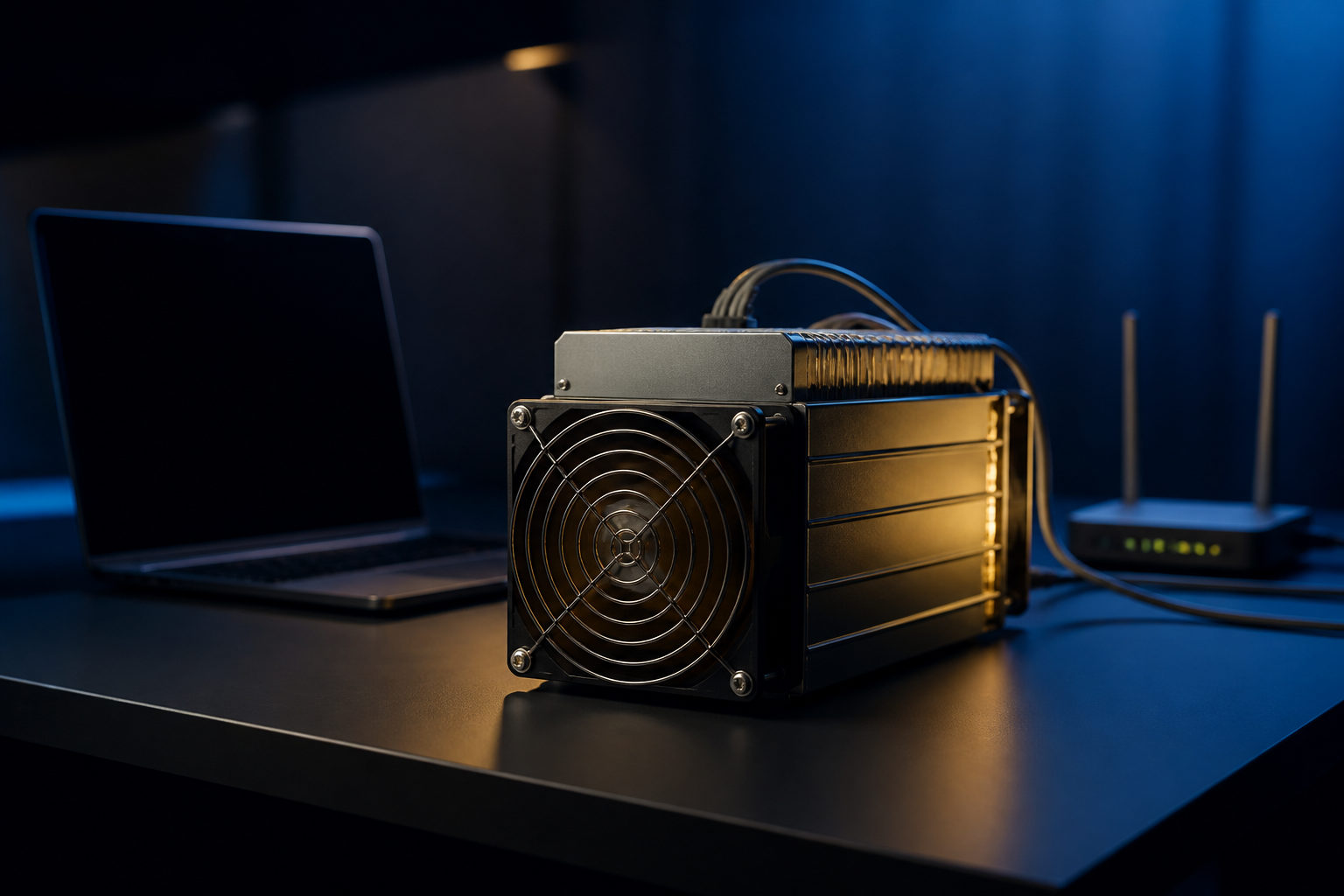
Yes. You can mine Bitcoin locally without downloading a full Bitcoin node, but in most setups you will rely on a mining pool or another upstream service for block templates, network connectivity, and part of the validation process.
Think of mining as a bookkeeping race
A simple way to picture Bitcoin mining is to imagine an ongoing bookkeeping race. Participants compete to add the next block by assembling valid data and running huge amounts of hashing work until one result fits the network rules. That race has more than one job inside it, and that is where confusion starts.
A full node and a mining machine do different things. A full node syncs the blockchain, checks transactions and blocks against the rules, and relays data across the network. Mining hardware performs the repeated hash calculations. If you put a machine in your home, that only tells you where the machine sits. It does not automatically mean you are independently handling every part of the Bitcoin mining process.
| Component | Main role | Requires downloading a node? | Why it matters |
|---|---|---|---|
| Full node | Syncs blockchain data, validates transactions and blocks, relays network data | Yes | Gives you independent verification |
| Mining hardware | Runs hash calculations and submits work | No | Determines whether you are actually mining |
| Mining pool connection | Delivers work, receives shares, handles pool-side coordination | No | Common path for individual miners |
| Mining software | Controls devices, manages communication, applies settings | No | Connects hardware to the process |
What happens when you mine without a full Bitcoin node
If you do not run your own full node, the usual arrangement is a pool-based setup. Your local machine still does real mining work, but the pool handles much of the surrounding infrastructure. It stays in sync with the Bitcoin network, prepares or distributes work, receives your submissions, and applies its own operating rules.
That means the answer to the keyword question is yes, with an important qualifier. You can mine locally without downloading a node, yet you are not fully self-contained. Some of the flow that would exist in an independent setup is being outsourced. The physical work may happen on your premises, while part of the information flow comes from elsewhere.
For many beginners, this is the practical entry point. It reduces setup complexity because you do not need to maintain a full blockchain copy or manage node sync yourself. It also makes troubleshooting simpler in one sense: device settings, pool connectivity, and machine status are easier to isolate than node behavior plus mining behavior at the same time.
The trade-off is independence. Without your own full node, you are trusting outside infrastructure for at least part of what your miner sees and reacts to. You are still participating, but your control over validation and direct network visibility is narrower.
| Mining approach | Need a full node? | What you gain | What you give up |
|---|---|---|---|
| Pool mining | Usually no | Faster setup, less operational overhead | Dependence on pool templates and pool rules |
| Run a node and mine through a pool | Yes | Better local verification and visibility | More storage, bandwidth, and maintenance |
| Independent mining | Usually yes | Highest autonomy | Harder setup and heavier cost burden |
Why people mix up nodes, wallets, and mining
New users often bundle every Bitcoin-related program into one mental category. That leads to the idea that installing any Bitcoin software means you are mining, or that downloading blockchain data automatically makes you a miner. In practice, these are separate functions.
A wallet manages keys and lets you send or receive bitcoin. A full node verifies blockchain data according to the network rules. Mining software controls hardware and communicates with a pool or another upstream source. These tools can exist on one machine, but they do not become the same thing just because they share a screen.
Another source of confusion is the word “local.” Some people use it to mean “on my own computer.” Others mean “inside my home or office.” In Bitcoin mining, local only describes where the equipment is placed or managed. It does not answer whether you are independently validating blocks, whether you are drawing work from a pool, or whether your setup makes economic sense.
Skipping the node does not remove the hard part
People sometimes assume the node is the main burden, so removing it must make Bitcoin mining easy. That is not how local mining works in real life. The bigger constraints are often hardware suitability, electricity, heat, noise, airflow, and ongoing maintenance. Those issues remain even if you never download a full node.
Mining equipment is built for sustained heavy workloads. Your environment has to support that. Poor ventilation can cause instability. Dust and ambient temperature can affect operation. Household power arrangements may be fine for everyday electronics but less comfortable for gear that is expected to run hard for long stretches.
Noise is another reality that beginners underestimate. A machine can be technically local and still be impractical in a living space. The same goes for heat output. Once equipment starts running, the question shifts from “Can I start?” to “Can I keep this running safely and tolerate the side effects?”
There is also the maintenance side. Even in a pool setup, you still need to deal with firmware settings, network interruptions, device monitoring, restarts, and fault diagnosis. Removing the full node removes one layer of responsibility. It does not turn mining into a one-click task.
| Cost area | What it means in practice | Does avoiding a node solve it? |
|---|---|---|
| Hardware | You need equipment suited for sustained mining work | No |
| Power and cooling | Safe electrical use and stable temperature control matter | No |
| Noise and space | Your home or work area must tolerate the equipment | No |
| Connectivity | The miner still needs stable communication with a pool or upstream service | No |
| Independent validation | Checking blockchain data yourself versus trusting external infrastructure | No, it reduces this capability |
When mining without a node makes sense
This approach makes the most sense for someone who wants to understand the workflow before adding more moving parts. If your goal is to learn how mining hardware connects, how pools assign work, and how device management feels in practice, then local mining without a node can be a reasonable first step.
It is also useful for people who care more about operating equipment than about running every part of the Bitcoin stack themselves. In that case, the pool model gives you a narrower but more approachable slice of the system. You focus on the miner, not the full verification path.
If your priority is sovereignty and independent rule checking, then a full node becomes more important. It will not make the hardware hash faster. What it changes is your position in the trust chain. You gain a direct way to verify network data instead of viewing it only through a service provider.
| Your goal | Better starting point | Main thing to evaluate |
|---|---|---|
| Learn the process | Local miner connected to a pool | Setup, monitoring, and troubleshooting |
| Increase independence | Run a full node and expand from there | Validation, sync, and maintenance effort |
| Consider long-term operation | Assess your environment first | Power, cooling, noise, and ongoing support work |
FAQ
Do I count as a real miner if I do not run a full node?
Yes. If your hardware is doing mining work and submitting valid results to a pool or another service, you are participating in mining. The difference is that you are not independently handling the full validation and network side of the process.
Can I mine Bitcoin locally with just my home computer?
You may be able to run software, but that is not the same as having a practical mining setup. Real participation depends much more on specialized hardware, cooling, power conditions, and sustained operation than on whether a desktop can launch a program.
Why do some miners still run a full node if pools are easier?
Because a full node adds independent verification. For users who care about checking blockchain data themselves, that capability matters even if the mining hardware is still connected to a pool for operational reasons.
Is it safer to avoid downloading a Bitcoin node?
Not in a simple yes-or-no sense. You reduce one category of software you need to maintain, but you also place more trust in outside services. The risk does not vanish; it shifts to a different boundary.
What should I check before trying local mining without a node?
Look at power, cooling, airflow, noise tolerance, and network stability before anything else. After that, make sure you understand your mining software settings and how your chosen pool handles work assignment and reporting.
If you only need the short answer, it is this: yes, you can mine Bitcoin locally without downloading a full node. Just be clear that you are usually joining an existing operational pipeline rather than running the entire system on your own, and the real constraints are still hardware, environment, and maintenance.
Disclaimer: This article is for informational and educational purposes only and is not investment, financial, or legal advice. Crypto assets are highly volatile and you could lose your entire investment. Do your own research and decide carefully.