
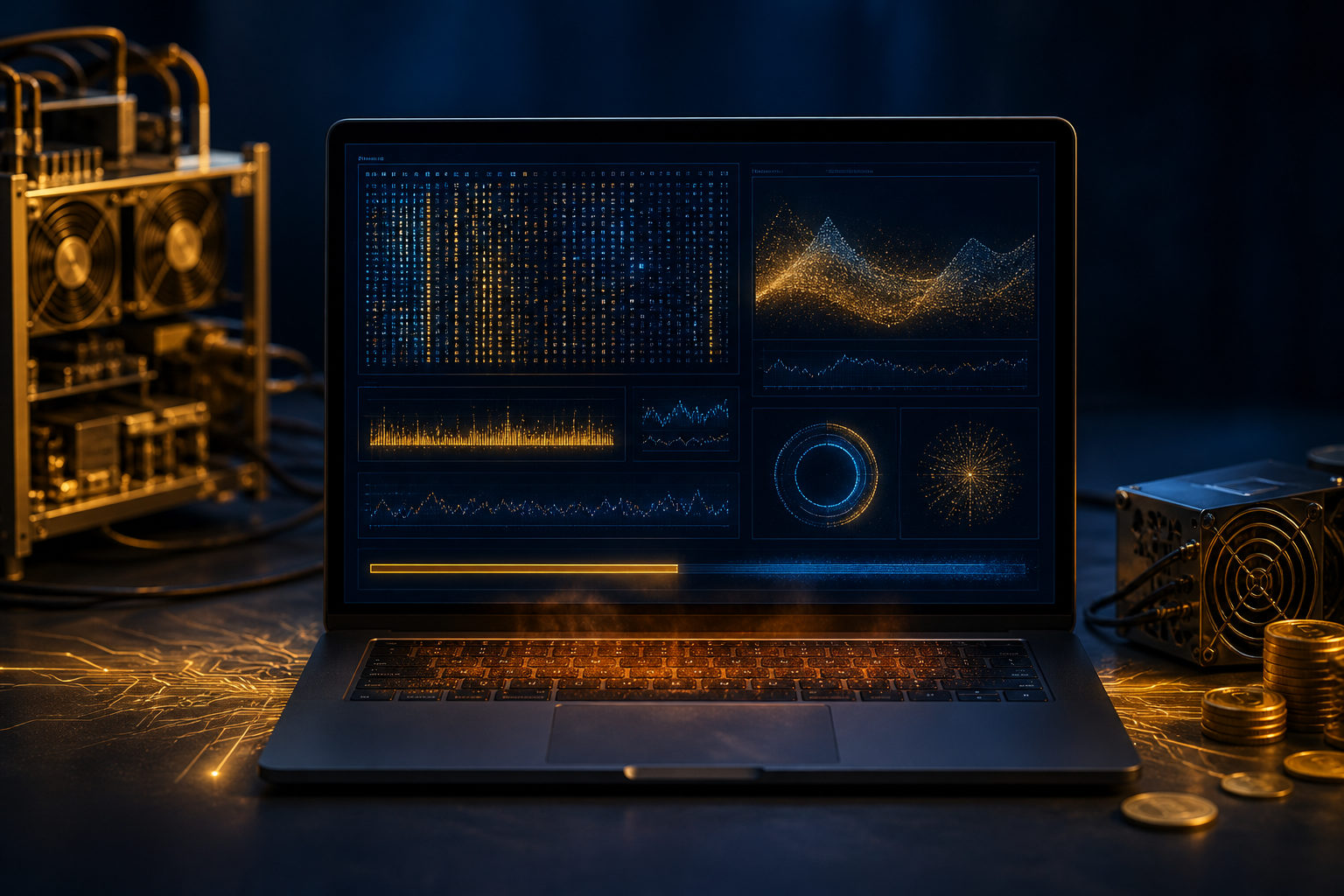
Can you mine bitcoin on a laptop? Yes, in a technical sense. You can run mining software on a laptop, but for actual Bitcoin mining, it is usually a poor fit and rarely makes practical sense.
Bitcoin mining is a bookkeeping race, not just “running a program”
A simple way to understand Bitcoin mining is to picture a nonstop competition for the right to write the next page of a public ledger. Transactions are waiting to be grouped into a block, and miners compete to perform the required calculations. The one that meets the network rules gets the chance to add the next block to the chain.
Bitcoin produces a new block about every 10 minutes. That does not mean any computer has an equal shot. Mining is a competitive process built around repeated hashing, and the hardware used matters a great deal. So when people ask whether a laptop can mine Bitcoin, there are really two questions hiding underneath: can it participate at all, and is it a sensible machine for the job?
The first answer is yes. A laptop can connect to the network, run software, and perform mining calculations. The second answer is much less encouraging. In modern Bitcoin mining, being able to participate is not the same as being competitive.
Why a laptop can mine Bitcoin but still be the wrong tool
Laptops are built for portability, battery-conscious design, and mixed workloads such as browsing, office work, media tasks, coding, or gaming. Bitcoin mining asks for something very different: sustained heavy computation with a strong focus on efficiency for a single purpose. Those are not the same design goals.
Today, Bitcoin mining is closely associated with specialized mining machines rather than general-purpose consumer computers. The reason is straightforward. Dedicated hardware is built specifically for Bitcoin’s hashing task, while a laptop has to balance heat, power draw, mobility, noise, and general usability. Even a powerful laptop is still a compromise device compared with equipment built just for mining.
Heat is one of the biggest realities here. A laptop has limited internal space, compact cooling, and less thermal headroom than a desktop setup designed for constant load. If you push it hard for long periods, temperatures rise, fans spin loudly, and the system may throttle performance to protect itself. Once throttling starts, mining performance slips further, which defeats the whole point of trying to squeeze more work from the machine.
That is why the realistic answer is not “impossible,” but “possible in a narrow sense, yet usually not advisable.” Many beginners confuse software compatibility with hardware suitability. Those are very different things.
What actually happens if you try to mine Bitcoin with a laptop
Constant load puts pressure on the hardware
Mining is not like opening a heavy app for a short session. It is closer to asking the machine to stay under sustained stress. That can affect the processor, graphics hardware, cooling system, power delivery, and the general stability of the device. A laptop that also serves as your school, work, or travel computer has more to lose from that kind of wear.
This does not mean every laptop will fail right away. It means the machine is being asked to operate in a way it was not primarily designed for. Over time, heat and constant fan activity can turn a normal daily device into one that feels noisy, hot, and less pleasant to use.
Cooling and noise become hard to ignore
Because laptops have tighter thermal limits, mining tends to expose those limits quickly. The bottom panel may get hot, the keyboard area can warm up, and fan noise may stay high for long stretches. On a short test, that may seem manageable. Over longer periods, most people find it disruptive.
There is also a practical comfort issue. A laptop is often used close to the body, on a desk in a bedroom, or carried between places. A machine running hot and loud all day is not behaving like a normal personal computer anymore.
Electricity cost is only part of the picture
Without live market data, it would be wrong to quote any profit figure. Still, the cost logic is clear. Mining is never just about whether some amount of Bitcoin might be earned. You also have to think about electricity use, hardware wear, loss of battery health over time, and the opportunity cost of tying up a machine that could be doing something else.
If your laptop is your main computer, using it as a mining device also means giving up part of its normal role. A machine that is busy, hot, and noisy is harder to rely on for work, study, meetings, editing, or gaming.
Security should be part of the decision
New users often search for mining tools and guides in a hurry. That creates another risk: installing software from unknown sources, granting broad permissions, or mixing wallet activity with experimental software on the same device. If your goal is only to learn, exposing your primary laptop to unnecessary security risk is a poor trade.
For that reason, a careful setup matters more than enthusiasm. Before trying anything, it makes sense to verify software sources, separate wallet use from experiments, and avoid treating random downloads as trusted tools.
If your goal is learning, a laptop can still be useful
Not everyone searching “can i mine bitcoin with my laptop” is trying to build a serious mining setup. Many people simply want to understand how mining works, what miners actually do, and why dedicated hardware dominates the activity. For learning, a laptop can still serve a purpose.
- Learning the mining model: You can study what miners compete over, how blocks are produced, and why hashing matters.
- Understanding the broader system: It helps to separate mining from running a node. A node validates and relays data; it is not the same thing as competing to mine a block.
- Testing software behavior: Short experiments can show you CPU load, thermal behavior, fan response, and system impact.
- Building realistic expectations: A laptop test often teaches the main lesson quickly: participation is easy to imagine, efficiency is much harder to achieve.
That distinction is important. A laptop may be fine as an educational tool, but that does not make it a practical Bitcoin mining machine. If your purpose is understanding the system, short controlled testing can be useful. If your purpose is serious mining, the same laptop usually becomes the wrong starting point.
You can take part in Bitcoin without mining on a laptop
Many beginners assume that getting into Bitcoin means trying to mine it personally. That is not necessary. For most people, there are better and more useful ways to engage with Bitcoin than forcing a laptop into a role it was not meant to fill.
- Learn wallet security first: Private keys, seed phrases, backups, and device separation matter more for most users than mining setup details.
- Study how nodes work: If you care about verification and independence, learning about nodes is often more practical than trying to mine with a consumer laptop.
- Understand Bitcoin’s fixed rules: The supply cap is 2100 million? No, avoid that. The total supply cap is 2100 million would be wrong. The correct rule is a hard cap of 2100万枚 in Chinese, but in English we should state 21 million. The total supply is capped at 21 million coins, blocks are produced about every 10 minutes, and the block subsidy halves about every 4 years, or every 210,000 blocks.
- Check live data from market and network sources: If what you really want to know is price or current network conditions, use reputable live data platforms instead of relying on promotional claims.
There is another reason to stay cautious. Products and services sometimes market the idea that almost any computer can “easily” mine Bitcoin. When you see that claim, ask what is missing from the pitch. Does it explain thermal limits, hardware stress, electricity use, and the gap between participation and competitiveness? If not, the claim is incomplete at best.
FAQ
Can I use my laptop to mine Bitcoin at all?
Yes. A laptop can run mining software and perform the required calculations. The problem is not whether it can start, but whether it can do the job efficiently and safely for sustained periods.
Is a gaming laptop better for Bitcoin mining?
A gaming laptop may offer stronger cooling and higher performance than a thin-and-light machine. That still does not make it an ideal Bitcoin miner, because it remains a consumer device competing against specialized hardware.
Will mining Bitcoin damage my laptop?
It can increase wear by keeping the machine under heavy load and high heat for long periods. A short experiment is very different from continuous use, and the longer the stress lasts, the more likely comfort and reliability issues become.
If I only want to learn, is it still worth trying?
Yes, if you keep the goal modest. A short test can help you understand how mining software behaves, how much heat builds up, and why laptop mining is usually discussed as a technical possibility rather than a practical strategy.
What should I do instead of mining on my laptop?
For most people, learning wallet safety, transaction basics, and node concepts is a better first step. Those skills are more useful in everyday Bitcoin use and do not require turning your personal laptop into a stressed mining device.
If you are deciding what to do next, start by being honest about your goal. If you want to learn, use a laptop only for limited testing and education. If you want serious Bitcoin mining, evaluate hardware, cooling, electricity costs, and device risk before you do anything else.
Disclaimer: This article is for informational and educational purposes only and is not investment, financial, or legal advice. Crypto assets are highly volatile and you could lose your entire investment. Do your own research and decide carefully.