
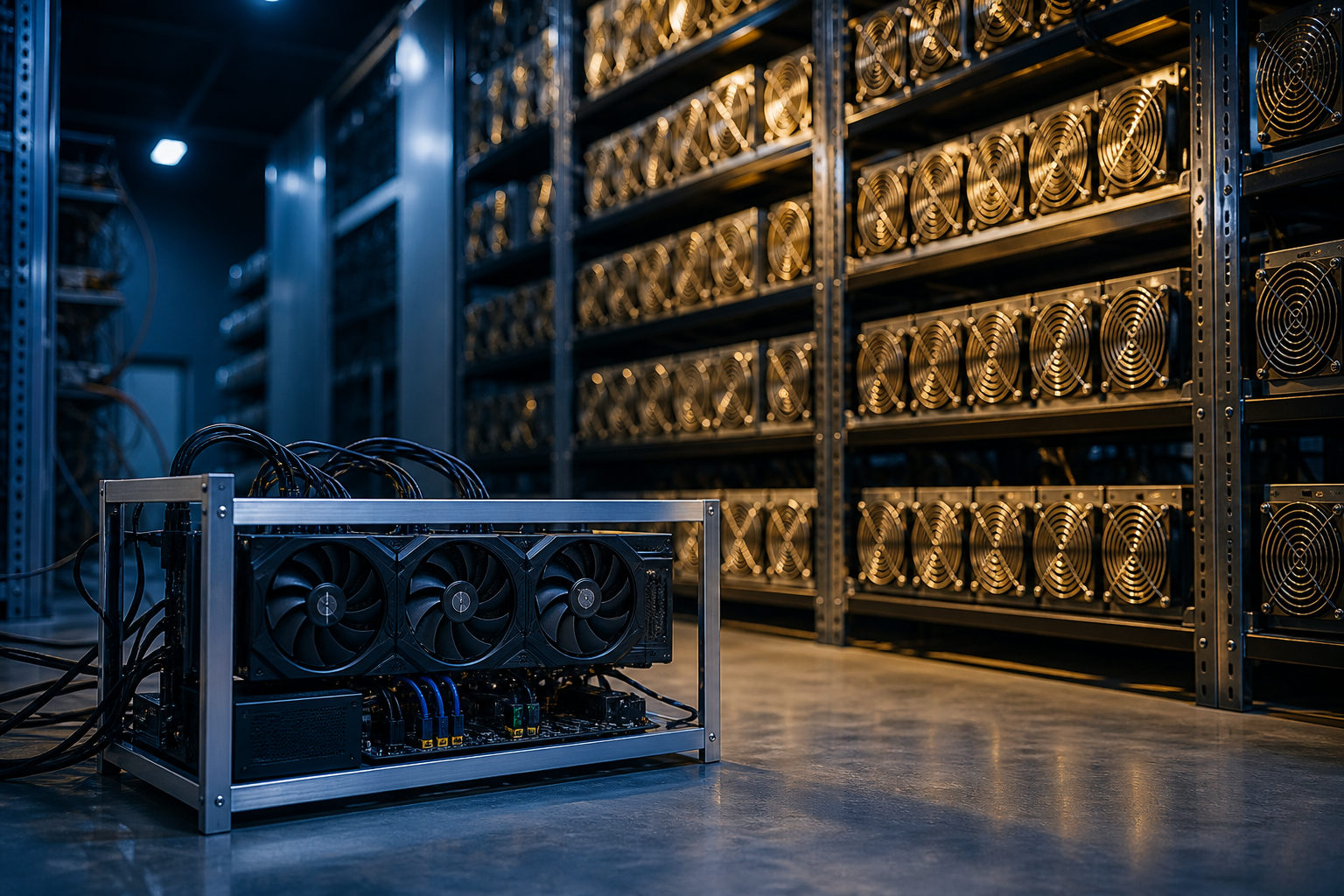
Can you mine bitcoin with gpu in 2026? Yes, in a technical sense you can still run the process, but for most people a GPU is no longer a practical tool for mining Bitcoin directly.
Think of Bitcoin mining as a bookkeeping race
A simple way to understand Bitcoin mining is to picture a public race for the right to write the next page of a ledger. Many participants compete at the same time, and the one that finds a valid result first gets to add a new block of transactions to the chain and receive the related block reward and fees.
This is not a contest of creativity or advanced problem solving. It is a speed contest built around repeating the same kind of hash calculation again and again. Bitcoin produces a block about every 10 minutes, and the network adjusts mining difficulty so that the pace stays close to that rhythm.
That matters because the question is not simply whether a computer can perform the work. The real issue is whether your hardware can stay competitive in a network where many other machines are chasing the same result at the same time.
Why GPUs are a weak fit for direct Bitcoin mining
GPUs are excellent at parallel workloads. They are useful for graphics, rendering, and other tasks that benefit from handling many operations at once. Bitcoin mining, though, has moved into a category where dedicated hardware is usually far better matched to the job.
Using the race analogy, a GPU is like an athlete trained for many events. A Bitcoin mining machine is closer to a specialist trained for one event only. When the rules stay fixed, the specialist tends to win. That is why many beginners get confused: if the software runs on a GPU, they assume the setup is still realistic for direct Bitcoin mining. Running is not the same as competing well.
By 2026, the practical answer is mostly about efficiency, power use, and hardware design. For most home users, the barrier is not “can it start” but whether it makes sense to keep it running.
If you only have a GPU, what can you actually do?
If your goal is learning, a GPU can still be useful. It can help you understand what miners do, how pools work, how wallet payouts are handled, and why block discovery is probabilistic instead of guaranteed. For education, a small test can be worth your time.
If your goal is to compete for Bitcoin block production in a serious way, the conversation changes. You need to think about dedicated mining hardware, pool choice, cooling, noise, uptime, power access, and routine maintenance. Many people focus on installation and ignore the daily reality of operating hardware around the clock.
There is also a common mix-up here. Some services let users point GPUs at other workloads and then pay out in bitcoin under their own rules. That is different from saying your GPU is directly competitive in Bitcoin mining itself. The payout currency and the underlying work are not always the same thing.
Questions to ask before you try
- What is your real goal? Learning the process or trying to build a long-term setup.
- Is your hardware matched to the task? A GPU and a dedicated miner belong in different categories.
- Can your space handle it? Heat, noise, and power draw affect everyday life.
- Are you ready for maintenance? Drivers, software, dust, temperature, and troubleshooting all matter.
- Do you have a wallet plan? Set up secure storage and backups before any payout reaches you.
The real calculation is total cost, not just hash power
When people ask whether they can mine Bitcoin with GPUs in 2026, they are often really asking whether the effort is worth it. That answer depends on much more than whether the machine can perform the work.
Electricity is the first filter. Mining is a continuous activity, not a quick benchmark. Then comes hardware wear. If your GPU is also used for gaming, rendering, or local compute tasks, mining puts pressure on a device that may already have other value to you.
Cooling matters too. So do fan noise, room temperature, network stability, downtime, and the time you spend managing the system. On paper, mining can look like a software task. In practice, it behaves more like operating equipment that needs regular attention.
That is why a GPU is best seen as a learning tool for Bitcoin mining in 2026, not as the default choice for direct participation. If your main goal is simply to get Bitcoin exposure, buying and holding, dollar-cost averaging, or studying custody options may be clearer paths than forcing a GPU into a role where it is usually at a disadvantage.
FAQ
Can a graphics card still mine Bitcoin at all?
At a technical level, yes, you can still interact with the process. The issue is not basic capability but practical competitiveness, and for most individuals a GPU is not well positioned for direct Bitcoin mining.
Is home Bitcoin mining with a GPU worth trying in 2026?
If you want to learn how mining works, a small experiment can be useful. If you want a serious setup, you need to examine power, cooling, noise, maintenance, and hardware fit before you go any further.
What is the difference between GPU mining and using a Bitcoin miner?
The main difference is specialization. A GPU is flexible and can handle many kinds of workloads, while a dedicated Bitcoin miner is built for repeated hashing under one specific mining model.
Where should I check the live Bitcoin price?
Without market data, it is better not to guess. Check a major market data platform or a large trading service for live quotes, then compare that with pool rules, fees, and equipment costs before making a decision.
If I do not need the learning experience, should I skip the GPU route?
For many people, yes. Once you understand the basics, your time may be better spent comparing participation paths, wallet security, and operating costs instead of testing a setup that is usually at a disadvantage.
Before you do anything, make a short checklist: what else your hardware is used for, how much noise and heat you can tolerate, how you will secure wallet backups, and whether you are willing to manage equipment on an ongoing basis. Those answers matter more than whether a GPU can start the mining software.
Disclaimer: This article is for informational and educational purposes only and is not investment, financial, or legal advice. Crypto assets are highly volatile and you could lose your entire investment. Do your own research and decide carefully.