
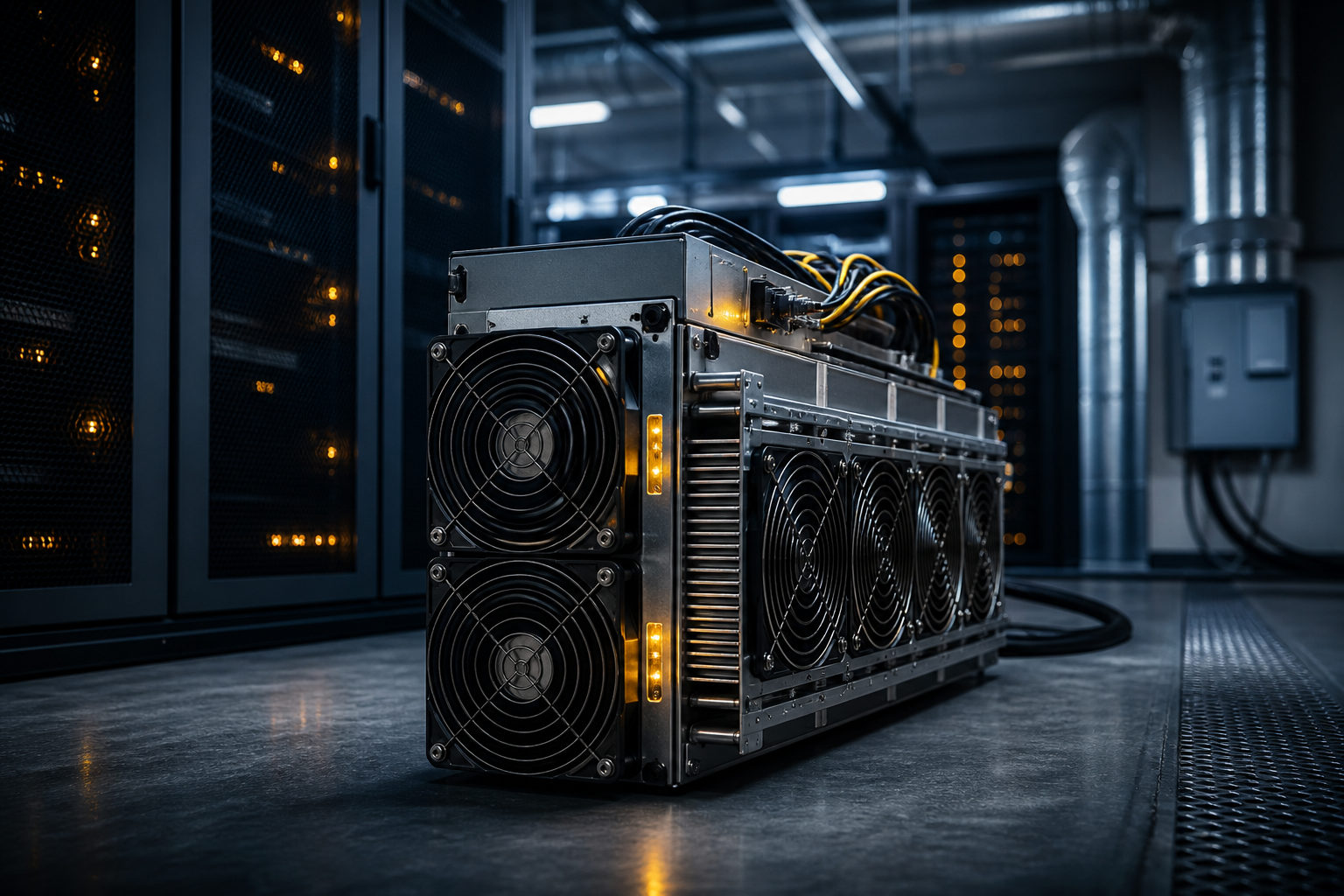
Yes, Bitcoin can still be mined, and new coins still enter circulation through mining; the harder question is whether mining makes sense for you once equipment, power, heat, and operational risks are on the table.
Why Bitcoin can still be mined
A simple way to picture Bitcoin is to think of it as an ongoing bookkeeping race. Many participants compete for the right to add the next page to the ledger. The winner gets to package a set of transactions into a new block and may receive the block reward plus transaction fees.
This process did not end years ago because Bitcoin was not issued all at once. It began with the genesis block in January 2009 and releases supply over time under fixed rules, with a total cap of 21 million coins. As long as all coins have not yet entered circulation, miners can still compete for newly issued Bitcoin. Later on, transaction fees are expected to matter more for miner incentives.
Bitcoin produces a block about every 10 minutes, and the network adjusts mining difficulty as competition changes so block production stays near that rhythm. So when people ask whether Bitcoin can still be mined, the technical answer is straightforward: yes. The practical answer depends on cost and execution.
What mining actually does
Many beginners hear the word mining and imagine coins being dug out of a computer. That image is easy to remember, but it is not really what happens. Miners validate and order transactions, then use computing power to compete for the chance to append a new block to the chain.
In other words, miners are repeatedly trying to produce a valid result under the network's rules. This is the proof-of-work system. The point is not busywork for its own sake. The point is that participating requires real-world resources, which makes rewriting the ledger much harder.
That is why the better question is rarely just whether Bitcoin can still be mined. A better question is whether you want to pay for specialized hardware, power, cooling, monitoring, maintenance, and downtime risk in order to join that competition.
How people still participate in Bitcoin mining
There are a few common paths today: running your own mining machine, joining a mining pool, or placing hardware with a professional hosting provider. You may also come across cloud-mining offers or similar contracts, but those can involve weak transparency, complicated terms, and meaningful counterparty risk.
Running your own machine
This is the most direct route. You buy a dedicated mining machine, connect it to power and the internet, configure the required settings, and keep it running. The catch is that modern Bitcoin mining hardware is not like an ordinary home computer. It brings noise, heat, steady electricity demand, and hardware management work.
People often focus on the machine purchase and ignore everything around it. Stable power, airflow, ventilation, firmware management, network reliability, and replacement parts all matter. If any of those pieces go wrong, the real-world result can be very different from the simple idea of just turning a device on.
Joining a mining pool
For smaller operators, joining a mining pool is often more realistic. A pool is like a team in the bookkeeping race. Participants combine computing power, and the pool distributes results according to its rules. This can make outcomes smoother than solo mining, but it also means you need to understand pool fees, payout rules, account security, and service reliability.
Marketing language should not be your main filter. Read how the pool calculates rewards, how often it pays, what security features it offers, and what happens if there are service interruptions. You are still depending on someone else's operation.
Using a hosting provider
Some people buy mining machines and place them in a professional facility that handles power, cooling, rack space, and maintenance. This can solve the problem of an unsuitable home environment, but it introduces new questions. Is the equipment really there, who handles repairs, what happens during downtime, and how easily can you move or recover your machines if needed?
If a service frames mining as effortless passive income, take a step back. Bitcoin mining is an operating business with physical and financial constraints, not a magic software setting.
The real issue is cost, not access
From a protocol view, Bitcoin can still be mined as long as the network keeps producing blocks. From a business view, what decides who stays in the game is cost structure. Power is usually the first major factor, followed by machine efficiency, cooling conditions, facility stability, maintenance capability, and your tolerance for outages.
Competition also changes over time. As more efficient machines join the network, older hardware can lose ground fast. Bitcoin goes through a halving about every 4 years, or every 210,000 blocks. The known halving years are 2012, 2016, 2020, and 2024. A halving reduces the new block subsidy, which means miners have to care even more about operating efficiency and cost discipline.
That is why the question many people mean to ask is not only whether bitcoins can still be mined, but whether entering now is sensible. The answer is different for each situation. Technical access still exists. Economic viability depends on your setup.
Common misunderstandings to clear up first
- Mistake one: a normal PC is enough. Early Bitcoin history and current mining conditions are very different. Modern Bitcoin mining is centered on specialized machines.
- Mistake two: if the machine is running, profit will follow. Mining is a competition, not a guaranteed-yield product. Running hardware is only the starting point.
- Mistake three: hosted mining means no risk. If equipment, payouts, or custody depend on another party, counterparty and execution risks remain.
- Mistake four: only the machine price matters. Power, cooling, repairs, monitoring, and downtime all affect the real outcome.
- Mistake five: storage can wait until later. Mining and custody are separate topics. Once you receive Bitcoin, wallet security and private key control matter immediately.
If your goal is exposure or education, mining may not be the first step
After looking into mining, many people realize they are less interested in running machines than in understanding Bitcoin or holding some amount of it. If your main goal is to learn, start with the basics: how blocks are formed, how transactions are confirmed, how wallets work, and what a full node does. If your goal is ownership, then buying, storing, and managing risk may be more relevant than mining itself.
Mining is closer to an infrastructure business than a casual software hobby. It is operational, physical, and cost-sensitive. For many individuals, the key decision is not whether Bitcoin can still be mined, but whether they are actually suited to this type of activity.
FAQ
Can bitcoins still be mined today?
Yes. Bitcoin supply is released over time under fixed rules rather than all at once, so new blocks still carry a block reward.
That said, the fact that mining still exists does not mean it is practical for every person. Equipment, power pricing, and operating conditions matter a lot.
Can I mine Bitcoin with a home computer?
You can run software and experiment with Bitcoin-related tools on a home computer, but that is not the same as being competitive in Bitcoin mining. In current conditions, ordinary consumer hardware is generally not suited to serious mining.
If your aim is learning, studying wallets, nodes, and block data is often more useful than trying to mine with unsuitable hardware.
What is the difference between solo mining and pool mining?
Solo mining means competing on your own for block production, which usually brings much more variance. Pool mining combines the computing power of many participants and shares results under a payout formula.
For smaller participants, pools are more common. You still need to evaluate the pool's rules, fees, reliability, and account protections.
Does halving mean Bitcoin mining stops making sense?
No. Halving does not stop mining, but it does cut the new block subsidy, which raises the importance of efficiency and cost control.
Whether mining still makes sense after a halving depends on your power costs, hardware quality, hosting terms, and ability to manage operational risk.
Where should I check the live Bitcoin price?
If you need a real-time market quote, use major market data platforms or large trading services with active price pages. Quotes can differ slightly between venues because of liquidity and update timing.
Do not rely on screenshots, chat posts, or short clips as your only source for price decisions.
If you are seriously thinking about mining, write down the basics before spending anything: where the machine comes from, how power will be handled, how cooling will work, which pool rules you accept, what any hosting contract says, and how your wallet will be secured. That checklist will tell you more than a sales pitch.
Disclaimer: This article is for informational and educational purposes only and is not investment, financial, or legal advice. Crypto assets are highly volatile and you could lose your entire investment. Do your own research and decide carefully.