
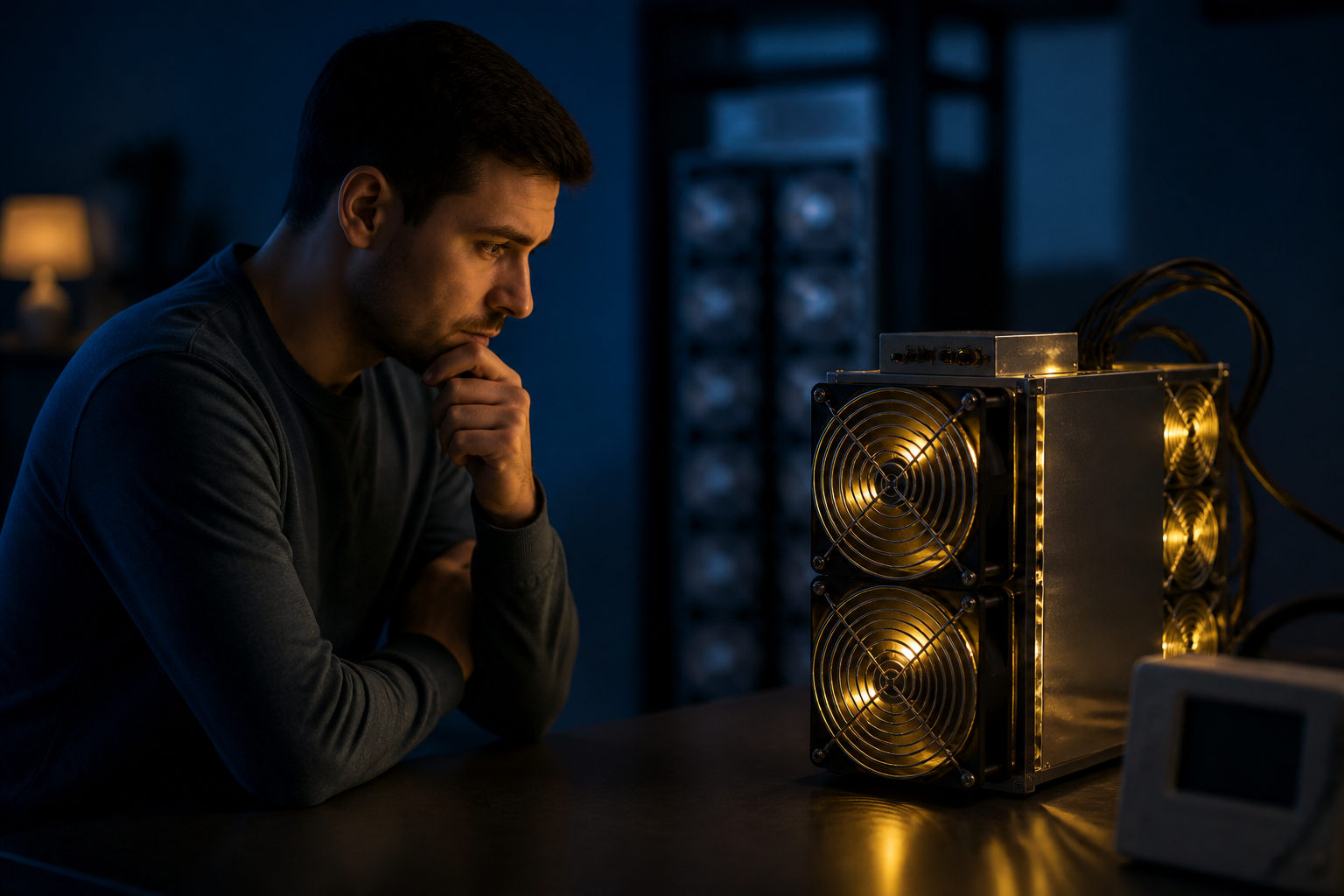
To get started mining bitcoins, first understand that you are joining a nonstop race to add the next block to Bitcoin’s public ledger, then decide whether your hardware, power, cooling, and time make that realistic.
What bitcoin mining actually is
A simple way to picture Bitcoin mining is to think of a global bookkeeping contest. Many participants compete to package recent transactions into a new block. The one that meets the network’s rules first gets the right to add that block and receive the block reward plus transaction fees.
Mining is often described as “creating” bitcoin, but the process is really about securing the network through computation. Machines keep trying different outputs until one satisfies the current target. Bitcoin produces a new block about every 10 minutes, and the network adjusts mining difficulty over time so block production stays near that pace.
This matters for beginners because mining is not a steady faucet you switch on. Even if you buy equipment, your results depend on competition, uptime, configuration, and the method you use to participate. Bitcoin’s supply is capped at 21 million coins, and issuance slows through halvings every 210,000 blocks, roughly every 4 years. The halving years so far are 2012, 2016, 2020, and 2024.
Choose the way you want to participate
When people ask how to start mining bitcoins, they often mean two different things. One group wants to learn how the system works. The other wants to know whether mining is practical for them at home or through a hosted setup. Those are related questions, but not the same one.
For most beginners today, the real limits are not software downloads or account creation. The hard part is dealing with power use, heat, noise, maintenance, and the fact that specialized hardware is usually needed for meaningful participation.
| Method | Who it fits | Main hurdle | What to expect |
|---|---|---|---|
| Solo mining | People with strong technical skills and suitable space | High setup demands and irregular block wins | Full control, but very uneven outcomes |
| Pool mining | Most beginners who want hands-on participation | Need to choose a pool and configure hardware | Rewards are shared based on contribution |
| Hosted mining | People who cannot keep machines on-site | Dependence on a third party | Less local work, but less direct oversight |
| Cloud mining contracts | People looking for the easiest entry point | Terms can be hard to verify | Simple on the surface, higher trust risk |
Pool mining is where many newcomers should begin their research. A mining pool combines the computing power of many miners and distributes payouts according to its rules when the pool finds a block. This smooths out the waiting time compared with going solo, but it also means you need to understand fee structures, payout methods, thresholds, and the quality of the pool’s dashboard.
If you do not have a place to run noisy, heat-producing equipment for long periods, mining may already be a poor fit. It is better to learn that early than after spending money on hardware.
What you need before you begin
Bitcoin mining now usually requires specialized ASIC hardware rather than a normal desktop or laptop. Alongside the miner itself, you need stable power, steady internet access, a workable cooling setup, and a bitcoin wallet to receive payouts.
| Item | Purpose | What beginners miss |
|---|---|---|
| ASIC miner | Provides hash power | Used machines may have hidden wear or repair history |
| Power setup | Keeps the machine running continuously | Outlets and wiring may be inadequate or unsafe |
| Internet connection | Lets the miner submit work without interruption | Frequent disconnects reduce effective uptime |
| Cooling and airflow | Helps avoid overheating and shutdowns | A room that feels acceptable to you may still be bad for the machine |
| Bitcoin wallet | Receives payouts from the pool | Wrong addresses or poor backup habits can cause losses |
| Pool account | Connects your miner to pool infrastructure | Rules differ widely between pools |
Your wallet choice should match your goal. If you plan to hold bitcoin for a long time, control over keys and backups matters more than convenience. If you only need a temporary receiving address, your focus may be different, but you still need to handle setup carefully.
You should also be prepared to read the basic status information from your miner and pool dashboard. Is the machine online? Has hash rate dropped? Is temperature climbing? Is the pool recording accepted work normally? You do not need to become an expert operator on day one, though you do need enough visibility to tell whether the machine is doing useful work.
A practical step-by-step path for beginners
Once you break the process down, getting started is less mysterious than it sounds. The challenge is that each step has operational consequences.
- Check your environment first. Confirm that your location can handle long-running equipment, stable internet, ventilation, and the noise level.
- Pick your participation model. Decide whether you want to run equipment yourself, use hosting, or stay in research mode for now.
- Set up a bitcoin wallet. Prepare a receiving address before connecting to a pool so payout handling is clear from the start.
- Choose a mining pool. Look at supported regions, payout methods, account controls, and how easy the dashboard is to understand.
- Install and configure the miner. This usually means entering pool server details, worker information, and payout-related settings, then checking whether the device comes online properly.
- Monitor performance. Watch uptime, heat, unexpected restarts, and pool-side reporting so you can catch issues early.
Beginners often treat mining as a one-time purchase. It is closer to operating a machine that needs regular attention. Dust, fan wear, unstable connections, power issues, and firmware problems can all affect output or take the miner offline.
If your goal is to learn before spending, that is a sensible approach. Study how pool payouts work, how wallets receive bitcoin, and how miner configuration screens are structured. Once you understand the process, it becomes easier to spot sales language that makes mining sound simpler than it is.
The cost reality many newcomers miss
The biggest mistake is focusing only on the purchase price of a miner. Ongoing costs and operating friction matter just as much, sometimes more.
| Cost or risk | How it shows up | Why people miss it |
|---|---|---|
| Electricity | Continuous running expense | Attention goes to hardware first |
| Noise | Affects living space and nearby people | Spec sheets do not convey real-world discomfort |
| Heat | Can force throttling or shutdowns | Being able to power on is not the same as being able to run well |
| Maintenance | Cleaning, troubleshooting, part replacement | Machines are often imagined as set-and-forget devices |
| Difficulty changes | Competition can increase over time | People assume hardware output is fixed in practical terms |
| Third-party risk | Hosting firms, pools, or contract sellers may be opaque | Convenience can hide weak transparency |
It is also important to separate mining from simply buying bitcoin. Mining means operating equipment under changing conditions. Buying bitcoin is an asset purchase and custody decision. If your real aim is just to own bitcoin, learning about wallets and purchase methods may be more useful than learning how to run a miner.
That distinction saves beginners from forcing the wrong solution onto the wrong goal. Some people are curious about the mechanics of Bitcoin and enjoy the operational side. Others mainly want exposure to bitcoin itself. Those paths overlap, but they are not interchangeable.
FAQ
Can I mine bitcoin with a regular computer?
You can use a regular computer to learn some of the concepts, but effective bitcoin mining usually requires specialized ASIC hardware. The gap is mainly about efficiency and the ability to run continuously under competitive conditions.
Is joining a mining pool better than mining alone?
For most beginners, a pool is easier to start with because it gives clearer reporting and smoother payout patterns. Solo mining offers more independence, but it places more weight on your setup and your tolerance for long stretches without results.
Do I need a bitcoin wallet before I start?
In most cases, yes. A wallet gives you a destination for pool payouts, and it also forces you to think about address management, backups, and who controls the keys.
Is cloud mining a good beginner option?
It can look simple, but the details matter a lot. If you cannot clearly explain the contract terms, fee deductions, suspension rules, and payout conditions, you may be taking on more risk than you realize.
Where should I check the bitcoin price before deciding whether to mine?
You can check live market prices on major market data sites or large exchanges. Do not base the decision on price alone; compare that information with your power costs, maintenance capacity, hardware conditions, and exit options.
Before you do anything else, write down your own constraints: space, electricity, internet reliability, cooling, wallet setup, pool choice, and the time you can give to maintenance. If one of those pillars is missing, starting to mine bitcoins should stay a research topic for now, not a purchase decision.
Disclaimer: This article is for informational and educational purposes only and is not investment, financial, or legal advice. Crypto assets are highly volatile and you could lose your entire investment. Do your own research and decide carefully.