
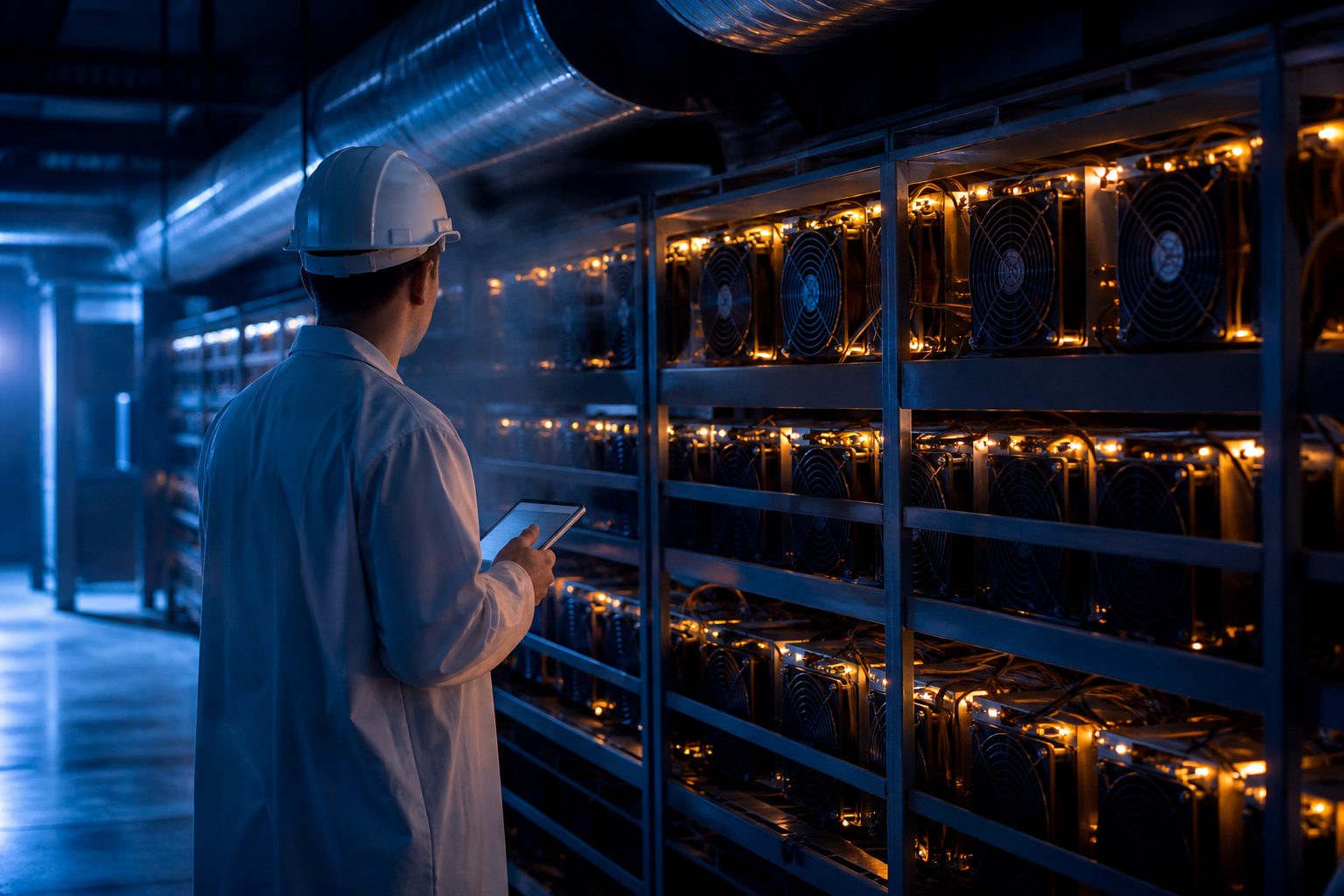
A real Bitcoin mining farm is a competitive accounting setup. Machines race on hash power, uptime, and electricity cost, not on digging up physical coins.
What is actually happening inside a mining farm
Forget the image of a dirt pit. A mining farm usually looks more like a tightly packed machine room, with rows of hardware running nonstop to assemble transaction blocks and compete for the right to add one to the chain.
The winner is the one that finds a valid result under the network rules first. There is no shortcut, no manual selection, and no way to skip the repeated trial-and-check cycle that defines the process.
Bitcoin is designed to produce a new block about every ten minutes. That rhythm keeps the system moving at a steady pace, while every miner follows the same rules and competes at the same time.
Why electricity and cooling matter so much
Mining hardware generates heat the moment it runs. If that heat is not handled properly, the machines may slow down, disconnect, or wear out faster than expected, so cooling is part of the business, not an afterthought.
That is why a farm needs more than power outlets. It needs airflow planning, fan systems, rack spacing, and enough environmental control to keep the equipment operating consistently.
Electricity is usually the biggest direct pressure point. More hash power does not automatically mean better results if power prices, machine efficiency, and daily maintenance are out of balance.
How regular people can take part
There are a few common paths. Some people buy hardware and run it themselves. Others join a mining pool so their hash power can be combined with many others and rewards can be shared by contribution. A third group simply studies the mechanism and buys Bitcoin without touching mining gear.
For a beginner, it helps to separate two questions. One is how Bitcoin is created. The other is whether you personally want to become a miner. The first is a learning task. The second means accepting equipment, space, power, maintenance, and price risk.
A mining farm is not a place where a machine is switched on and money appears on its own. Hardware wears out, conditions change, and the rules can shift, so the real business is ongoing management.
Cost reality matters more than the story
Many people are drawn to the idea of “winning the accounting race” and miss the long-term cost structure. In practice, the deciding factors are power cost, machine efficiency, cooling quality, maintenance discipline, and capital tolerance.
If you think of mining as an industrial operation, the boundaries become clearer. It is not just buying a machine and waiting for it to pay itself off. It is a high-consumption system that has to be managed continuously.
Bitcoin’s block reward changes after each halving, which tightens the economics for miners. The network went through those halvings in 2012, 2016, 2020, and 2024, and each one made inefficient operators harder to keep afloat.
FAQ
What is a Bitcoin mining farm really mining?
It is not mining physical ore. It is competing for the right to write the next block of transactions into Bitcoin’s ledger.
The process is more like a race than extraction. The result comes from matching the network rules, not from digging up a fixed stock of something.
Should a regular person set up mining gear?
If your goal is to understand Bitcoin, learning the rules is enough. If your goal is to participate directly, you need to handle equipment, location, noise, cooling, and cost management.
For many people, understanding how the network works is more useful than rushing into a farm.
Why do mining farms look so loud and hot?
Because many machines are running nonstop, fans and cooling systems have to work all the time. If heat is not controlled well, efficiency drops and stability suffers.
That is not a side effect. It is part of daily operations.
How is a pool different from solo mining?
Solo mining uses one machine or a small set of machines on its own, so results can swing widely. A pool combines many miners’ hash power and distributes results by contribution, which usually makes outcomes steadier.
For most people, a pool is easier to understand and closer to how participation works in practice.
If you want to understand a real Bitcoin mining farm, focus on how hash power, electricity, cooling, and network rules fit into one operating system.
Disclaimer: This article is for informational and educational purposes only and is not investment, financial, or legal advice. Crypto assets are highly volatile and you could lose your entire investment. Do your own research and decide carefully.