
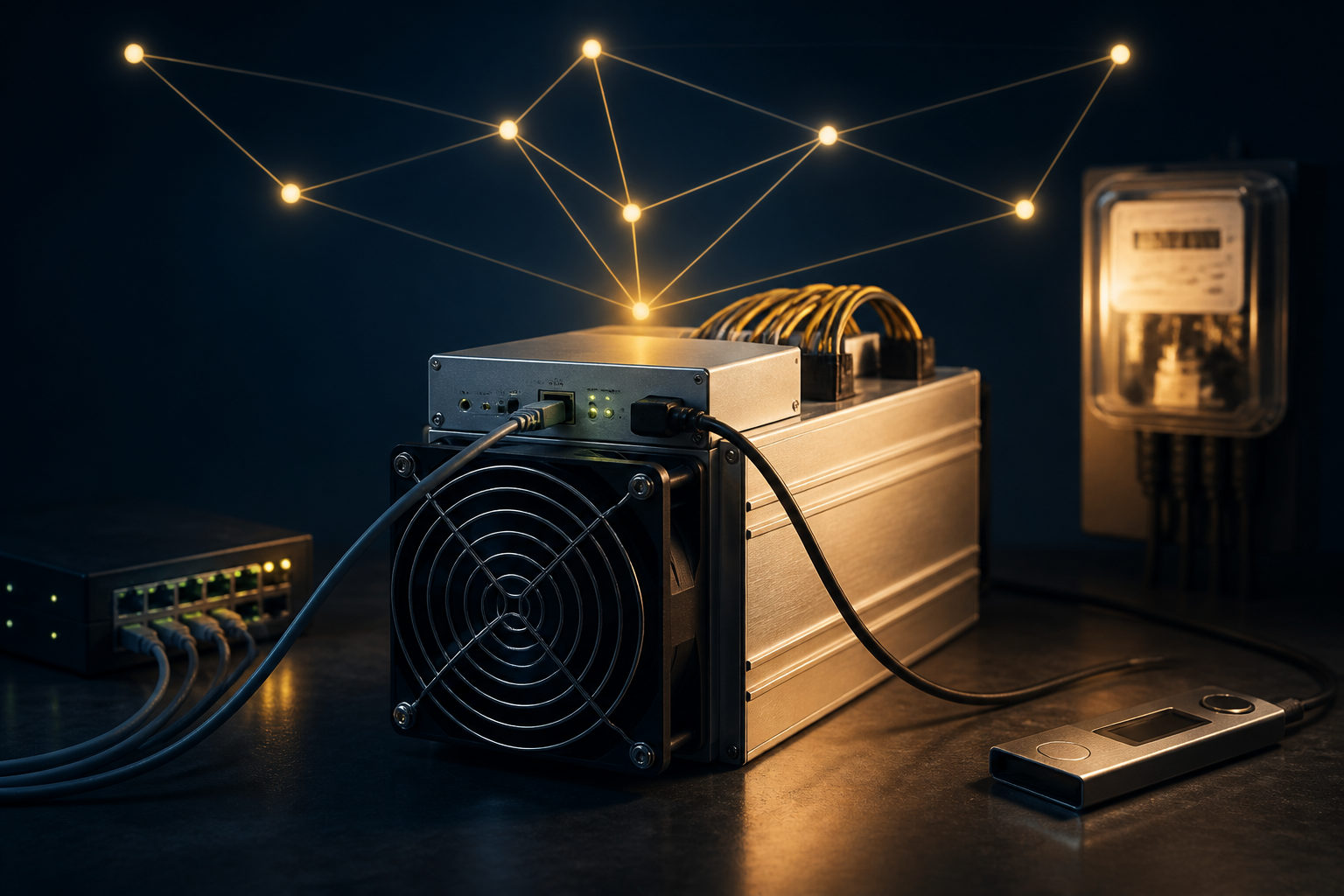
To join a bitcoin mining pool in 2026, you need four basics: mining hardware, stable power, a bitcoin wallet, and a pool account or worker setup. The setup steps are simple enough; the harder part is deciding whether mining makes sense for your costs, space, and maintenance burden.
A useful way to think about bitcoin mining is a bookkeeping race. The network keeps running a contest to decide who gets to add the next block. A mining pool is a team in that race: many miners combine their computing power, and when the pool finds a valid block, the reward is divided according to the pool's payout rules.
What a bitcoin mining pool actually does
Bitcoin began with the genesis block in January 2009, after the 2008 white paper, Bitcoin: A Peer-to-Peer Electronic Cash System, was released under the name Satoshi Nakamoto. The system uses proof of work, and the network produces a block about every 10 minutes.
For an individual miner, solo mining means competing alone. That is possible in theory, but the outcome can be highly uneven because a single miner may wait a very long time before finding a block. A pool changes that experience by combining many miners into one larger participant, then splitting the result based on contributed work.
Think of it as a team event, not a shortcut
New miners often assume a pool somehow makes bitcoin easier to mine. That is not the right frame. The network difficulty and the underlying competition stay the same; what changes is how the outcome is shared.
In other words, a mining pool does not rewrite Bitcoin's rules. It turns a very lumpy, winner-takes-the-block process into something closer to steady allocation for participants.
What you need before joining a bitcoin mining pool
Most beginners focus on signup screens first, even though the real preparation starts elsewhere. A pool can coordinate work and payouts, but it cannot solve your electricity bill, heat output, equipment noise, or hardware failures.
- ASIC mining hardware: Bitcoin mining is generally done with specialized machines rather than ordinary home computers.
- Power and cooling: You need a place where the machine can run continuously without unstable power or poor ventilation.
- Reliable internet: Your miner needs a stable connection to the pool server so it can submit work without frequent interruptions.
- A bitcoin wallet: You need a BTC address to receive payouts, ideally one you control directly.
- Basic operational skills: You should be comfortable logging into the machine interface, entering pool details, checking status pages, and spotting faults.
This is where expectations often break down. Joining a pool is not the same as opening a passive income account. Without a miner contributing real hashpower, a pool has nothing to attribute to you. Even with the right machine, long-term mining still depends on power costs, hardware efficiency, and the ability to keep the unit running.
Why many people get stuck before they really start
Some assume the technical part is the biggest hurdle. In practice, home conditions are often the bigger issue. Mining machines produce heat and noise, and many living spaces are simply not suited for that kind of continuous operation.
Others confuse a real pool with products that market exposure to mining without making clear what is happening behind the scenes. If you are learning how to join a bitcoin mining pool in 2026, keep the definition strict: a pool combines actual mining work from connected machines.
How to join a bitcoin mining pool step by step
The joining process is easier to manage when broken into a sequence. Doing it in order also makes troubleshooting much easier later.
- Set up your wallet first: Make sure you have a working BTC address and verify that you control it.
- Choose a mining pool: Read the pool's payout method, fee policy, withdrawal rules, account security options, server locations, and documentation.
- Create an account or worker name: Some pools require a full account. Others let you mine using a wallet address and worker identifier.
- Enter the pool connection details in your miner: This usually means a server address, a port, a worker name, and a password field defined by the pool.
- Start the machine and watch the status: Look for a stable connection, accepted shares, and any signs of overheating, disconnects, or hardware errors.
- Secure the account settings: If the pool offers two-factor authentication or payout address protection, turn them on.
The point most beginners miss is that an “online” label is not enough. A miner can appear connected while still having trouble submitting valid work, reconnecting too often, or running too hot. You need to check both the machine dashboard and the pool dashboard before assuming the setup is finished.
What matters when choosing a pool
Start with clarity. A usable pool explains how it pays miners, what fees apply, how withdrawals work, and what happens during outages or account issues. If those basics are hard to find, treat that as a warning sign.
Then look at connection quality. A server closer to your region may reduce latency and help keep work submissions steady. After that, look at transparency: status pages, maintenance notices, setup guides, and support resources matter more in daily use than marketing language.
What you usually enter into the miner
Most miners ask for a pool URL or server address, a port, a worker name, and a password field. That password field is not always your normal account password. In some pools, it is just a placeholder value or a way to attach a label to the worker, so always follow the pool's own instructions.
Once saved, the machine starts sending work to the pool. At that stage, compare what the miner shows with what the pool panel shows. If both sides reflect active, accepted work, you are probably connected correctly.
The hard part is not joining. It is staying operational.
Without live market data and your personal cost structure, specific profit claims would be empty. What matters more is the operating reality: a pool only changes how mining output is shared. It does not erase the commercial limits of mining.
- Electricity cost: This is one of the biggest factors in whether mining is sustainable for you.
- Machine efficiency: Hardware quality and efficiency shape how much pressure your setup faces.
- Cooling and noise: If the environment is wrong, uptime becomes harder to maintain.
- Maintenance and downtime: Dust, fans, temperature swings, network instability, and configuration errors can all interrupt operation.
- Pool rule changes: Fee schedules, payout methods, and security requirements can change, so you need to review them from time to time.
It also helps to understand Bitcoin's built-in supply schedule. The total supply is capped at 21 million coins, and the block subsidy is cut in half about every 4 years, or every 210,000 blocks. The halving years so far are 2012, 2016, 2020, and 2024. For miners, that means the business side of mining keeps tightening around efficiency, costs, and disciplined operations.
That is why “how to join a bitcoin mining pool 2026” is only partly a setup question. It is also a filter question: do you have the hardware, location, budget, and tolerance for ongoing operational work?
FAQ
Can a beginner still join a bitcoin mining pool in 2026?
Yes. The connection process itself is not especially difficult. The bigger question is whether you have suitable hardware, power access, ventilation, and enough patience for ongoing maintenance.
If those basics are weak, connecting to a pool may be technically possible while still being a poor fit in practice.
Can I join a pool without owning a mining machine?
In normal bitcoin mining, no. A pool distributes results based on contributed mining work, so without hardware providing hashpower, there is nothing meaningful to credit to your setup.
If you see claims that you can mine BTC in a pool without actual mining equipment, check very carefully what service is really being described.
What is the difference between pool mining and solo mining?
Solo mining means you compete alone for block discovery, which creates very uneven outcomes. Pool mining combines many participants into one group and splits the result according to pool rules.
For many smaller miners, that means less variance in how rewards arrive, even though the network itself has not become easier.
How do I know whether a mining pool is trustworthy?
Look for clear payout rules, transparent fee disclosures, readable setup documents, stable server options, and strong account security features. A pool should explain itself plainly.
If a pool is vague about withdrawals, account protection, or how downtime is handled, that is enough reason to slow down.
How soon will I know if my setup is working?
You can usually see connection status and share submissions soon after the miner starts. The timing of pool-side statistics and payout displays depends on that pool's own reporting and accounting system.
A better test is consistency: check whether the machine stays connected, whether accepted work keeps appearing, and whether the payout address is set correctly.
Final checks before you switch the miner on
Before you start, confirm three things: your payout wallet is under your control, your location can handle continuous power and heat, and you have read the pool rules from start to finish. If any of those points still feel fuzzy, pause before running the machine for long periods.
After startup, do not rely on a single glance at one dashboard. Watch for disconnects, temperatures, fan behavior, and accepted work over time; in mining, stable operation is not a bonus, it is the baseline.
Disclaimer: This article is for informational and educational purposes only and is not investment, financial, or legal advice. Crypto assets are highly volatile and you could lose your entire investment. Do your own research and decide carefully.