
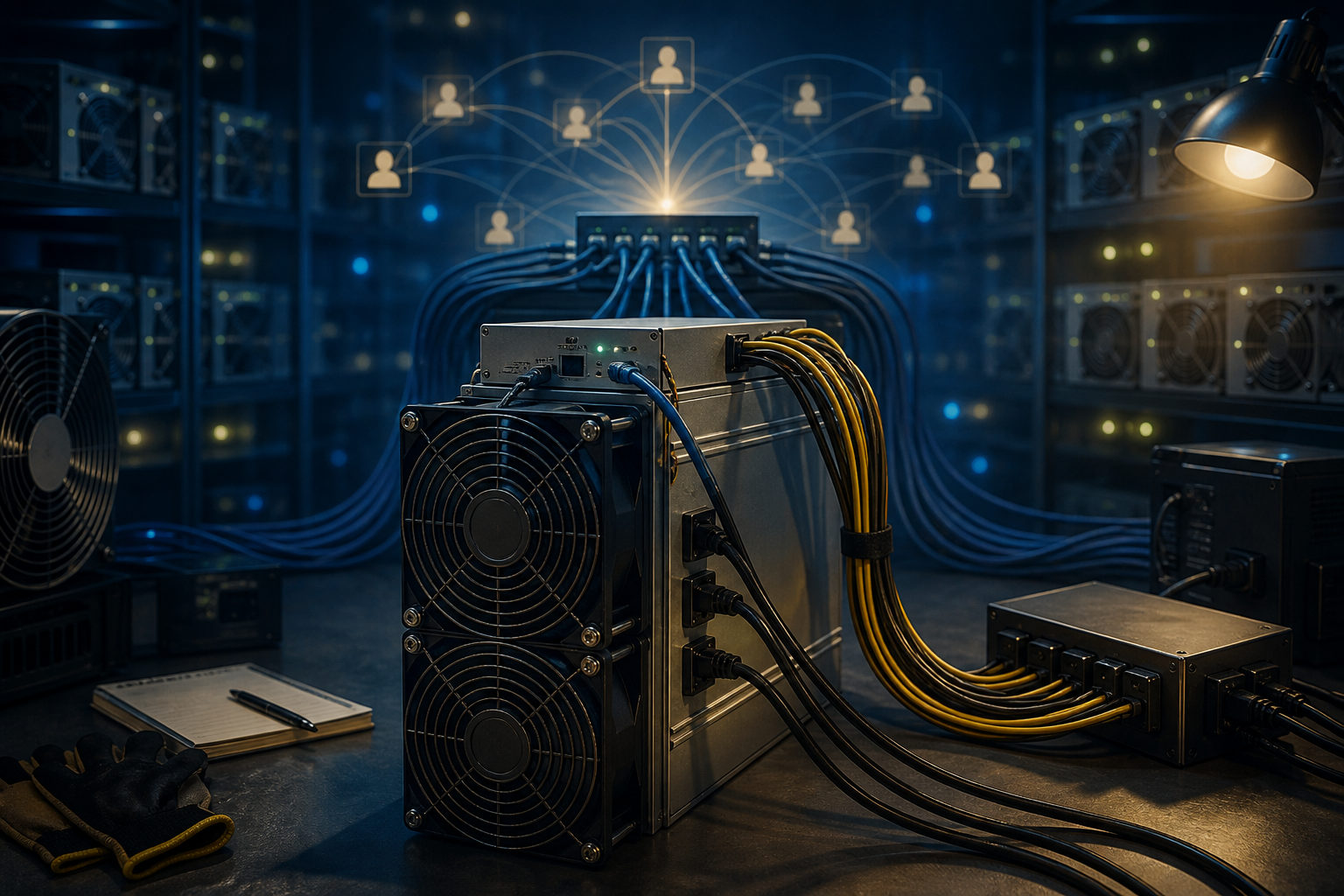
To join a Bitcoin mining pool in 2026, you first need to confirm that you have the right hardware, power setup, cooling, internet stability, and wallet security. A mining pool can smooth out how rewards are shared, but it does not remove the real costs of mining.
A simple way to understand Bitcoin mining is to picture a nonstop bookkeeping race. Miners around the world compete to add the next block to the Bitcoin blockchain. Roughly every 10 minutes, a new block is found. If you mine alone, your chance of finding a block is very small, so many miners combine their hash power in a pool and then split payouts based on each participant's contribution.
What a Bitcoin mining pool actually does
A mining pool is a coordination system. It does not create extra Bitcoin out of thin air, and it does not turn a weak setup into a strong business. The pool operator distributes mining jobs to connected machines, tracks valid work submitted by each miner, and applies a payout method based on the pool's rules.
This changes the pattern of earnings, not the underlying economics. Solo mining can mean waiting a long time for a single large result. Pool mining spreads that uncertainty across many participants, so payouts may arrive more regularly, even though your share is smaller. For most individuals, the main appeal of a pool is lower variance in timing, not lower operating cost.
In practice, a pool setup usually includes:
- The miner: supplies the machine, electricity, space, cooling, and maintenance.
- The pool operator: runs the servers, assigns work, tracks contribution, and processes payouts.
- A wallet or payout account: receives Bitcoin distributed by the pool.
That last part matters more than many beginners expect. If you do not control your payout destination securely, good mining performance can still end in poor security practice.
Before you join, decide whether mining makes sense for you
Many guides jump straight into setup screens. That is useful later, but not at the start. Bitcoin uses proof of work, and competition is continuous. Before you pick a pool, you should decide whether you are actually in a position to mine in a practical way.
You usually need specialized hardware
Bitcoin mining today is generally done with dedicated ASIC miners rather than ordinary desktop computers. That is because the network is highly competitive, and general-purpose hardware is not designed for this kind of workload. If your goal is education, you can study pool dashboards and connection settings. If your goal is real participation, hardware choice is a core decision.
Electricity is a basic constraint
Mining machines run under sustained load, and that means sustained power use. Your electricity arrangement can shape whether mining is manageable at all. Even without using any profit estimates, you should know whether your power source is stable, whether your location allows continuous operation, and whether your utility costs fit your tolerance for ongoing expense.
Cooling, noise, and space are not side issues
Mining hardware is not like a quiet home appliance. It produces heat and noise on a constant basis. If ventilation is poor or temperatures climb too high, performance may drop and downtime may increase. If the machine is in a place where noise is a problem, the project may become impractical even before you think about payouts.
Internet stability affects effective mining time
Your miner has to stay connected to the pool server and submit valid work consistently. If the connection drops often or packet loss is heavy, your effective contribution can suffer. A stable connection matters more than chasing a short burst of speed. Mining is an uptime activity.
How to join a Bitcoin mining pool step by step
If your hardware, power, location, and internet setup are in good shape, the actual onboarding process is fairly direct. The exact screens differ from one pool to another, but the workflow is usually similar.
- Prepare a Bitcoin payout address: You need a wallet or payout destination that you control securely. For long-term holdings, many users prefer not to leave all funds in a single custodial account.
- Choose a mining pool: Look at payout rules, fee disclosures, server options, account controls, and service reliability. Marketing language should not be your main filter.
- Create your account and secure it: If registration is required, use a strong password and enable two-factor authentication if available. Separate login security from payout security wherever possible.
- Get the pool connection details: Pools commonly provide a server address, a port, a worker naming format, and a password field. In some cases, that password field is just a label or setting field rather than a true secret.
- Enter the settings in your miner dashboard: Log in to the machine's management interface, add the primary pool, a backup pool, your worker name, and any required fields, then save and apply the settings.
- Watch both the machine and the pool dashboard: Do not assume that a machine marked as online is working perfectly. Check whether the pool sees stable contribution, and review rejected shares, hardware errors, and offline events.
- Finish payout and security controls: Review payout thresholds, address locking, withdrawal permissions, and any whitelist features the platform offers.
A common beginner mistake is treating a successful connection as proof that everything is fine. It is not. A miner can appear online while still performing poorly. In the same way, a pool dashboard can show some activity while the machine is running too hot or producing too many errors. You need both views.
How to choose a mining pool without focusing only on brand names
Pool selection affects your day-to-day experience more than many first-time miners realize. For individual miners, the fine print matters. Two pools can look similar at a glance while handling accounting, fees, and account protections quite differently.
Understand the payout model first
Most pools distribute rewards according to contributed work, but the exact method can vary. What matters is not memorizing every industry acronym. What matters is understanding whether the pool offers smoother payouts or more direct exposure to block-finding variance, how fees are applied, and whether the accounting is transparent enough for you to follow.
Server options and route quality matter
Many pools offer multiple regional servers. Picking the nearest or most stable option can reduce connection problems. This is not only about speed. It is about avoiding interruptions that can cut into your valid submissions over time.
Dashboard quality helps with maintenance
A useful pool dashboard should show worker status, contribution trends, payout history, alerts, and account permissions in a clear way. If the service hides important details or offers weak error reporting, troubleshooting becomes harder. Good visibility can save you time and help you catch hardware problems early.
Low fees are not the whole story
A pool with lower fees may still be a poor fit if uptime is weak, explanations are vague, or account security tools are limited. The practical question is whether the pool is reliable, understandable, and manageable for your setup. Cost matters, but so does operational quality.
The biggest misconceptions and risks after you join
Many newcomers think joining a pool makes mining easy and passive. That is not how it works. A pool can reduce the randomness of waiting for a block, but it does not make hardware management disappear.
- Misconception one: a pool guarantees profit. It does not. Pooling changes distribution, not your power bill, machine efficiency, equipment aging, or network competition.
- Misconception two: once the machine is running, you can ignore it. In reality, miners can face overheating, fan issues, firmware mistakes, connection drops, and unexpected downtime.
- Misconception three: leaving payouts on a platform is always the easiest option. Convenience and security are not the same thing. If all funds stay in one custodial place, account risk becomes concentrated.
- Misconception four: raw hash power is all that matters. It is important, but so are power usage, noise, serviceability, and your ability to recover from downtime.
There are also site and policy considerations. Your building or hosting location may have restrictions on sustained high-load equipment. Power interruptions, ventilation limits, and local rules can all shape whether mining is workable in daily life. For many individuals, these practical limits matter more than the technical setup page.
If your real goal is Bitcoin exposure rather than hardware operation, then buying Bitcoin and learning proper self-custody may be more suitable than running mining equipment. Mining is an infrastructure activity. It is not just an account signup.
FAQ
Do I need to own a mining machine to join a Bitcoin mining pool?
In the usual sense, yes. Joining a pool generally means contributing actual hash power from hardware you own or control. Opening an account by itself is not the same as participating in Bitcoin mining.
Can I use a home internet connection for pool mining?
It can work if the connection is stable enough for long sessions. The key question is not whether you can get online, but whether your link can stay reliable with minimal interruptions.
Is pool mining better than solo mining for beginners?
For many beginners, a pool is easier to understand operationally because payouts are usually more regular. That does not mean total returns are automatically higher; it means the waiting pattern is less extreme than mining alone.
What should I check when comparing mining pools?
Start with payout rules, fees, server choices, dashboard clarity, and account security controls. If the service is vague about withdrawals, accounting, or worker management, treat that as a warning sign.
Do I need to watch the Bitcoin price every day after joining a pool?
Price watching is less important than machine monitoring. In most cases, temperature, uptime, hardware errors, rejected work, and payout settings deserve more attention than short-term market moves.
Before you connect your miner, make a short checklist: confirm the hardware is suitable, the location can handle heat and noise, the power source is stable, the internet connection can stay up, the wallet setup is secure, and the pool rules are fully understood. If those basics are not in place, joining a pool is too early.
Disclaimer: This article is for informational and educational purposes only and is not investment, financial, or legal advice. Crypto assets are highly volatile and you could lose your entire investment. Do your own research and decide carefully.