
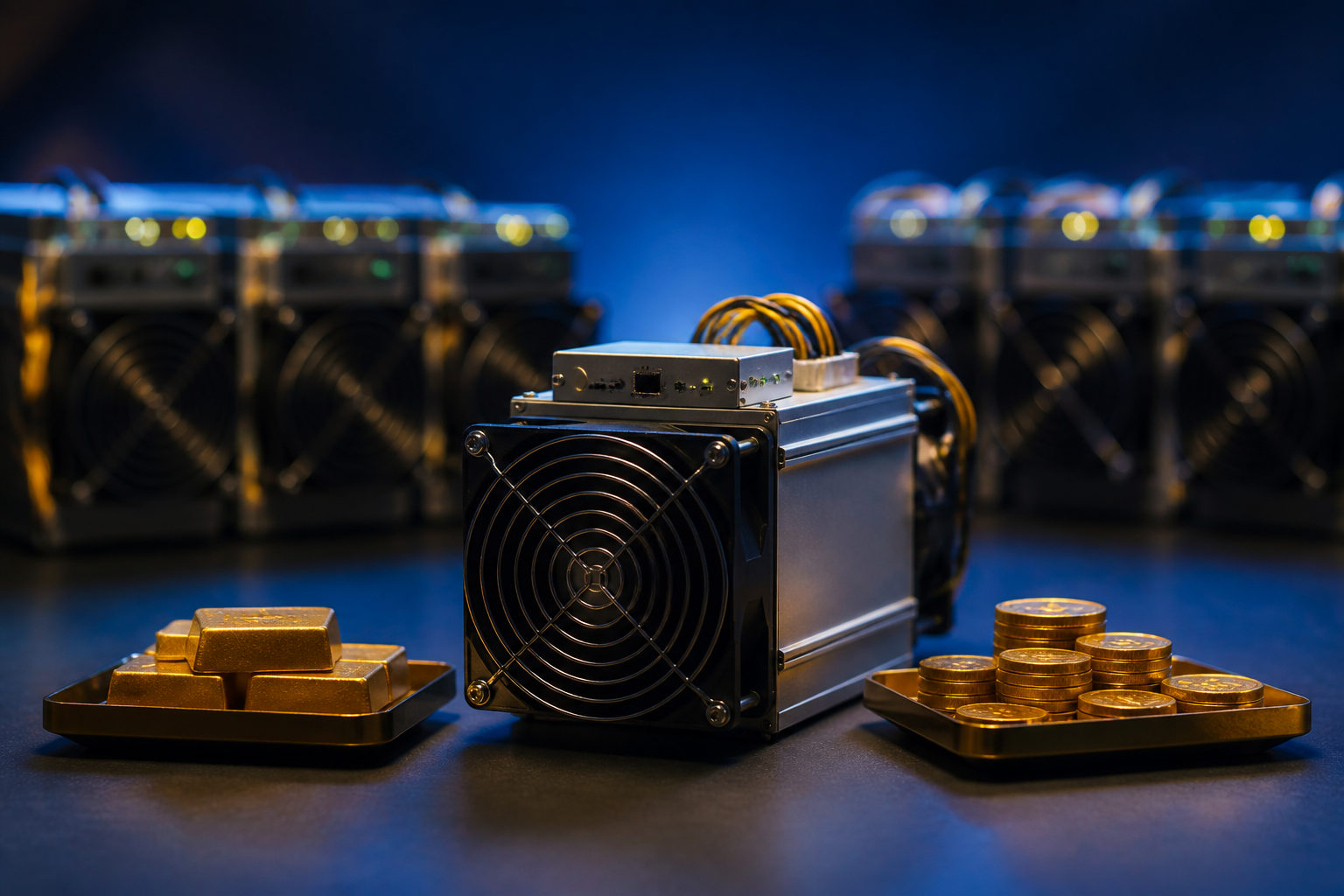
The short answer is simple: there is no single Bitcoin mining pool that is the most profitable for everyone. The best choice depends on how the pool pays miners, what it charges, how stable its servers are, how close its nodes are to you, and whether your own power and hardware costs leave any room for profit.
Think of mining as a bookkeeping race
Bitcoin mining makes more sense when you picture it as a nonstop bookkeeping race. Miners all over the world compete to add the next block to the chain. The network targets roughly one block every 10 minutes, and the miner or pooled group that finds a valid block gets the block reward.
After the halving on 2024-04-19, the current block reward is 3.125 BTC. At about 144 blocks per day across the network, daily issuance is about 450 BTC. That number belongs to the whole network, not to any one miner or pool, and that is the first reason the question of “most profitable” has no fixed answer.
A mining pool does not create extra Bitcoin out of thin air. It combines the hashpower of many miners so they can share results more regularly instead of waiting a long time for a solo win. What changes is the shape of your income, the fee structure, and the amount of friction between your machine and the final payout.
What actually changes pool profitability
Many new miners compare pools as if they were identical products with different logos. They are not. Two pools can serve the same network and still produce different outcomes for the same miner because a pool is partly a payout system and partly an operational service.
| Factor | Why it matters | What to check |
|---|---|---|
| Payout model | It affects whether income is smoother or more volatile | See whether the pool emphasizes stable payouts or block-based variance |
| Pool fee | It comes directly out of your expected return | Read the fee schedule and look for extra deductions |
| Latency | High delay can cause more stale or rejected shares | Use a node that is geographically or network-wise closer to you |
| Reject rate | Invalid or late shares reduce effective output | Check mining logs and dashboard statistics over time |
| Uptime | Disconnects and unstable infrastructure mean lost mining time | Watch for outages and how quickly the pool recovers |
| Transparency | Clear reporting helps you verify whether payouts make sense | Look for visible share data, fee rules, block records, and payout history |
| Custody exposure | Funds left on a pool account carry platform risk | Review payout thresholds and automatic withdrawal settings |
A lower listed fee does not always mean better real-world results. If a pool has weaker connectivity for your location, or if your shares arrive late more often, the operational loss may eat up the difference. On the other hand, a pool with a slightly less appealing headline fee can still perform better if it has better infrastructure and clearer accounting.
This is why miners who ask which pool pays the most should first ask a narrower question: which pool wastes the least of my available hashpower and matches the kind of payout variance I can live with?
Payout method matters as much as the fee
Pool profitability is often discussed as if all pools divide rewards in the same way. They do not. The payout model changes who carries variance and when it shows up in your account balance.
| Payout model | How it works in practice | Who may prefer it | Main tradeoff |
|---|---|---|---|
| PPS | You are paid for valid shares in a more predictable way | Miners who want steadier cash flow | Fee terms can be less forgiving |
| FPPS | Builds on fixed-share logic and includes part of fee-related revenue in the payout formula | Miners who want broader accounting coverage | Details differ by pool, so the label alone is not enough |
| PPLNS | Payout depends more on shares over a moving window and actual block luck | Miners who stay online continuously and can tolerate variance | Short sessions and frequent switching tend to work poorly |
| PROP | Rewards are divided by round contribution | Miners who understand variance and want a straightforward model | Short-term payouts can swing sharply |
If you are operating on a tight budget and need smoother receipts to cover electricity or hosting bills, a more stable payout style may fit better. If your setup is built for continuous operation and you are comfortable with greater variance, a model tied more closely to pool luck may be acceptable.
There is another catch: the same three or four letters can hide different details across platforms. A pool may use a familiar payout label while handling rejected shares, transaction fee distribution, or payout timing in its own way. Read the rules, not just the acronym.
The pool is only one part of the profit equation
A pool can improve distribution and reduce variance, but it cannot fix a weak business model. Profit comes from what remains after expenses, and most of the hardest expenses sit outside the pool dashboard.
| Profit component | Can the pool change it directly? | Why it matters |
|---|---|---|
| Reward distribution | Yes | The pool changes how and when your mining output is credited |
| Hardware efficiency | No | ASIC generation, wear, cooling, and tuning shape your output per unit of power |
| Electricity cost | No | This is often the biggest hard cost in mining |
| Local network quality | Partly | Pool node selection helps, but your own connection still matters |
| Downtime risk | Partly | Pool stability matters, yet power and site operations matter too |
| Balance exposure | Partly | Payout settings affect how long funds remain on the pool platform |
Bitcoin’s supply rules also matter for the bigger picture. The hard cap is 21,000,000 BTC, and issuance is expected to continue until about 2140. The reward halves every 210,000 blocks, roughly every four years. The halving dates so far are 2012-11-28, 2016-07-09, 2020-05-11, and 2024-04-19, with the next one expected around 2028. Those facts do not tell you which pool to join today, but they explain why miners face a stricter reward environment over time.
That long-term pressure is one reason there is no universal winner. A pool can improve execution, but it cannot erase poor power economics or inefficient hardware. If your machine burns too much electricity for the hashpower it produces, even a well-run pool may not save the operation.
One more practical point: pool balances are not the same as self-custody. A pool usually pays to the Bitcoin address you set. The smallest Bitcoin unit is 1 satoshi, equal to 0.00000001 BTC. You should still review account security, payout thresholds, and whether funds sit on the platform longer than you want.
How to join a pool and compare it the right way
Joining a pool is technically straightforward, but a clean setup matters. New miners often focus on the signup step and skip the settings that decide whether the operation runs efficiently day after day.
- Confirm your hardware: Bitcoin mining uses SHA-256 proof of work, and in real mining conditions that usually means dedicated ASIC hardware. A normal home computer can connect to software, but it is not competitive in practical terms.
- Prepare a wallet address: Have your own Bitcoin receiving address ready before you configure pool payouts. Keeping too much balance on the pool side is a separate risk.
- Pick the best node: Test the pool server that gives you the lowest stable latency from your location. Better connectivity often means fewer stale shares.
- Name your workers clearly: Worker naming helps you identify which machine is underperforming or dropping offline.
- Watch the right metrics: Effective hashrate, reject rate, disconnect frequency, and payout records tell you more than a flashy real-time dashboard number.
- Set automatic payouts: Choose a payout threshold and schedule that limit how long funds remain with the pool.
If you are comparing two or three pools, the fairest test is to use the same miner, a similar time window, and as few environmental changes as possible. Do not judge too quickly from a short burst of good luck. Instead, compare operational quality: reject rate, connection stability, clarity of records, and whether you can verify how payments were calculated.
That approach gives you a practical answer to the original question. The most profitable pool is often the one that matches your setup with the least friction, not the one that markets itself most aggressively.
FAQ
Does a larger Bitcoin mining pool always pay better?
Not always. A larger pool may find blocks more frequently and smooth out payouts, but your own result still depends on fees, payout rules, latency, and reject rate. Bigger can mean steadier, not automatically higher.
Can I pick a pool by looking only at the fee?
That is risky. The listed fee is visible, while stale shares, outages, hidden conditions, and weak reporting can reduce what you actually receive. A lower fee on paper can lose to better infrastructure in practice.
Can I still mine Bitcoin with a home PC?
You can run software and connect to a pool, but that is very different from operating competitively. In normal market conditions, dedicated ASIC miners dominate Bitcoin mining because general-purpose computers are far less efficient.
Will the pool control my Bitcoin wallet?
A normal pool does not control your wallet if you provide your own receiving address. The real concern is leaving too much unpaid balance on the platform or using weak account security.
Why did I switch pools and see little change in actual profit?
Because the pool is only one variable. If electricity is expensive, hardware is outdated, or your connection is unstable, changing the pool may improve consistency without producing a dramatic jump in net return.
Use this final checklist before choosing a pool
| Checkpoint | Good sign | Warning sign |
|---|---|---|
| Payout rules | You can understand and verify them | The label is familiar but the details are vague |
| Fee structure | Deductions are clear | Extra conditions appear after signup |
| Node quality | Low stable latency and low rejects | Frequent swings or weak peak-hour performance |
| Reporting | Share data, payouts, and worker history are visible | Records are too thin to audit |
| Payout settings | Thresholds fit your risk tolerance | Balances tend to remain on the platform too long |
| Operations | Disconnects are easy to detect and recover from | Troubleshooting is slow or unclear |
If you want one rule to keep, use this one: do not search for a permanent “highest profit” pool as if it were a fixed name. First remove pools with weak transparency, unstable nodes, or payout rules you cannot explain back to yourself. Then compare the remaining choices against your own power cost, hardware efficiency, and tolerance for payout variance.
Disclaimer: This article is for informational and educational purposes only and is not investment, financial, or legal advice. Crypto assets are highly volatile and you could lose your entire investment. Do your own research and decide carefully.