
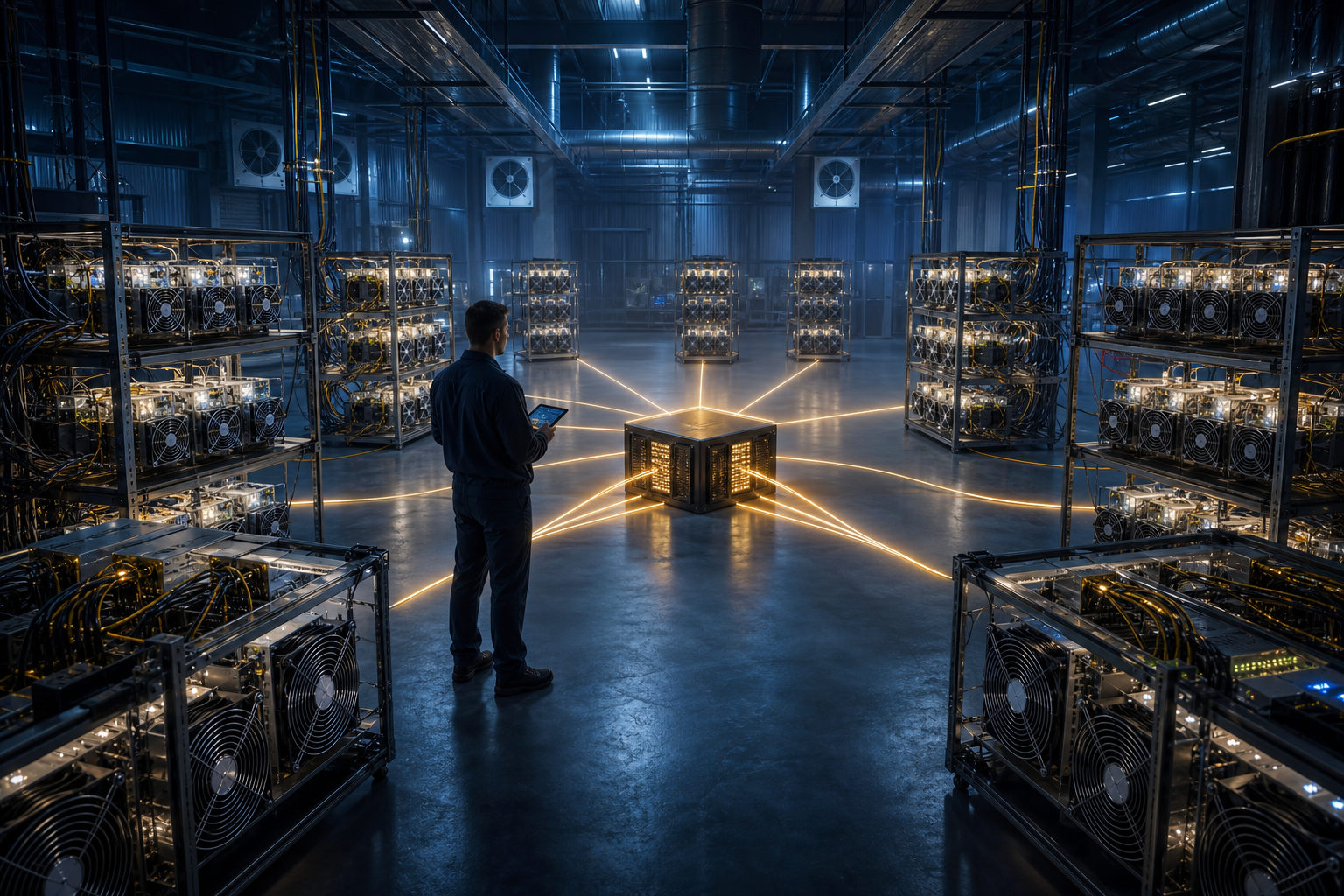
A bitcoin mining pool is a group setup where miners combine hash power, work on the same block race together, and split block rewards and fees based on the pool’s payout rules.
Why bitcoin mining pools exist
Bitcoin mining is a competition to add the next block to the chain. If a miner works alone, the outcome can be extremely uneven: long stretches with nothing, then a reward only if that miner finds a valid block before everyone else.
Mining pools were created to reduce that variance. Instead of competing as isolated operators, miners connect their machines to one pool, share the work, and receive smaller but more regular payouts when the pool finds blocks. The Bitcoin network produces a new block about every 10 minutes, so many miners prefer a setup that smooths the waiting time.
How a bitcoin mining pool works
At the core, Bitcoin uses proof of work. Mining machines keep trying different hashes until one of them finds a result that meets the network target. In a pool, thousands of machines may be attempting this at the same time under one coordinated system.
When any miner inside the pool finds a valid block, the pool can submit that block to the network on behalf of the group. The reward does not automatically belong only to the machine that found it. The pool first checks how much work each participant contributed, then distributes the proceeds according to its own rules.
To track contribution fairly, pools usually assign easier proof tasks to miners during the process. These records act like scorekeeping. They are not full Bitcoin blocks, but they help the pool measure who has been contributing usable work before a real block is found.
A simple analogy is a relay team. One runner breaks the tape, but the whole team gets credit for reaching the finish. The pool then decides how the result is divided inside the team.
How people join a bitcoin mining pool
For most people, joining a bitcoin mining pool is technically easier than becoming profitable at mining. The signup steps are usually straightforward. The hard part is running equipment in a way that makes operational sense over time.
Typical steps
- Get specialized mining hardware built for Bitcoin mining.
- Choose a pool and read its fee structure, payout method, and minimum payout rules.
- Create an account or worker profile, depending on how the pool is set up.
- Enter the pool connection details into the miner’s control panel.
- Add a wallet address for payouts and monitor the machine after it starts running.
That process sounds simple on paper, but it leaves out the practical side. Bitcoin mining today is specialized and competitive. Hardware cost, electricity, heat, noise, uptime, repairs, and network stability all matter before a miner ever receives a payout from the pool.
What to compare before choosing a pool
- Payout method: different methods change how smooth or variable payouts feel.
- Pool fees: fees directly affect what miners keep.
- Stability: disconnects and latency can reduce effective performance.
- Transparency: a good dashboard should show worker activity, shares, and payment records clearly.
- Minimum payout threshold: this affects how often funds are sent out.
A bitcoin mining pool does not remove the business reality
A common misunderstanding is that pooling makes mining easy money. It does not. A pool mainly changes the timing of rewards by spreading variance across a group. It does not erase expenses or protect miners from weak hardware, downtime, poor operations, or changes in market conditions.
That is the key point. A pool can make income less lumpy than solo mining, but it cannot guarantee profit.
There is also a network-level issue to keep in mind. If too much hash power gathers in only a few pools, people may worry about concentration. That does not mean every large pool is a problem by itself, but pool choice is about more than a clean interface or a popular name.
Mining in a pool vs mining solo
| Factor | Pool mining | Solo mining |
|---|---|---|
| Reward timing | Usually smoother | Usually more uneven |
| Reward structure | Shared by pool rules | Full block reward only if you find a block |
| Best fit | Many small or mid-sized miners | Operators with stronger independent capacity |
| Main focus | Reliable pool choice and uptime | Full self-managed operation |
| Risk feel | Lower variance, shared fees | Higher variance, no pool cut |
For many miners, pool mining is the practical route. Solo mining still exists, but it asks for more tolerance for uncertainty and stronger independent setup.
FAQ
What are bitcoin mining pools in simple terms?
They are coordinated groups where miners combine computing power and try to find blocks together. When the pool succeeds, rewards are split according to the pool’s accounting method.
Do I need mining hardware to join a bitcoin mining pool?
In most cases, yes. A mining pool organizes work and payouts, but it does not create hash power for you. Without hardware or hosted mining resources, there is nothing to contribute.
Is a bitcoin mining pool the same as a wallet?
No. A pool manages mining coordination and payout distribution, while a wallet stores and receives bitcoin. People often use both, but they serve different jobs.
Can beginners start with a bitcoin mining pool?
Beginners can study how pools work, but that is different from being ready to mine. It is better to review hardware needs, heat, noise, electricity, and maintenance before spending money.
How do I judge whether a bitcoin mining pool is worth using?
Look for clear payout rules, visible worker statistics, stable service, and solid account security. If the pool is vague about fees or payments, caution makes sense.
If your goal is understanding what a bitcoin mining pool is, focus first on its real function: it spreads mining variance across a group. If your goal is taking part, check hardware, electricity, cooling, and pool rules before doing anything else.
Disclaimer: This article is for informational and educational purposes only and is not investment, financial, or legal advice. Crypto assets are highly volatile and you could lose your entire investment. Do your own research and decide carefully.