
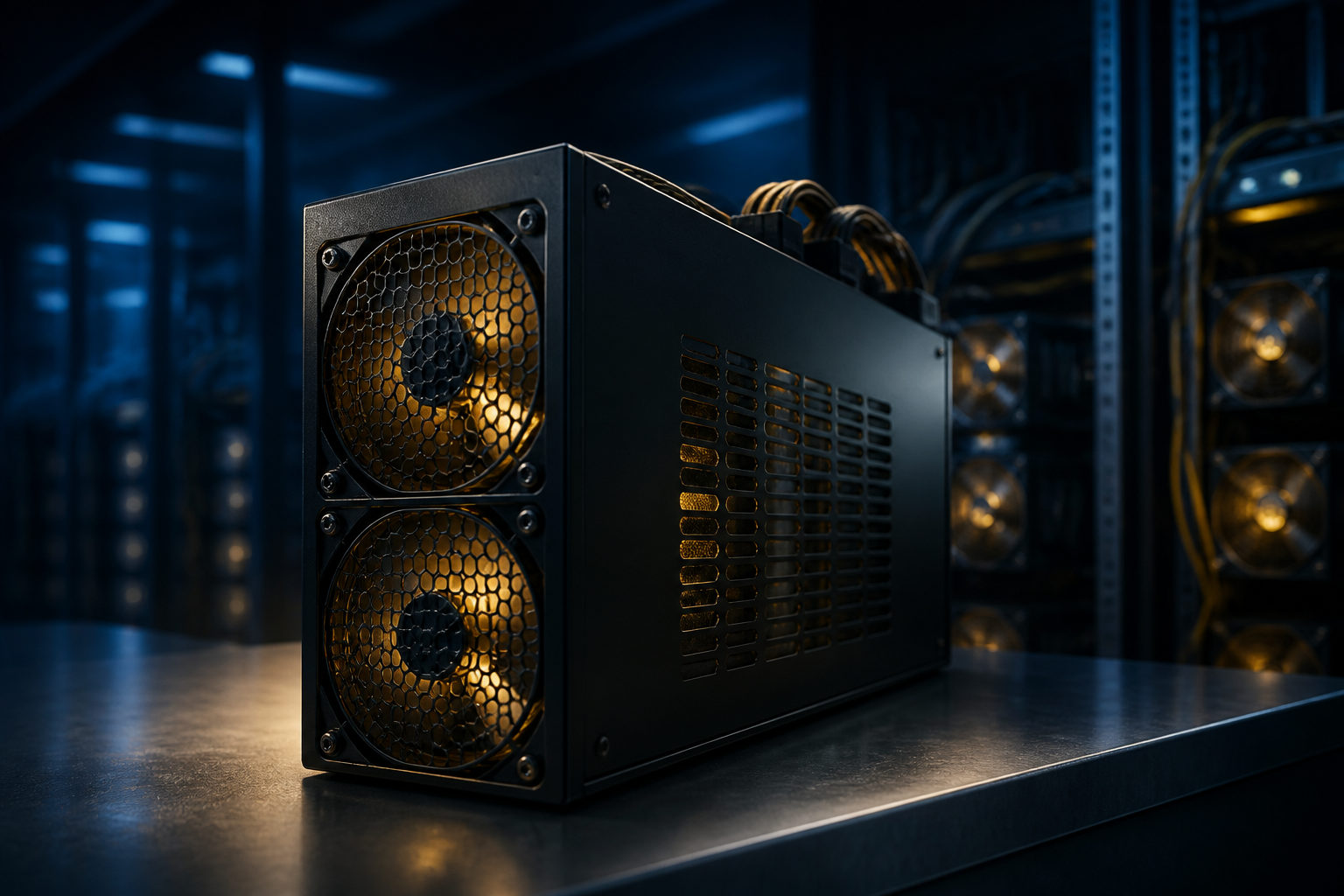
A bitcoin miner is a person or company that uses computing power to compete for the right to add the next block to the Bitcoin blockchain. A bitcoin miner machine is the specialized hardware used for that job.
What a bitcoin miner actually does
Think of Bitcoin as a public ledger that anyone can read, while no one gets to write the next page by personal choice. Miners collect pending transactions, check that they follow the protocol, build a candidate block, and race to produce a valid proof of work.
That race is the heart of mining. Machines keep hashing block data again and again, changing the parts that can be adjusted, until one miner finds a result that meets the network's current difficulty rule. Then the block can be broadcast to the network for verification.
If other nodes accept it, that miner earns the block reward plus transaction fees tied to that block. So when people ask what bitcoin miners do, the plain answer is this: they secure the network and compete to record new transactions.
Miner, mining machine, and mining pool: different things
People often blur these terms together. They should not.
| Term | What it refers to | Main role |
|---|---|---|
| Bitcoin miner | A person, group, or company participating in mining | Provides hash power and competes for block production |
| Bitcoin miner machine | Specialized hardware built for mining | Performs repeated hash calculations |
| Mining pool | A coordination arrangement that combines many miners' hash power | Smooths reward distribution |
A miner can own machines directly, rent space for them, or join a pool. The machine is a tool. The miner is the operator or owner. The pool is a coordination layer that helps participants share results under set rules.
Why do pools exist? Variance. A solo miner may wait a long time without finding a block, even when the setup is working exactly as intended. Pooling hash power changes the payout pattern, though it also introduces pool fees and reliance on the pool's operation.
What a bitcoin miner machine is and how it works
A bitcoin miner machine is usually a purpose-built device designed for one narrow task: running Bitcoin's proof-of-work calculations as efficiently as possible. This is not the same as using an ordinary laptop for a casual background process. Modern mining is much more specialized.
The machine takes block header data and hashes it over and over, trying new values each round. Most attempts fail. All of them are expected to fail until one works.
Bitcoin is set up so that a new block is found about every 10 minutes. To keep that rhythm from drifting too far, the network adjusts mining difficulty as total hash power rises or falls. More competition pushes the target tighter; less competition can ease it. So a miner is never solving a fixed puzzle once and for all. The threshold keeps moving.
That is why hardware efficiency matters so much. Electricity use, heat, airflow, uptime, and maintenance are not side issues around mining. They are the work.
Why Bitcoin needs miners
Mining is not only about issuing new coins. Miners help Bitcoin function without a central bookkeeper.
They package transactions into blocks and put real-world cost behind the process of block creation. That cost makes it harder for anyone to rewrite the ledger at will. Other participants can verify the work, reject invalid blocks, and continue building on accepted history.
New bitcoin enters circulation through this system under fixed rules. Bitcoin's total supply is capped at 21 million coins. The block subsidy halves about every 4 years, or every 210,000 blocks. Halving years so far are 2012, 2016, 2020, and 2024.
Bitcoin itself began with the genesis block in January 2009, after the 2008 white paper titled Bitcoin: A Peer-to-Peer Electronic Cash System. Mining has been part of the design from the start, not a later add-on.
Can ordinary people still participate in Bitcoin mining?
Yes. Whether it makes sense is a different question.
Many beginners picture mining as installing software and letting a machine run. The harder part is operational reality: power cost, hardware sourcing, cooling, noise, repair work, and local rules around facilities and electricity use. Miss one of those, and the plan can break quickly.
- Power cost: mining runs continuously, so electricity pricing shapes the outcome.
- Hardware wear: mining machines age, and newer equipment can be more efficient.
- Heat and noise: these machines are built for output, not comfort in a spare bedroom.
- Maintenance: firmware, networking, dust, and failed components all need attention.
- Setup model: solo mining, pool mining, and hosted arrangements come with different trade-offs.
For many people, buying and holding bitcoin is simpler than operating mining hardware. Mining is closer to an industrial activity than a casual side app. Small test setups can teach the basics, but they do not remove the cost structure that defines the business.
FAQ
What is a bitcoin miner in simple terms?
A bitcoin miner is the participant trying to add the next block to Bitcoin by supplying computing power. That participant might be an individual, a group, or a company.
What does a bitcoin miner do all day?
Miners validate pending transactions, assemble candidate blocks, and run proof-of-work calculations through mining hardware. If a valid block is found and accepted, they receive the related block reward and transaction fees.
What are bitcoin miners: people or machines?
The term can point to the participants, while everyday conversation sometimes uses it for the hardware too. Strictly speaking, the miner is the actor and the mining machine is the device.
Can a normal computer mine Bitcoin now?
It can run mining software, but that is very different from being competitive. Today's Bitcoin mining is dominated by specialized machines built for this exact workload.
What is a bitcoin miner machine?
It is a dedicated hardware device made to perform Bitcoin hashing as efficiently as possible. Its job is narrow, repetitive, loud, and power-hungry.
If you are deciding whether to get involved, start with a checklist for electricity, ventilation, machine sourcing, and time for upkeep. Those practical limits tell you far more than a glossy sales pitch ever will.
Disclaimer: This article is for informational and educational purposes only and is not investment, financial, or legal advice. Crypto assets are highly volatile and you could lose your entire investment. Do your own research and decide carefully.