
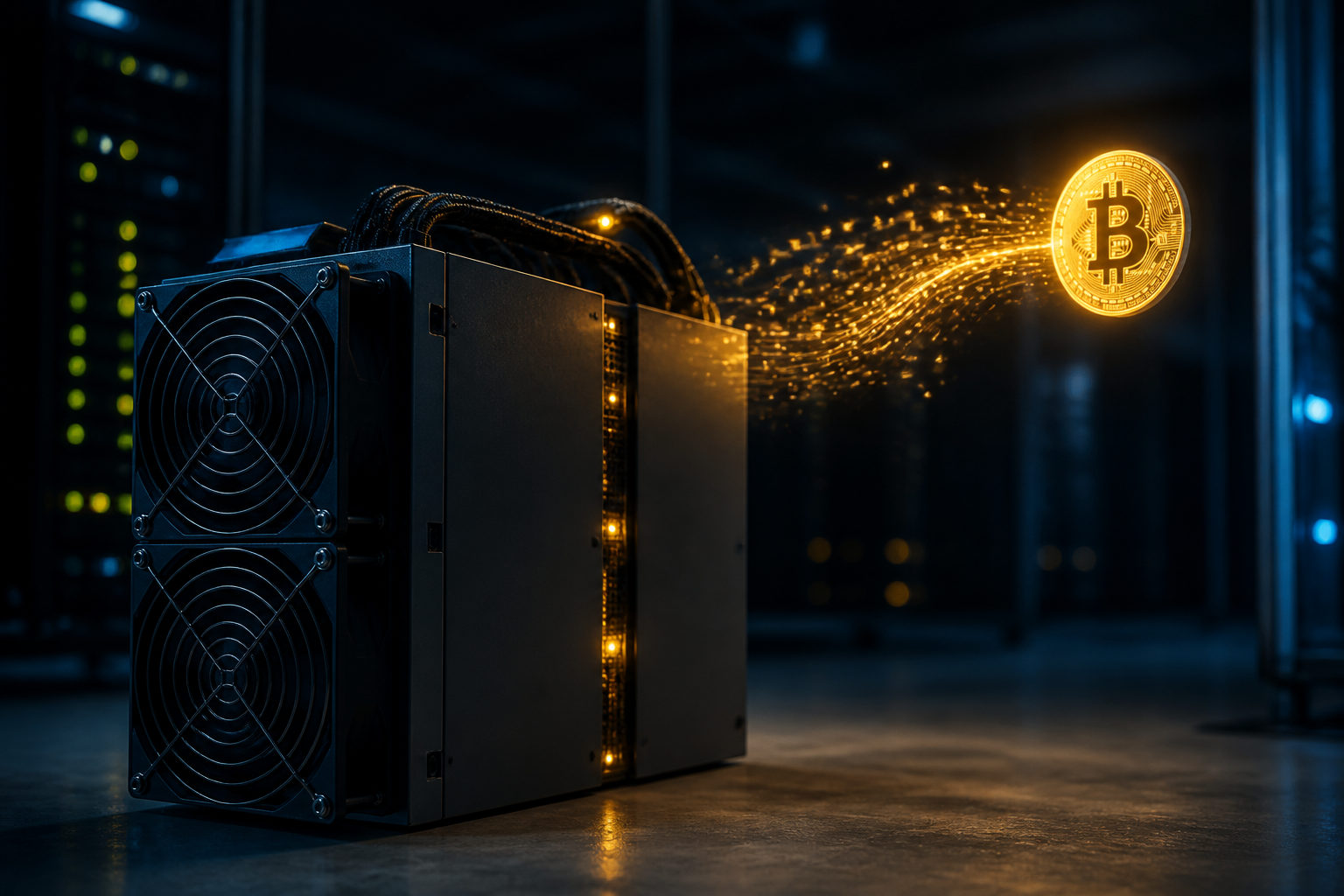
Miners earn bitcoin by competing to add new blocks to the blockchain. When a miner produces a valid block that the network accepts, that miner receives newly issued bitcoin tied to the block and the transaction fees included in it.
It starts with a public bookkeeping race
A simple way to picture bitcoin mining is to imagine a global ledger that anyone can inspect but no one can rewrite at will. Miners help update that ledger by gathering pending transactions into a candidate block and running repeated hash calculations to find a result that fits the network rules.
This is a competition, not a salary system. Many miners are trying to solve the same kind of problem at the same time, and only the miner that gets a valid block accepted first earns the block-level payout. Everyone else who spent electricity on that round usually gets nothing from that specific block.
That payout has two parts. One part is the block reward, which is the protocol’s way of issuing new bitcoin into circulation. The other part is transaction fees, paid by users who want their transfers included in a block.
| Source of miner income | Where it comes from | What it means in practice |
|---|---|---|
| Block reward | New bitcoin created under protocol rules | The most direct source of newly earned bitcoin for miners; it declines over time |
| Transaction fees | Fees attached to user transactions | Varies with demand for block space and can shift a lot |
What miners actually do
Mining is not just leaving a machine on. A miner or mining operation collects unconfirmed transactions, checks whether they follow the rules, builds a block candidate, and keeps hashing until it finds a valid result. After that, the block has to be broadcast and verified by other nodes before the reward is recognized by the network.
Miners do not get to edit balances or invent transfers. Their role is to package valid transactions and prove, through computation, that they met the conditions needed to propose a new block. The network’s consensus rules limit what a miner can include and what other nodes will accept.
Bitcoin produces a new block about every 10 minutes. To keep that pace from drifting too far as more or fewer machines join the network, mining difficulty adjusts over time. As total network hashpower rises, it usually becomes harder for a single machine acting alone to find a block.
The block reward also changes on a fixed schedule. Bitcoin has a supply cap of 21 million coins, and the block subsidy halves about every 4 years, or every 210,000 blocks. The halving years so far are 2012, 2016, 2020, and 2024. That is why miners pay close attention to machine efficiency, operating discipline, and fee income.
How people take part: solo mining vs mining pools
If someone wants to earn bitcoin through mining, the first practical choice is how to participate. The two main routes are solo mining and joining a mining pool, and they feel very different in day-to-day operation.
| Approach | Best fit | Income pattern | Main trade-off |
|---|---|---|---|
| Solo mining | Operators with meaningful hashpower and technical control | Long stretches with no payout are possible, followed by a full block-related reward if a block is found | Income can be very uneven and infrastructure demands are high |
| Mining pool | Participants who want smoother payouts | Many miners combine hashpower, and rewards are shared by pool rules | You depend on pool policies, fees, and payout systems |
Solo mining is straightforward in theory. You run your own hardware and keep the full reward if your operation finds a valid block first. The problem is the scale of competition. For a small participant, the wait for a successful block can be extremely long.
Mining pools change that experience by grouping many miners together. When the pool finds a block, it distributes earnings among members based on their contributed work and the pool’s accounting method. That often makes income less lumpy, though it also means sharing revenue and trusting the pool operator’s systems.
Some services add hosting or managed operations on top, but those services do not remove the basic economics. Mining still depends on hardware, electricity, uptime, and payout rules. Any pitch that treats it like effortless passive income deserves careful scrutiny.
Why earning bitcoin from mining is not the same as making a profit
Many beginners understand that miners receive bitcoin, yet miss the harder question: what does it cost to get it? Mining is a cost-heavy activity. Hardware is only the start. There is also electricity, cooling, noise control, physical space, repairs, networking, and the risk of downtime.
Two miners can produce the same asset and still end up in very different positions. A better machine, cheaper power, cleaner airflow, and stronger maintenance habits can change the result in a major way. A weaker setup may still generate bitcoin while failing to cover the full operating bill.
| Cost factor | Why it matters | Common mistake |
|---|---|---|
| Hardware efficiency | Determines how much useful hashpower you get from ongoing energy use | Focusing on purchase price alone |
| Electricity | Mining equipment runs for long periods and power cost shapes viability | Using light-use assumptions for a full-load activity |
| Cooling and environment | Heat, dust, and poor airflow can reduce stability | Treating a home setup like a professional facility |
| Maintenance | Downtime directly cuts effective mining time | Assuming the machines can run unattended for long periods |
| Pool rules | Payout method affects when and how income arrives | Reading promo claims without checking details |
There is also a timing issue. Mining revenue arrives in bitcoin, while many expenses need to be paid on schedule in ordinary business terms. That gap can create pressure even when the mining operation is still producing coins. For many newcomers, the real difficulty is not understanding the concept of mining; it is managing the operating reality around it.
What to check before trying it yourself
If your goal is only to answer the question of how miners earn bitcoin, the short answer is block rewards plus transaction fees. If you want to participate, a few practical checks matter more than excitement.
- Hardware type: Modern bitcoin mining is generally done with specialized machines, not standard consumer computers.
- Wallet setup: You need a wallet address to receive payouts, and you should know whether you are using self-custody or a third-party service.
- Pool terms: Fee schedules, payout thresholds, and reward methods can change the user experience a lot.
- Operating environment: Heat, sound, and power stability are not side issues; they shape whether your setup can keep running.
- Exit plan: Mining machines are specialized hardware, so resale conditions and depreciation deserve attention before purchase.
Mining is only one way to interact with bitcoin. Some people are better served by learning wallets, transactions, and custody first. Others come from hardware, data center, or energy backgrounds and may find mining easier to evaluate.
FAQ
Do miners earn bitcoin just by keeping machines turned on
No. A machine that is powered on is only participating in the competition. In solo mining, long periods without a block are possible, while pool mining usually smooths payouts without removing cost risk.
Running hardware and earning usable income are related, but they are not the same thing.
Which matters more for miners: block rewards or transaction fees
Both matter, though they play different roles. Block rewards are the protocol-driven issuance, while transaction fees depend on how much users compete for block space.
As halvings continue, fee income tends to attract more attention in the mining business model.
Can a regular computer still mine bitcoin
It can participate at a technical level, but that does not mean it is competitive. The issue is less about whether software can run and more about whether the hardware can produce meaningful results against specialized miners.
If you want to learn the process, experimentation can help. If you want to earn bitcoin consistently, hardware quality matters a lot.
How do mining pools decide my payout
Each pool uses its own accounting rules to measure contributed work and distribute rewards. That means payout timing, fee treatment, and variance can differ from one pool to another.
Before joining, read the pool’s reward method and minimum payout conditions rather than relying on marketing claims.
Why do miners keep going after a halving
Because miners do not look at one variable in isolation. They weigh machine efficiency, electricity conditions, maintenance quality, cash-flow pressure, and expectations for future fee income.
Some operators upgrade and stay active. Others leave when their setup no longer works economically.
If you plan to try mining, review your hardware choice, power arrangement, cooling setup, wallet destination, and pool terms before spending money. For most beginners, the biggest mistake is underestimating operations rather than misunderstanding the basic idea.
Disclaimer: This article is for informational and educational purposes only and is not investment, financial, or legal advice. Crypto assets are highly volatile and you could lose your entire investment. Do your own research and decide carefully.