
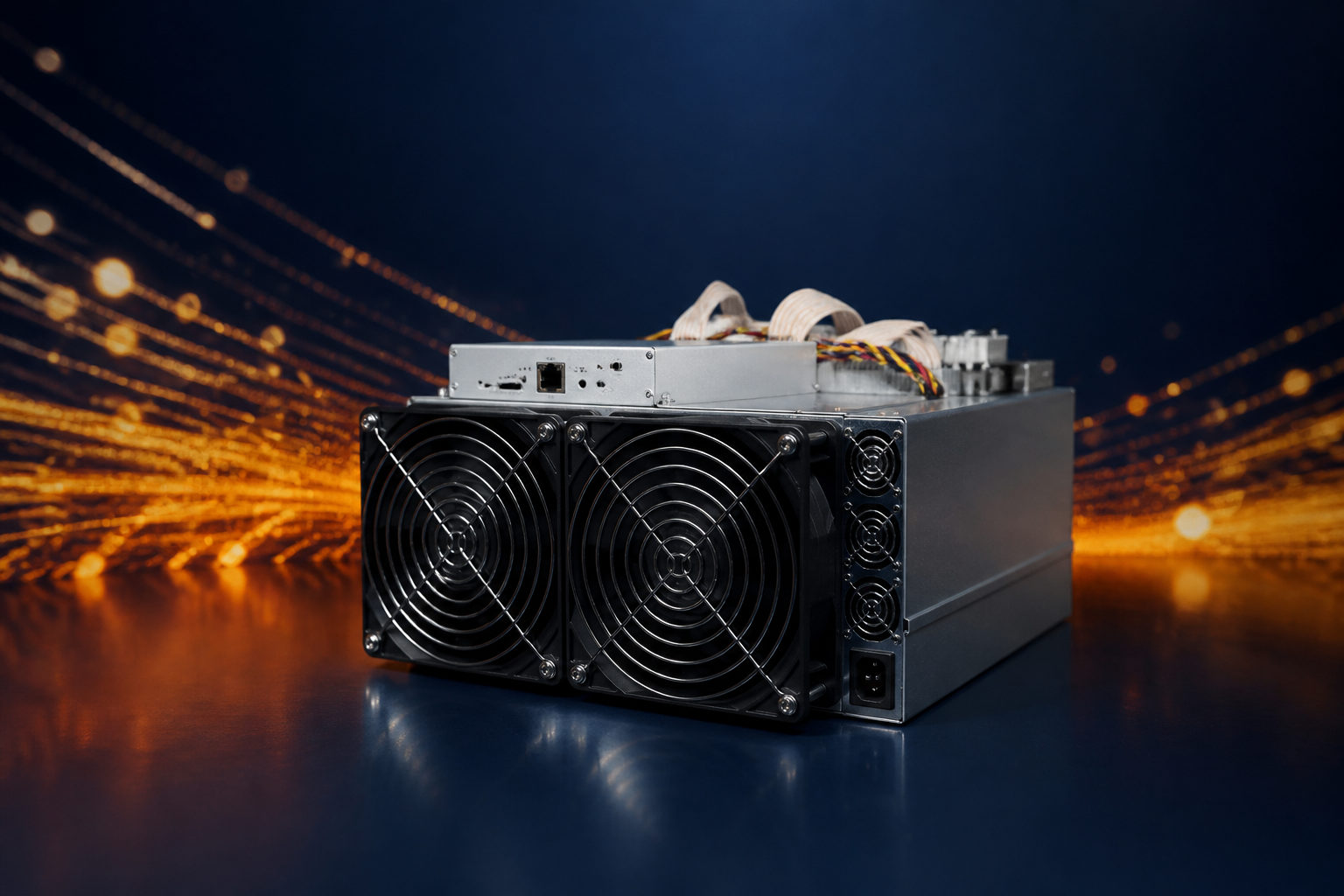
A Bitcoin miner ASIC is a machine built for one job: performing the hashing work used in Bitcoin mining. Its purpose is to compete for the right to add a new block to the blockchain by running the proof-of-work process as efficiently and continuously as possible.
Think of mining as a nonstop bookkeeping race
Bitcoin runs on a public ledger. Everyone can inspect it, but adding a new page to that ledger requires meeting a strict computational condition first. Miners around the world race to produce a valid block candidate, and the first acceptable result gets broadcast to the network for verification.
That is where ASIC hardware enters the picture. An ordinary computer can perform calculations, and a graphics card can do large amounts of parallel work, but Bitcoin mining became so specialized that general-purpose hardware lost practical relevance. ASIC machines were designed to focus almost all of their resources on the exact hashing task Bitcoin uses.
Bitcoin produces a new block about every 10 minutes. During that interval, mining machines keep trying different inputs at very high speed. They are not reading transactions in a human sense or solving a puzzle through reasoning; they are repeating a defined hashing procedure until one result meets the network target.
What ASIC means in Bitcoin mining
ASIC stands for application-specific integrated circuit. The phrase matters because it describes the whole design philosophy: the chip is created for a narrow task instead of broad computing use. In Bitcoin, that task is running SHA-256-related mining operations again and again under heavy load.
When people say “ASIC miner,” they usually mean the full machine, not just the chip. A usable mining unit includes hashing boards, a control board, power delivery, cooling, and firmware that manages the device. All of those parts are arranged around one goal: keeping the hardware running at high intensity for long periods without constant manual intervention.
This specialization gives the machine its strength and its limitation at the same time. A Bitcoin ASIC is useful for mining and little else. It is not a flexible workstation, and it is not a home PC with an extra feature added on top.
How a Bitcoin ASIC miner actually works
Once connected, the miner receives block work from a node or, more commonly for individuals, from a mining pool. It then modifies allowed fields in the block header and hashes those versions over and over. Each hash is another attempt. If one of those attempts produces a result that satisfies the current network difficulty requirement, the miner can submit it as a valid solution.
Other nodes still have to verify the block. Mining hardware does not get to rewrite Bitcoin’s rules or decide unilaterally what counts as valid. Its role is to generate proof of computational work inside the rules the network already enforces.
This is also why mining is tied to security. Proof of work links block production to a cost in hardware, electricity, time, and operations. A valid block shows that real-world resources were consumed in a way that other participants can check.
Main parts of an ASIC miner
- Hashing chips: the core components that perform mining calculations.
- Control board: handles coordination, settings, and basic system management.
- Power supply: keeps the machine fed with stable power during continuous load.
- Cooling system: usually fan-based, and often loud in real-world use.
- Network connection: required for receiving work and submitting results.
Beginners often focus on the machine’s advertised performance and ignore the support conditions around it. In practice, stable power, airflow, dust control, and reliable connectivity often decide whether the miner performs well day after day.
How people take part in Bitcoin mining today
There are two broad paths: solo mining and pool mining. Solo mining means your machine works on its own and you accept the full variance of waiting for a valid block. Pool mining combines the work of many miners, then distributes results according to the pool’s method.
For most individuals, pool mining is the more realistic route. Bitcoin mining is highly competitive, and a single machine operating alone faces long and uneven waiting periods. A pool does not change the underlying proof-of-work rules, but it changes how participation is organized and how outcomes are shared among contributors.
Joining a pool does not remove the operational burden. You still need to set up the machine, monitor uptime, keep firmware in working order, and handle interruptions when the hardware or local environment causes problems. If you use hosting, another layer appears: machine ownership, service boundaries, maintenance responsibility, and withdrawal terms all need close reading.
People also confuse mining with simply buying bitcoin. These are very different actions. Mining is closer to running a piece of industrial hardware under constant constraints. Buying bitcoin is direct asset exposure. Anyone comparing the two should be clear about which kind of commitment they actually want.
The real hurdle is ongoing cost, not getting the machine to turn on
A Bitcoin ASIC miner is not a household appliance that you set up once and forget. It consumes electricity continuously, creates heat, pulls in dust, and depends on an environment that supports nonstop operation. Small failures matter because downtime means the machine stops contributing work.
Electricity is the first reality check. Even without listing rates, the local power situation can decide whether a mining setup is practical at all. Cooling comes next. Poor airflow, high ambient temperature, or dirty conditions can reduce stability and increase wear. Then there is noise, replacement parts, repair logistics, and the time needed to notice and fix problems before a machine sits idle for too long.
ASIC hardware also has a narrow life cycle. Because it is specialized, its usefulness is tied closely to mining conditions. If the environment becomes less favorable for older equipment, repurposing options are limited. A buyer should understand that this is purpose-built infrastructure, not general hardware that can easily shift to another role later.
Seeing an ASIC miner as an effortless source of passive income usually leads to bad decisions. A better frame is to view it as an operations-heavy tool that asks for planning, maintenance discipline, and tolerance for uncertainty.
ASIC miners compared with PCs and GPU rigs
| Hardware type | Fit for Bitcoin mining | Flexibility | Typical trade-off |
|---|---|---|---|
| ASIC miner | High | Low | Strong task focus, limited alternative use |
| GPU rig | Weak for Bitcoin today | Higher | Broader utility, little practical edge in Bitcoin mining |
| Standard PC | Very weak | High | Good for general computing, poor fit for mining competition |
The comparison comes down to specialization versus versatility. ASIC machines concentrate their design on one target, while general hardware preserves wider use cases and gives up competitiveness in Bitcoin mining.
Who should learn about ASIC miners first
If you enjoy hardware deployment, thermal management, network reliability, and the maintenance side of infrastructure, ASIC mining can be a useful area to study. It gives a direct view into how Bitcoin’s proof-of-work system relies on physical cost and machine uptime.
If your goal is simply to understand Bitcoin, hold some, or learn self-custody, mining hardware does not need to be your entry point. Wallet basics, private keys, transaction confirmation, and node concepts usually provide more immediate value for newcomers. ASIC knowledge becomes easier to place once those foundations are already clear.
FAQ
What does a Bitcoin ASIC miner actually do?
It performs the hashing work required for Bitcoin mining and competes to produce valid block results. If it is connected to a pool, its work contributes to the pool’s total output rather than standing alone.
Can I mine Bitcoin with a normal computer?
In principle, a normal computer can run the same kind of hashing process. In real mining conditions, general hardware lacks the efficiency, thermal design, and sustained performance needed to compete with dedicated ASIC machines.
Can I run a Bitcoin miner ASIC at home?
Technically, yes, if your location can handle the power draw, heat, noise, and network stability the machine needs. Many first-time buyers run into trouble because the living environment is a poor match for nonstop industrial-style hardware.
Is pool mining still my own mining?
Yes. Your machine is still contributing work. The difference is that you are sharing the variance of block discovery with many other miners and receiving allocation under the pool’s rules.
Do I need to understand ASIC miners before learning Bitcoin?
No. ASIC miners belong to the infrastructure side of Bitcoin. Many people are better served by learning wallets, keys, and transaction basics first, then returning to mining once the core system makes more sense.
If you want to evaluate an ASIC miner seriously, write down the conditions you can actually control: space, power, airflow, noise tolerance, network reliability, and the time you can spend on maintenance. That list will usually tell you faster than marketing material whether mining is a workable project for you.
Disclaimer: This article is for informational and educational purposes only and is not investment, financial, or legal advice. Crypto assets are highly volatile and you could lose your entire investment. Do your own research and decide carefully.