
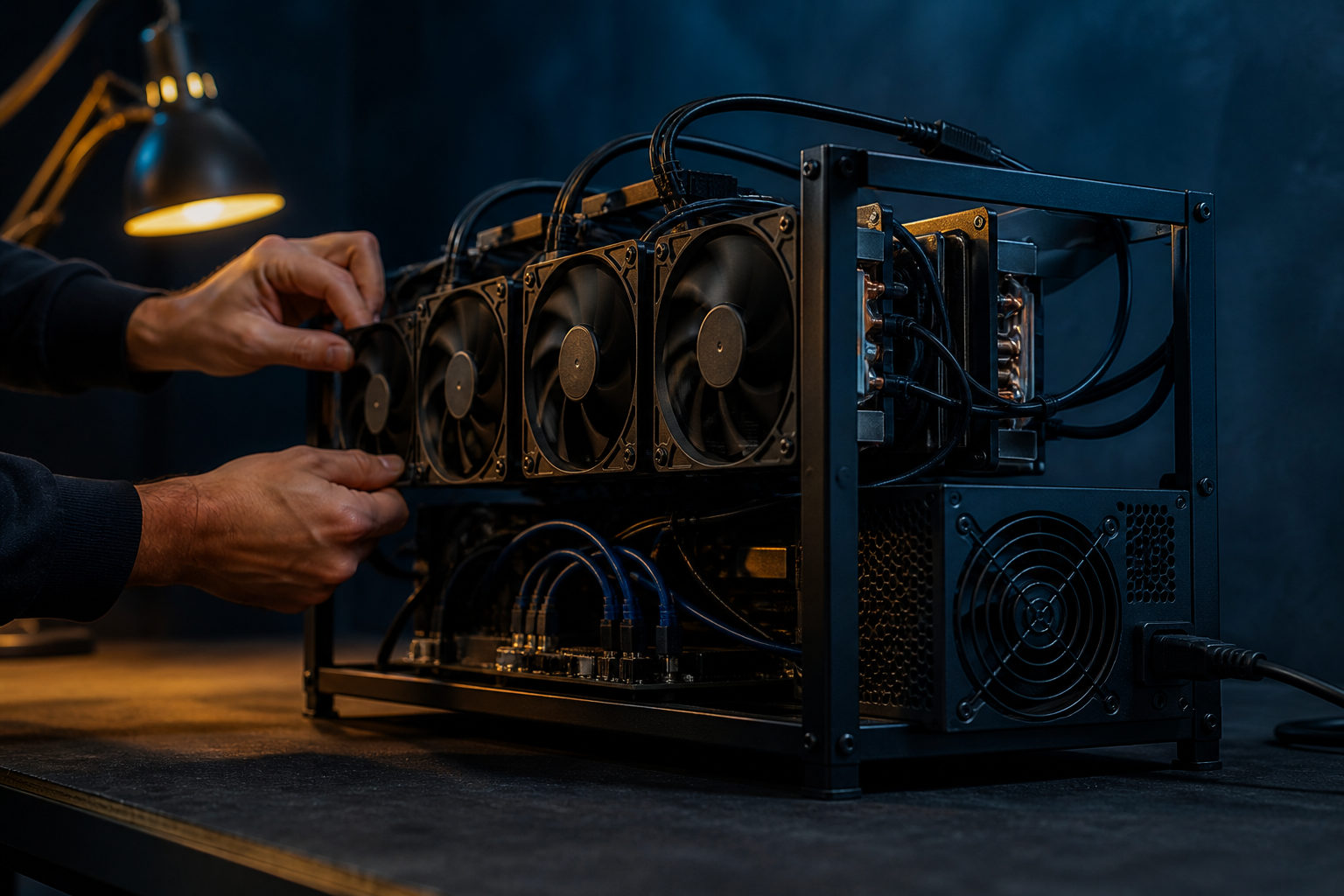
How to set up a bitcoin miner starts with one honest answer: you need dedicated ASIC hardware, stable power, wired internet, good cooling, a mining pool, and a wallet address before the machine is worth turning on.
Think of bitcoin mining as a bookkeeping race
Bitcoin mining is a competition to add the next block of transactions to the blockchain. Miners run calculations, and the participant who finds a valid result first gets the chance to publish that block and receive the block reward plus transaction fees under the network rules.
This process uses proof of work. The Bitcoin network produces a block about every 10 minutes, so mining is built around constant machine output rather than manual effort. In practice, anyone asking how to set up a bitcoin miner today is usually talking about an ASIC miner, not a home PC.
A lot of beginners picture mining as installing software on a spare computer. Real bitcoin mining is closer to deploying a loud, hot, specialized machine that has to run steadily for long periods.
Decide whether you want to learn the process or run a machine long term
People use the same search phrase for different goals. Some want to understand how mining works. Others want to plug in hardware and keep it operating every day.
| Goal | Best approach | Main focus |
|---|---|---|
| Learn the basics | Study the miner interface, pool workflow, and wallet setup | Understand blocks, hashpower, and payout flow |
| Test at home | Run a short trial in a controlled space | Noise, heat, internet stability, and power limits |
| Operate long term | Plan hardware, airflow, maintenance, and monitoring together | Downtime handling and recurring operating burden |
For home users, the real barriers are often physical. ASIC miners generate heat, pull in dust, and create constant fan noise. If the room traps hot air or the electrical setup is weak, the machine may boot successfully and still be a poor fit for daily use.
Setting up a bitcoin miner is not a one-time task. If the machine stays online for long stretches, you may end up dealing with disconnects, fan wear, rising temperatures, firmware changes, and pool-side configuration checks.
What you need before you start
A working bitcoin mining setup includes more than the miner itself. At minimum, you need an ASIC miner that supports Bitcoin mining, a matching power supply, reliable wired internet, a place where heat can be exhausted, a mining pool account, and a Bitcoin wallet address that you control.
| Component | What it does | What beginners miss |
|---|---|---|
| ASIC miner | Performs Bitcoin mining calculations continuously | Hardware condition, firmware source, and complete ports |
| Power setup | Supplies steady electricity | Loose connectors, weak extension gear, and circuit limits |
| Wired internet | Keeps the miner connected to the pool | Wi-Fi is convenient but usually less stable |
| Cooling and airflow | Moves hot air away from the machine | Heat recirculation can hurt stable operation |
| Mining pool account | Lets your miner join pooled hashpower | Server choice, backup pool fields, and worker naming |
| Wallet address | Receives mined bitcoin | Backup and ownership should be checked first |
Start with the physical location
Pick the location before you touch the settings page. The space should have dependable power, room for airflow, manageable dust, and enough separation from living areas if noise is a concern.
Heat is often underestimated. If hot air stays trapped near the machine, operating conditions get worse fast.
Connect the hardware carefully
Attach the miner to its power supply, then connect it to your router or switch with an ethernet cable. Before powering on, check the cable fit and make sure the power arrangement is appropriate for sustained use.
Once the machine starts, do a basic health check. Listen for abnormal noise, confirm the fans are spinning, and make sure the device appears on your local network.
Enter the miner interface and add pool details
Most ASIC miners provide a local management page. Inside that interface, you usually enter the pool address, worker name, and worker password field required by the pool. The exact format depends on the service you choose, so copy the fields carefully.
After saving the settings, the miner will try to connect and begin submitting work. The real test is whether the machine stays connected, keeps submitting valid work, and operates within a normal temperature range.
Pool setup, wallet control, and maintenance matter more than many expect
Solo mining is possible in theory, but for an individual operator the chance of finding a block alone is very low. That is why most people join a mining pool. A pool combines hashpower from many miners and distributes payouts according to its own rules.
| Item | Purpose | What to check |
|---|---|---|
| Pool URL | Connects your miner to the selected pool | Server region, backup endpoints, and connection consistency |
| Worker name | Identifies a specific machine | Clear naming helps when one unit has issues |
| Payout address | Receives mining proceeds | Make sure you control the wallet |
| Dashboard monitoring | Shows uptime and warning signals | Look for disconnects, overheating, or weak performance |
Your wallet deserves extra care. Set up the receiving address first, confirm that you can back it up, and only then place it into the pool account. If the address is wrong or you do not control it properly, the problem is much bigger than a minor setup mistake.
Dust buildup, fan issues, intermittent networking, and rising temperature are common enough that they should be expected. A bitcoin miner is hardware that needs regular observation.
The cost reality behind bitcoin mining
Many people asking how to set up a bitcoin miner are really asking whether they can participate at all. A better question is whether they can keep the setup running without the environment fighting back.
The cost is not limited to buying a machine. Electricity, cooling, noise management, space, cleaning, spare parts, and your own time all shape the actual experience.
Bitcoin itself has a maximum supply of 21 million coins. Its block subsidy halves every 210,000 blocks, which works out to about every 4 years, and past halving years include 2012, 2016, 2020, and 2024. That means mining is tied to long-term competition and protocol rules, not a passive device you can ignore after setup.
If your main goal is education, running a miner long enough to understand the workflow can still be useful. If your goal is steady operation, treat it as an ongoing hardware and environment management job from day one.
FAQ
Do I need to build a bitcoin miner from separate parts?
Usually no. Most beginners use a finished ASIC miner and then handle power, networking, and pool configuration around it. The harder part is preparing the environment and keeping the unit stable over time.
Can I mine Bitcoin with a regular computer?
At the basic concept level, any computing device can attempt proof-of-work calculations. In real-world Bitcoin mining, though, dedicated ASIC machines dominate, so a standard computer is mainly useful for learning rather than practical participation.
Is the setup complete once the miner is online?
No. Network access is only the first checkpoint. You still need to confirm that the pool details are correct, the machine is submitting work consistently, and the dashboard shows healthy operating conditions.
Should I create a wallet before joining a pool?
That is the safer order for most people. Having your own receiving address ready first makes it easier to verify payout settings and avoids rushed changes while the miner is already being configured.
What is the biggest home setup problem for beginners?
Noise and heat are the usual shock. Many people expect the technical setup to be the hard part, then find that airflow, room comfort, and electrical planning are what really determine whether the miner can stay in place.
Before you buy or power anything on, write down a short checklist: where the miner will sit, how power will be delivered, where hot air will go, which wallet receives payouts, and who will monitor the machine. If those answers are vague, the setup is not ready yet.
Disclaimer: This article is for informational and educational purposes only and is not investment, financial, or legal advice. Crypto assets are highly volatile and you could lose your entire investment. Do your own research and decide carefully.