
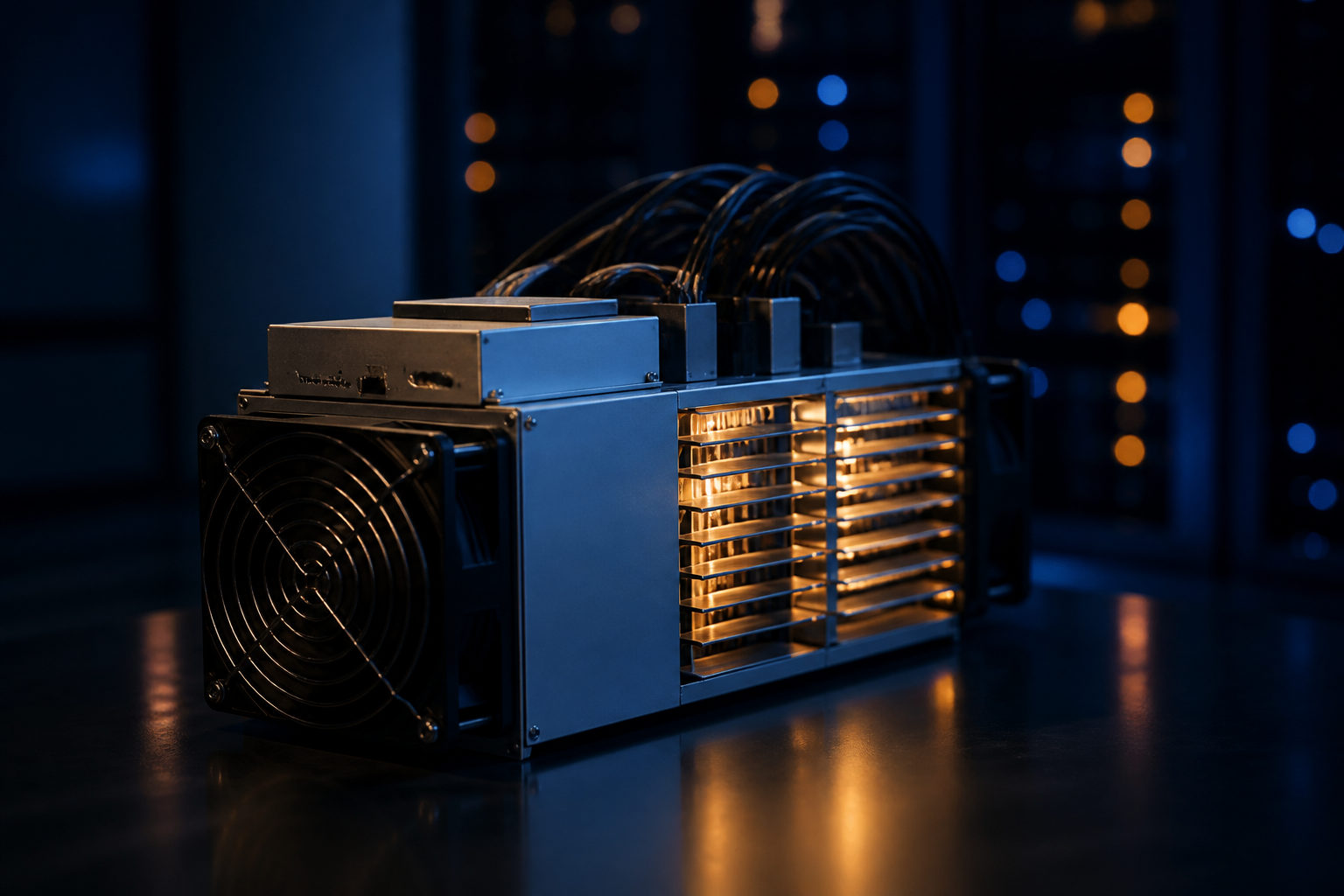
Yes, bitcoin mining machines work. Their job is to run nonstop calculations in a block-writing race, and the real question is whether your hardware, power, cooling, and setup can keep up with that competition.
What a bitcoin mining machine actually does
A simple way to picture bitcoin mining is to imagine a public ledger that needs a new page added on a regular basis. When pending transactions are grouped into a candidate block, miners compete to find a hash that satisfies the network's proof-of-work rules. The machine that helps produce a valid result gives its operator a shot at earning the block reward and transaction fees tied to that block.
This does not mean a mining machine creates bitcoin out of thin air. It spends computing power to search through huge numbers of possible hashes. Bitcoin is designed to target roughly 10 minutes per block, and the network adjusts difficulty so block production stays near that pace even when total mining power changes.
After the 2024-04-19 halving, the current block reward is 3.125 BTC. Bitcoin cuts that subsidy every 210,000 blocks, which is about once every 4 years, and the next halving is expected around 2028. The network now adds about 450 BTC per day in total, based on about 144 blocks and a 3.125 BTC block subsidy. That daily figure describes the whole network, not what one machine or one miner receives.
Why the answer is yes, but that still does not settle the practical question
If you ask whether a bitcoin mining machine can perform its intended task, the answer is clearly yes. When it has electricity, network access, and a valid mining configuration, it can keep hashing and submitting work. Many people stop there, and that is where confusion starts.
A machine can be fully functional and still be a poor choice for the person who bought it. Bitcoin has a hard cap of 21,000,000 BTC, expected to be fully issued around 2140, and the subsidy keeps shrinking over time. At the same time, miners are competing against specialized hardware across the world. So the issue is not whether the box turns on; it is whether its efficiency, operating conditions, and mining arrangement make sense in a live market.
The race analogy helps. Every miner is trying to hand in the winning answer first, but only one valid block gets accepted at a time. Your machine may be doing real work every second and still fail to land the winning result during any given stretch.
| Question | Reality | What it means for the user |
|---|---|---|
| Does the machine work | Yes, if power, cooling, and connectivity are stable | Working hardware is not the same as a worthwhile setup |
| Can one machine find blocks steadily | For a solo user, that is usually very hard | Most participants use pools to smooth out variance |
| Is output fixed | No, it changes with difficulty, uptime, and pool rules | Do not confuse network-wide issuance with personal production |
| Can older hardware still run | Often yes | Running is different from remaining competitive |
How a mining machine joins the block race
The process is more mechanical than mysterious. Mining software or a mining pool assembles pending transactions into a candidate block. The machine receives block header data and then keeps changing certain values, hashing over and over to see whether it can produce a result below the current target.
Because valid outcomes are rare, the machine succeeds by trying massive numbers of combinations at high speed. If it finds an acceptable result, that answer is sent back to the pool or broadcast to the network. Other nodes verify the block, and only then does it become part of Bitcoin's chain.
One detail many beginners miss is that the machine is mainly a specialized hashing device. Full verification, long-term blockchain storage, and network propagation are handled by other parts of the setup, such as node software, pool infrastructure, and a stable internet connection. A mining rig is one piece of the system, not a self-contained magic box.
| Stage | What the machine does | What must be in place |
|---|---|---|
| Receive work | Takes candidate block data from a pool or local setup | Stable connectivity |
| Hash repeatedly | Runs nonstop proof-of-work attempts | Suitable chips and stable power |
| Submit results | Sends valid shares or a block result back | Low interruptions and low latency |
| Stay online | Maintains continuous hash production | Cooling, maintenance, and uptime |
How people take part in bitcoin mining today
For most individuals, there are three broad routes: solo mining, pool mining, and some form of hosting or managed service. These are not just technical choices. They shift who carries the variance, who controls the equipment, and how transparent the arrangement really is.
Solo mining gives you full independence. If your setup finds a block, the reward and fees belong to your side of the operation. The problem is variance. A small miner competing against the global network may wait a very long time without finding a block.
Pool mining is the common path because it combines the work of many participants. The pool has a better chance of finding blocks as a group, then distributes proceeds under its payout rules. This does not remove risk, though. You still depend on pool reliability, fee structure, accounting methods, and uptime on your end.
Hosting or managed mining can look convenient because someone else handles the site, power delivery, and part of the maintenance. That convenience comes with a different test: can you verify what you are buying, how the machines are operated, and what happens if service quality drops or reporting becomes unclear?
| Participation model | Best suited to | Main advantage | Main constraint |
|---|---|---|---|
| Solo mining | Users with technical skill and infrastructure | Direct control | Extreme variance for small operators |
| Pool mining | Most practical participants | Smoother payout experience | Pool rules and fees matter |
| Hosted or managed mining | Users who do not want machines on site | Less physical burden | Counterparty and transparency risk |
What decides whether a mining machine is useful in real life
The biggest barriers are usually physical and economic, not theoretical. A bitcoin mining machine needs steady electricity, throws off heat, and often makes enough noise to rule out normal home use. If power is expensive, cooling is weak, or the site is unsuitable, the machine may still hash perfectly while the overall setup fails in practice.
Hardware type also matters. Bitcoin mining today is dominated by specialized ASIC machines built for this exact hashing task. A normal desktop, gaming PC, or laptop can run wallets, browser tabs, or even node software, but that does not make it a competitive bitcoin miner.
Uptime has its own weight. Dust buildup, unstable power, bad airflow, fan issues, and internet interruptions can all cut output by taking the machine offline or forcing it to run below normal performance. New buyers often focus on getting the unit delivered and give too little attention to months of maintenance after that.
| Factor | Why it matters | Frequent mistake |
|---|---|---|
| Electricity | Mining depends on continuous power draw | Looking only at the machine price |
| Cooling | Heat affects stability and hardware life | Assuming basic room ventilation is enough |
| Noise and space | Machines can be hard to place in ordinary living areas | Thinking home installation will be simple |
| Maintenance | Downtime harms participation in the block race | Treating the unit like an appliance that never needs attention |
FAQ
Are bitcoin mining machines just solving math problems all day?
That analogy is fine as a starting point, but the real process is repeated hashing under proof-of-work rules. The machine is not working through a puzzle step by step; it is trying huge numbers of possibilities until one fits.
Can I mine bitcoin with a regular home computer?
You can run software related to bitcoin on a normal computer, and you can learn the basics that way. In real mining competition, general-purpose machines are usually far too weak compared with specialized ASIC hardware.
Why do so many miners join pools?
Because solo mining leaves small operators with very uneven results. Pools combine many miners' work and spread outcomes according to pool rules, which makes participation more predictable.
Is buying a mining machine enough to get started?
No. You also need a workable power setup, cooling, networking, firmware configuration, and a clear decision on whether you are mining solo or through a pool. Without that, the machine may turn on and still fail to operate well over time.
How does the halving affect mining machines?
It changes the block subsidy miners compete for. Since the reward fell to 3.125 BTC on 2024-04-19, machine efficiency, uptime, and operating costs have become even more important for anyone thinking about mining.
If you want a useful answer to whether bitcoin mining machines work, start with conditions rather than marketing. Check your power, cooling, noise tolerance, maintenance ability, and mining model first; those points decide whether the machine is merely active or actually viable for you.
Disclaimer: This article is for informational and educational purposes only and is not investment, financial, or legal advice. Crypto assets are highly volatile and you could lose your entire investment. Do your own research and decide carefully.