
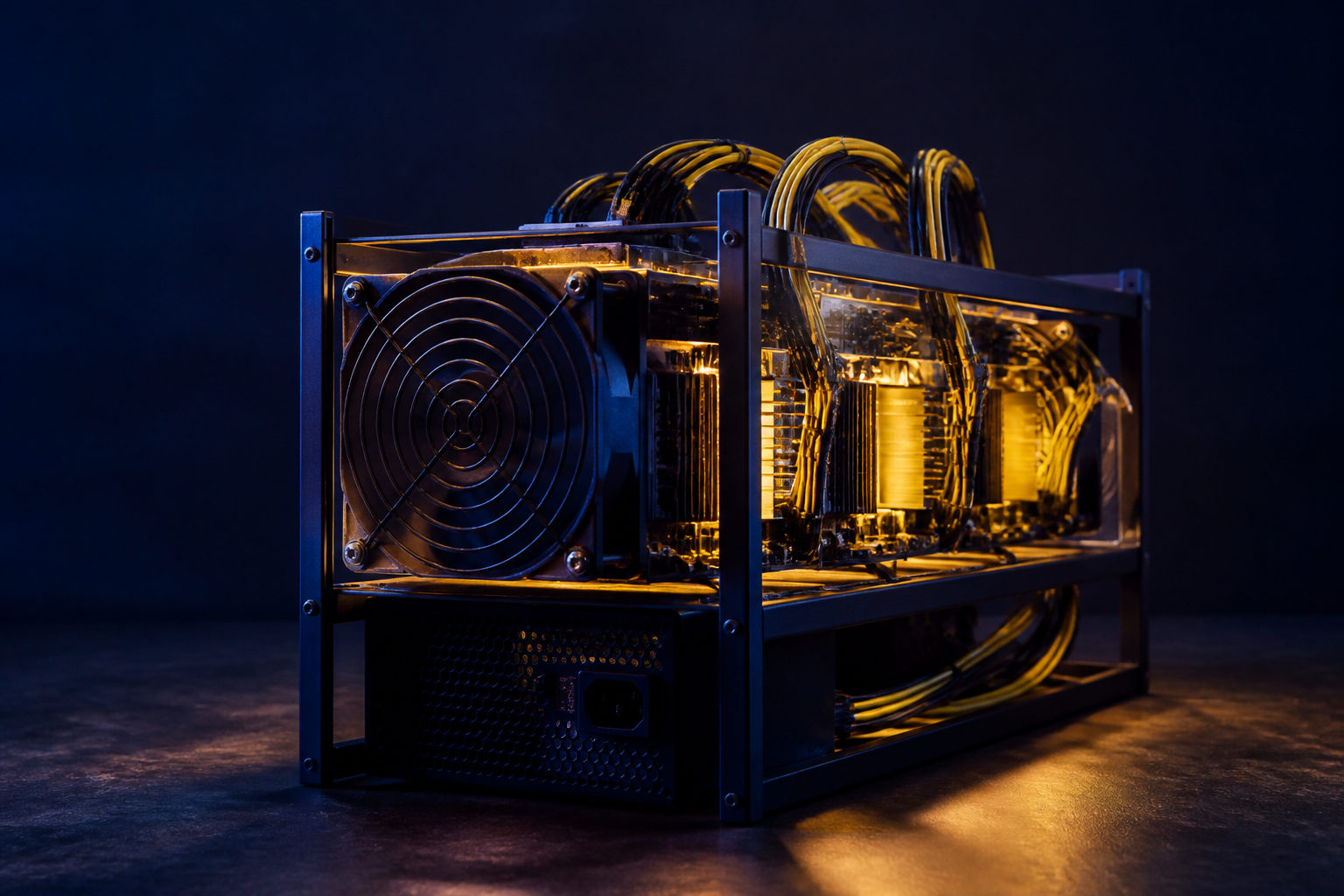
A bitcoin mining rig is a specialized machine built to perform Bitcoin hashing as fast and as efficiently as possible. Its job is to compete in Bitcoin's block production process, not to act like a normal PC.
What a bitcoin mining rig actually does
A simple way to picture Bitcoin is to think of a public ledger that many computers verify and share. Miners collect pending transactions into a candidate block, then use proof of work to compete for the right to add that block to the chain.
That is why the phrase “mining” can mislead beginners. The machine is not digging coins out of storage. It is running repeated hash calculations in an attempt to find a valid result before other miners do.
Bitcoin targets a new block about every 10 minutes. The network adjusts mining difficulty so that, across the whole network, block creation stays near that pace even when more or less computing power joins the competition.
Because the task is narrow and repetitive, modern Bitcoin mining depends on purpose-built hardware. A mining rig is designed to do this one kind of work over and over with as little wasted energy as possible.
What counts as a mining rig today
In current Bitcoin mining, the standard machine is an ASIC miner. ASIC stands for application-specific integrated circuit, which means the chip is built for one job rather than general computing.
In Bitcoin's early years, people could mine with ordinary CPUs and later with GPUs. That era is part of Bitcoin history, but it does not describe the practical reality for most people now. On today's network, a regular desktop computer is usually not competitive.
| Component | Role | Why it matters |
|---|---|---|
| ASIC chips | Perform Bitcoin hash calculations | They define the machine's mining capability |
| Power supply | Delivers stable electricity to the rig | Power quality affects uptime and reliability |
| Cooling system | Removes heat from constant high-load operation | Heat management affects performance and lifespan |
| Control board | Handles startup, configuration, and monitoring | Useful for setup, diagnostics, and maintenance |
| Network connection | Links the rig to a pool or node | A disconnected rig cannot submit valid work |
From the outside, some mining rigs look a bit like compact servers. The difference is their purpose. A server is meant for varied computing tasks, while a bitcoin mining rig is tuned for one repeated function: hashing block headers as fast as possible.
The machine itself is only part of the setup. The real operating environment includes airflow, dust control, stable internet, safe electrical infrastructure, and a place where the noise will not become a problem.
Why mining rigs can earn bitcoin
When a miner, or a mining pool on behalf of its participants, successfully mines a block, the block includes a reward plus transaction fees. Bitcoin's block subsidy halves every 210,000 blocks, which is roughly every 4 years. The halving dates so far are 2012-11-28, 2016-07-09, 2020-05-11, and 2024-04-19.
After the 2024-04-19 halving, the current block reward is 3.125 BTC, and that stays in place until the next halving around 2028. Since Bitcoin aims for about 144 blocks per day, the network adds about 450 BTC daily. That figure applies to the whole network, not to any single miner, home setup, or company.
Bitcoin also has a hard supply cap of 21,000,000 BTC, with issuance expected to continue until around 2140. That fixed issuance schedule is one reason mining is so competitive: miners are chasing a reward that becomes harder to obtain over time.
How people take part: solo mining, pools, and hosting
Buying hardware is only the first step. A miner still needs a way to participate in the network and a practical plan for keeping the machine online.
| Approach | Who it fits | How it works | Main trade-off |
|---|---|---|---|
| Solo mining | Operators with technical skills and suitable infrastructure | You run your own machine and compete directly for blocks | Results can be very uneven |
| Mining pool | Most individual miners | Your hash power is combined with others and rewards are shared by pool rules | You depend on the pool's payout method and operations |
| Hosted mining | People who cannot run a rig at home | Your machine is placed in a third-party facility | You take on hosting counterparty and uptime risk |
For most individuals, a mining pool is the common entry point. Pooling does not remove risk, but it changes the experience. Instead of waiting for your own machine to find a full block on its own, you receive payouts based on the pool's rules and your contributed work.
Solo mining is still possible in a technical sense, yet that does not mean it is practical for a small operator. Bitcoin mining is competitive enough that a single machine may run for a long time without producing a solo block. That is a probability issue, not a setup mistake.
Hosted mining can solve some home setup problems, especially power and cooling constraints, but it introduces a different set of questions. You have to evaluate the operator, contract terms, maintenance process, and what happens if the provider has operational trouble.
What to check before buying a bitcoin mining rig
Beginners often focus on one thing only: how powerful the machine sounds. In real use, a mining rig lives or dies by operating conditions.
| Factor | Why it matters | Typical beginner mistake |
|---|---|---|
| Electricity cost | It shapes the running cost of the rig | Looking at hardware price alone |
| Cooling | Constant heat affects stability and wear | Assuming household ventilation is enough |
| Noise | Air-cooled rigs are often loud | Underestimating the impact on home use |
| Maintenance | Dust, fan issues, and disconnects need attention | Treating it like an appliance you can ignore |
| Pool terms | Payout rules affect your actual experience | Joining without reading the details |
| Used hardware condition | Past wear can affect reliability | Buying only because the price looks lower |
Home mining raises another issue that many people miss: electrical safety. A rig is a high-load machine that runs for long periods. The room, wiring, outlets, and ventilation all matter. If the environment is a poor fit, downtime and hardware stress become much more likely.
This is also why there is no universal answer to “how much bitcoin can one rig mine per day.” Output depends on network difficulty, the rig's actual performance, pool terms, downtime, and electricity costs. Anyone offering a fixed number without those variables is skipping the hard part of the question.
How a mining rig differs from a wallet or node
A mining rig, a wallet, and a node do different jobs. The rig supplies hash power. A wallet manages private keys and receiving addresses. A node validates and relays Bitcoin data across the network.
That distinction matters in practice. If you mine through a pool, you usually need a Bitcoin address for payouts. Bitcoin's smallest unit is 1 satoshi, equal to 0.00000001 BTC. The pool sends your earned bitcoin to that address; the coins are not “stored inside” the mining rig itself.
Running a full node can be useful if you want stronger verification independence, but it is not the first hurdle for understanding mining hardware. First learn what the rig does, how the payout path works, and what operating costs come with the setup.
FAQ
Can I mine bitcoin with a normal computer instead of a mining rig?
For the current Bitcoin network, that is usually not realistic. Modern Bitcoin mining is dominated by ASIC machines because they are built specifically for hashing, while normal computers are designed for general tasks.
Can I run a bitcoin mining rig at home?
Technically, yes. The bigger question is whether your home setup can handle power draw, heat, noise, and continuous operation without turning into a maintenance problem.
Do I need a wallet if I join a mining pool?
In most cases, yes. Pool payouts need a Bitcoin address, so you should know where the rewards are being sent and who controls that address.
Why do people say solo mining is unpredictable?
Because finding a block has a strong probability element. A machine can work properly for a long time and still not find a block on its own during that period.
Is a used mining rig a smart way to start?
Sometimes, but only if you can judge its condition well. Older units may come with fan wear, chip degradation, repair history, or hidden reliability issues that are hard to spot from a listing alone.
If you want the shortest answer, a bitcoin mining rig is a dedicated machine for Bitcoin proof-of-work calculations. Before you buy one, check power, cooling, noise, maintenance demands, and pool rules in that order, then decide whether the setup fits your situation.
Disclaimer: This article is for informational and educational purposes only and is not investment, financial, or legal advice. Crypto assets are highly volatile and you could lose your entire investment. Do your own research and decide carefully.