
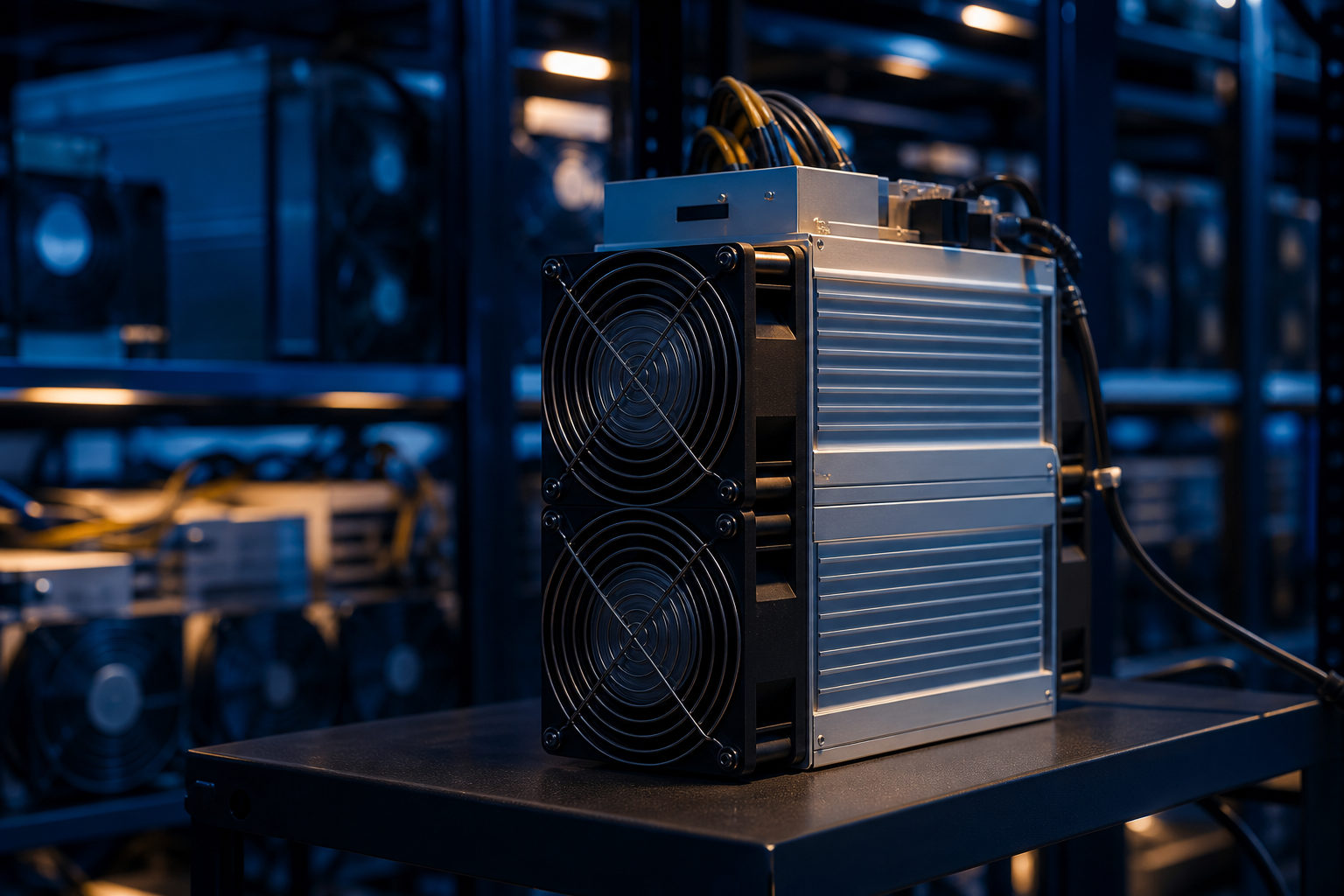
Bitcoin is typically mined with ASIC machines, which are specialized devices built for SHA-256 hashing. Regular computers and most GPU setups are no longer the standard choice for Bitcoin mining; in practice, miners usually run ASIC hardware and connect it to a mining pool.
Think of mining as a contest to win the next ledger entry
A simple way to understand Bitcoin mining is to picture a public bookkeeping race. Miners compete to package transactions into the next block, and the winner gets the right to add that block to the chain. That winner may receive the block reward plus transaction fees included in the block.
Bitcoin aims for a new block about every 10 minutes. The network adjusts difficulty so that block production stays close to that pace even as more machines join or older hardware drops out. Once you see mining as repeated hashing under a fixed rule set, the hardware shift makes sense: when everyone is solving the same narrow task, specialized machines beat general-purpose ones.
The issuance schedule adds another layer. The block reward is cut in half every 210,000 blocks, which is roughly every 4 years. Those halvings took place on 2012-11-28, 2016-07-09, 2020-05-11, and 2024-04-19. After the 2024 halving, the current block reward is 3.125 BTC. With about 144 blocks per day, the network adds roughly 450 BTC daily. That figure describes the entire network, not what one machine, one miner, or one company receives.
The machine typically used: ASIC miners
If someone asks what machine is typically used to mine bitcoin, the direct answer is an ASIC miner. ASIC stands for application-specific integrated circuit. In plain English, it is hardware designed for a very limited job and tuned to do that job far more efficiently than a normal PC.
For Bitcoin, the job is SHA-256 hashing. A laptop or desktop can perform SHA-256 calculations, but it is built to handle many kinds of tasks: browsing, office work, media, coding, gaming, and more. An ASIC miner gives up that flexibility and focuses almost entirely on one purpose. That trade-off is why it became the standard tool in Bitcoin mining.
| Hardware type | Typical use in Bitcoin mining today | Main strength | Main limitation |
|---|---|---|---|
| CPU | No | Accessible for learning basics | Too inefficient for current competition |
| GPU | Usually no | Strong parallel processing | No longer the mainstream choice for Bitcoin |
| FPGA | Rare | More specialized than CPUs or GPUs | Not the usual route for most miners today |
| ASIC miner | Yes | Built specifically for SHA-256 | Limited to a narrow purpose and needs proper operating conditions |
When people say “Bitcoin mining machine,” they almost always mean an ASIC. The unit itself is only part of the setup. It still needs stable power, cooling, airflow, network access, a wallet address for payouts, and a management interface so the operator can monitor uptime and errors.
How an ASIC miner takes part in the race
An ASIC miner does not “dig coins out of the internet.” It performs huge numbers of hashing attempts while changing certain values in the candidate block header. The goal is to find a result that satisfies the network’s current difficulty target. Since many miners across the world are trying at the same time, success is probabilistic.
That point matters because beginners often expect a single machine to produce a steady, predictable amount on its own. Mining does not work that way. One machine contributes work to a global competition, and the outcome depends on its share of total network power, how long it stays online, pool rules, and operating costs.
Most miners join a mining pool instead of mining solo. A pool combines the work of many machines, competes for blocks as a group, and then distributes rewards according to its payout method. This does not remove uncertainty, but it usually smooths earnings compared with waiting alone for a full block win.
Bitcoin’s supply design also shapes miner behavior. The total cap is 21,000,000 BTC, with issuance continuing until around 2140. New bitcoin enters circulation through mining under the protocol rules rather than through a central issuer. The genesis block was created on 2009-01-03, and the white paper, Bitcoin: A Peer-to-Peer Electronic Cash System, was released by Satoshi Nakamoto on 2008-10-31. Those dates matter here because they frame mining as part of network security and issuance, not just as a hunt for rewards.
Can an individual still mine Bitcoin?
Yes, an individual can still mine Bitcoin. The harder question is whether the full setup makes sense for that person’s circumstances. Buying an ASIC is only the opening step. Power availability, heat management, noise, downtime risk, maintenance, and pool choice often matter more than the purchase itself.
Home mining sounds simple until you consider constant high-load operation. ASIC miners generate heat and can produce substantial noise. They also need clean airflow and stable connectivity. If the machine frequently goes offline, overheats, or sits in a place where the environment cannot support it, real-world results can fall apart even when the hardware is technically correct.
Another practical issue is that mining returns are not determined by the machine alone. Network competition changes over time, block rewards change on the halving schedule, and payout structures differ across pools. Asking “Which machine is used?” is a good starting point. Asking “What conditions do I need to run it well?” is the question that usually decides whether the plan is realistic.
| Participation route | Who it fits | What it offers | What to watch |
|---|---|---|---|
| Home deployment | People with suitable power and space | Direct control over the hardware | Heat, noise, maintenance, and power constraints |
| Hosted mining | People who do not want equipment on-site | Less burden on home infrastructure | Dependence on the hosting operator and service terms |
| Mining pool participation | Most active miners | Smoother reward distribution | Need to understand pool payout rules |
| Learning first without buying | Beginners | Better judgment before spending on hardware | No direct operating experience yet |
What to check before buying any Bitcoin mining machine
Start with algorithm fit. Bitcoin mining hardware must be designed for SHA-256. A machine sold as a “miner” is not automatically suitable for Bitcoin. Next, look at the environment where it will run: power stability, cooling, airflow, dust control, and network uptime all affect whether the device can stay productive.
Then review operational support. Can you monitor the machine easily? Is maintenance practical where you live? If the unit fails, do you have a workable repair path? These are not minor details. Specialized hardware that sits idle because of repeated faults can turn a promising setup into a frustrating one.
You should also prepare the payout side before turning anything on. Pool rewards are commonly sent to a Bitcoin wallet address, so wallet control matters from day one. It helps to know that 1 satoshi is 0.00000001 BTC, which is one hundred-millionth of a bitcoin. Pool dashboards and payout records often make more sense once you understand that smaller unit.
There is one famous historical anecdote that many newcomers hear about: on 2010-05-22, Laszlo Hanyecz spent 10,000 BTC on two pizzas, a moment now remembered as Bitcoin Pizza Day. It does not help you choose a machine, but it does show how far the ecosystem has moved from hobbyist experimentation to highly specialized mining hardware.
FAQ
Can I mine Bitcoin with a normal PC today?
In a technical sense, a normal PC can perform the required hashing. In practical mining terms, it is not the standard path anymore, because ASIC miners dominate Bitcoin’s SHA-256 competition.
Are GPU miners the same as Bitcoin miners?
No. Bitcoin mining is typically done with ASIC machines designed for SHA-256. GPU mining is more commonly discussed in networks where that kind of hardware still has a useful role.
How long does one machine take to mine one bitcoin?
There is no fixed answer. The result depends on the machine’s performance, total network competition, pool payout rules, uptime, and operating conditions, so a simple time estimate would be misleading.
Why do miners join pools instead of mining solo?
Pool mining usually makes payouts less uneven. Solo mining can lead to very long waits because a single operator must win an entire block alone before receiving the full reward.
Is a used ASIC miner a smart way to start?
It can lower upfront spending, but the machine’s condition matters a great deal. Repair history, stability under load, and remaining useful life are more important than the sticker price by itself.
Use this decision filter before you spend money
If you want the shortest accurate answer, it is this: Bitcoin is typically mined with ASIC machines. Before buying one, check whether you can support the machine with stable power, cooling, noise tolerance, network uptime, pool setup, and a wallet you control. Without those pieces in place, knowing the right hardware name does not mean you are ready to mine.
Disclaimer: This article is for informational and educational purposes only and is not investment, financial, or legal advice. Crypto assets are highly volatile and you could lose your entire investment. Do your own research and decide carefully.