
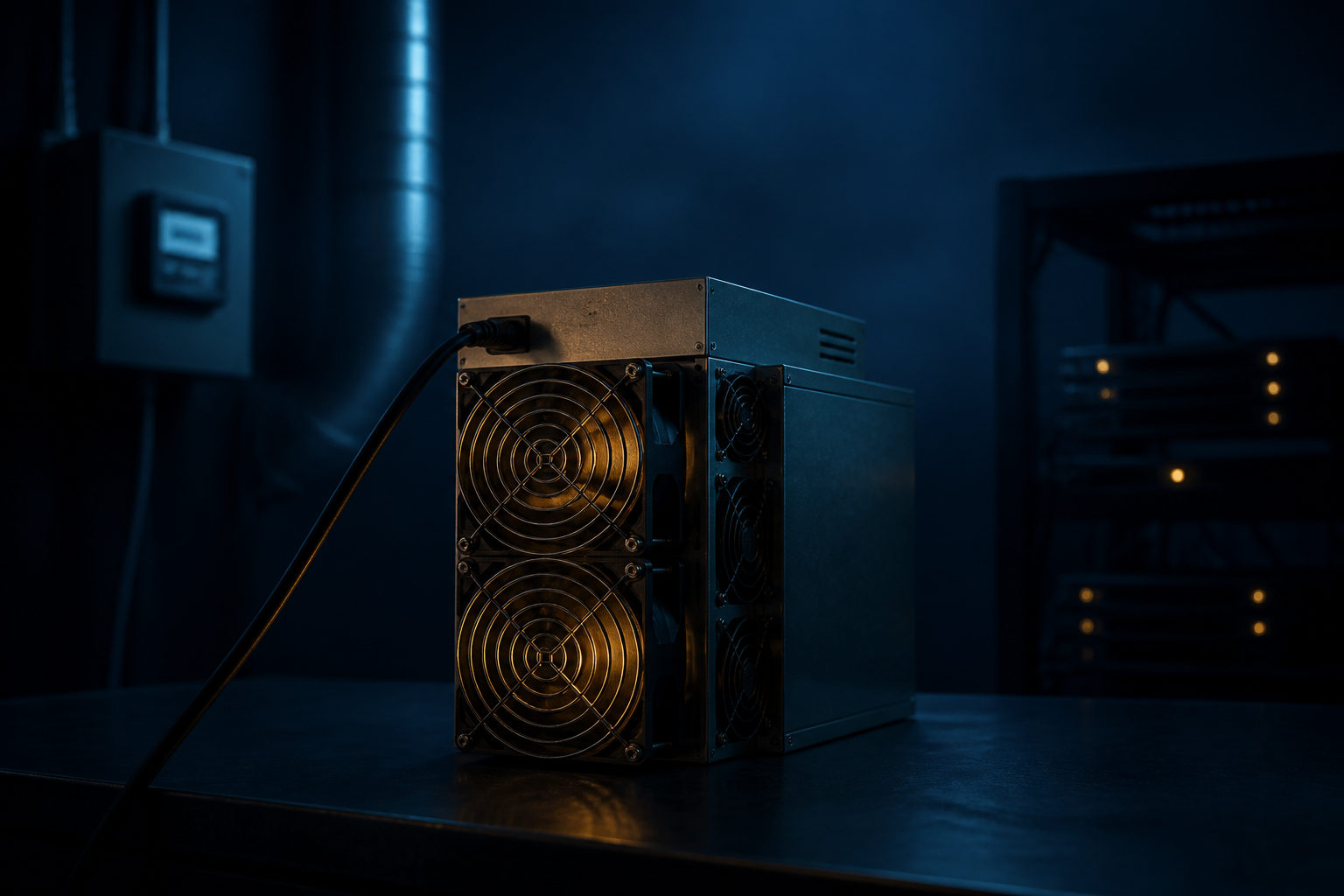
Are bitcoin miners worth it? For most people, only sometimes. The answer depends less on the machine itself and more on power cost, operating setup, contract risk, and whether you can live with uncertain payback.
Start with the real question
Many buyers frame this as a simple profit question: buy a miner, plug it in, collect bitcoin. That leaves out the hard part. A miner is specialized hardware that consumes electricity nonstop, produces heat and noise, needs maintenance, and competes against a network that does not stand still.
The better question is whether you are entering a manageable operating business or stepping into a cost structure you do not control well. If you expect stable passive income, the mismatch can be immediate. If you already have suitable power, a realistic place to run hardware, and enough patience to treat the machine as a volatile production asset, the idea becomes more reasonable to evaluate.
The variables that decide whether a miner makes sense
| Factor | Why it matters | What to check |
|---|---|---|
| Power cost | Mining converts electricity into bitcoin, so power cost shapes your margin | Rate stability, extra service charges, peak pricing, contract length |
| Hardware efficiency | More efficient units hold up better when competition rises | Model age, condition, repair history, expected power draw |
| Network competition | Your share of block rewards can shrink as global hash rate changes | Avoid assuming today's output will hold steady |
| Hosting terms | Most buyers do not run miners at home | Downtime policy, maintenance process, payout rules, machine retrieval |
| Noise and heat | Home environments often fail here first | Ventilation, dedicated space, electrical load, neighbor impact |
| Exit liquidity | Mining rigs depreciate and can become hard to sell | Resale demand, warranty status, whether the model is already aging out |
People often ask for a fixed daily output number, but there is no single number that stays true. Actual production depends on machine health, uptime, pool payout method, and changes in network difficulty. Bitcoin targets roughly one block every 10 minutes. After the 2024-04-19 halving, the current block subsidy is 3.125 BTC, and the network adds about 450 BTC per day in total. That figure belongs to the entire network, not to any individual miner or company.
The halving cycle matters because it narrows the room for inefficient equipment. Bitcoin cuts the block subsidy every 210,000 blocks, roughly every four years. That happened on 2012-11-28, 2016-07-09, 2020-05-11, and 2024-04-19, with the next one expected around 2028. A machine that looked acceptable before a halving can become much less attractive once rewards drop and competition keeps moving.
Most bad decisions come from weak cost accounting
The purchase price of the miner is only the first line item. Buyers also need to think about shipping, import-related charges, rack setup, hosting fees, repair costs, replacement fans or power supplies, firmware issues, and the fact that a machine earns nothing while it is offline. Promotional calculators tend to highlight ideal output and leave these frictions in the background.
Running a unit at home creates a different set of costs. Continuous noise can be hard to tolerate, heat has to go somewhere, and electrical capacity needs to be checked before operation. If your setup is not built for sustained load, the operational headache can arrive before any meaningful bitcoin output does.
| Setup | Possible advantage | Main drawback |
|---|---|---|
| Home operation | Direct control over the machine | You handle noise, heat, maintenance, and power safety yourself |
| Hosted operation | Better suited for continuous running and centralized maintenance | You depend on contract clarity and the host's execution |
| Used machine | Lower upfront spend in some cases | Higher information risk and more uncertainty around remaining life |
| New machine | Condition and warranty are easier to assess | Higher initial cost and sharper depreciation risk if conditions weaken |
Your output is paid in bitcoin, not in fixed dollar cash flow. Bitcoin has a hard cap of 21,000,000 BTC, with issuance expected to continue until about 2140. Its smallest unit is 1 satoshi, equal to 0.00000001 BTC. Results depend not only on what the machine produces, but also on whether you need to sell quickly to cover operating bills or can hold part of the output longer.
Risk is broader than price volatility
Price gets most of the attention, yet hardware and counterparty risk can be just as important. A miner is highly specialized equipment, so resale value depends on market demand for that model and on the broader cycle. In strong conditions, good units may be difficult to source. In weaker conditions, used prices can fall and leave owners with less flexibility.
Hosting risk deserves careful review. If someone else runs the facility, you need clarity on machine ownership, payout control, downtime communication, repair authorization, and retrieval rights if you decide to exit. Vague language in a hosting agreement can create problems that are hard to solve later.
Mining pool choice also matters. Pools differ in payout methods, fee structures, minimum withdrawal rules, and how they handle rejected shares. You need a setup where the rules are easy to inspect and the payout path stays under your control.
Operational discipline matters as well. Dust, unstable cooling, poor cabling, and delayed maintenance can reduce uptime. A machine that looks profitable in a clean spreadsheet may perform much worse in a messy real-world environment.
A restrained framework for deciding
- Check power conditions first. If you do not have a durable advantage or at least a workable setup on electricity, the rest of the analysis may not matter much.
- Verify the machine, not the sales pitch. Confirm model details, usage history, repair history, and warranty status.
- Map the operating environment. Decide whether the unit will run at home or in a hosted site, then list the practical issues that follow from that choice.
- Use conservative assumptions. Do not model perfect uptime, zero repairs, and stable output as your default case.
- Define your exit before entry. If you want out later, can you retrieve the machine, resell it, and absorb the depreciation?
This framework does not promise a yes or a no. If several items on the list remain unclear, waiting is often the stronger move.
FAQ
Is it too late to buy a bitcoin miner now?
There is no universal cut-off point. The better way to think about timing is whether your costs, hardware quality, and operating plan still make sense after the latest halving reduced the block subsidy to 3.125 BTC.
Can I mine bitcoin with one machine at home?
Technically, yes. In practice, heat, noise, ventilation, and electrical load are the usual barriers, and many home setups become frustrating long before the owner learns much from them.
Are used bitcoin miners a better deal?
Sometimes they lower the entry cost, but they raise information risk. A used unit may have hidden wear, prior repairs, or weaker remaining life, so the lower price does not automatically mean better value.
Should I sell mined bitcoin right away?
That depends on your cash flow needs. If operating costs must be covered regularly, immediate selling may reduce pressure; if you can fund operations separately, holding part of the output changes the economics.
What if I want bitcoin exposure without running a miner?
That is a different decision with a different risk profile. Buying bitcoin directly or learning custody first avoids many hardware and hosting issues, though it brings its own trade-offs.
Before you spend anything, confirm these points
Get the full recurring cost list in writing, not just the advertised power rate. Ask for verifiable machine details and clear handover terms. Review downtime, maintenance, payout, and retrieval procedures line by line. Use only capital you can afford to leave exposed to hardware depreciation and uncertain operating results.
If those basics are still fuzzy, a bitcoin miner is probably not a clear business decision for you yet. It is an equipment-heavy bet with enough friction that unanswered questions become real costs very quickly.
Disclaimer: This article is for informational and educational purposes only and is not investment, financial, or legal advice. Crypto assets are highly volatile and you could lose your entire investment. Do your own research and decide carefully.