
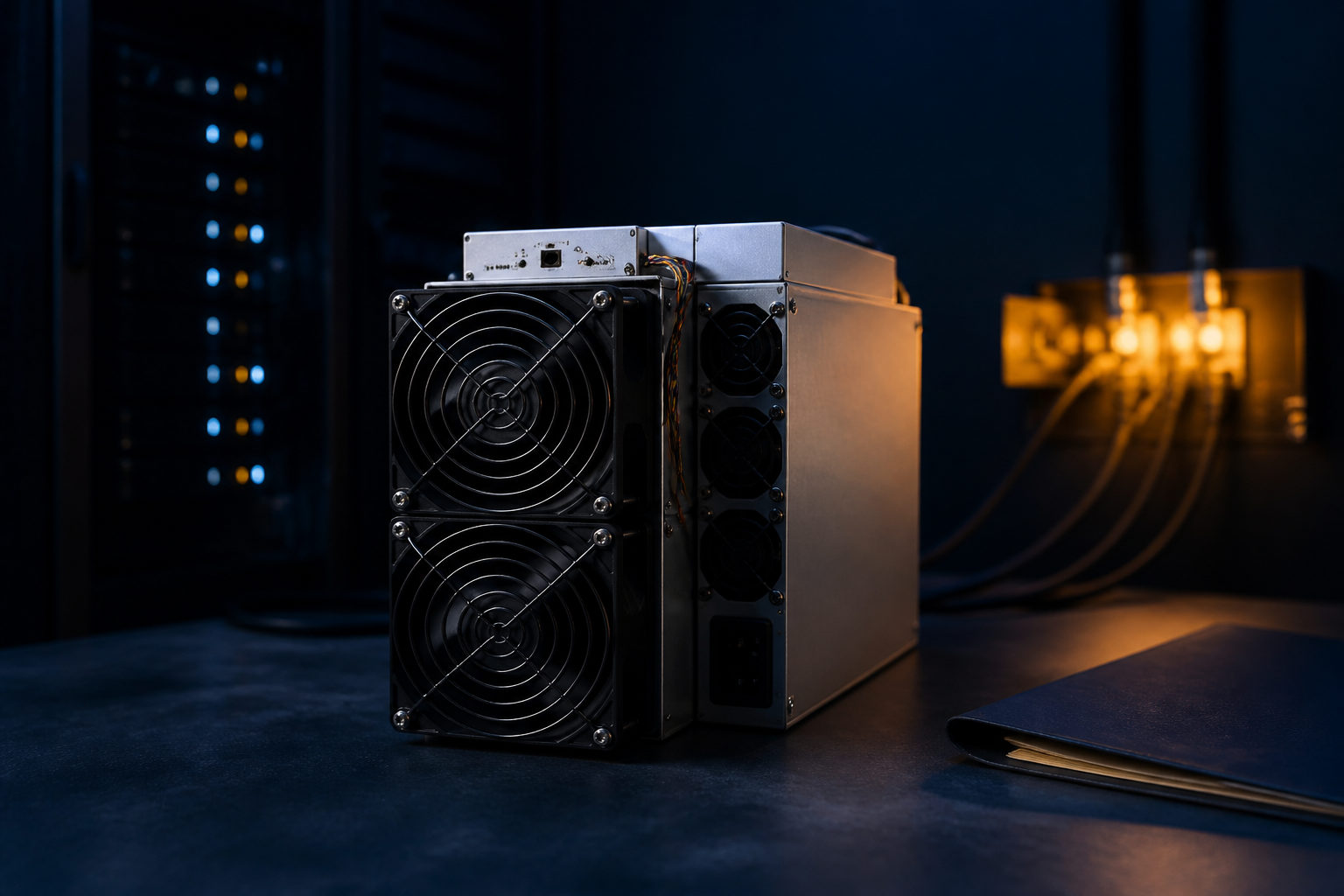
A real bitcoin miner that pays is not a single machine with guaranteed income. Whether mining works for you depends on electricity cost, hardware efficiency, uptime, hosting terms, and how payouts are actually handled.
Think of bitcoin mining as a bookkeeping race
The easiest way to understand mining is to picture a nonstop competition to win the right to add the next page to a public ledger. Bitcoin miners around the world run specialized hardware and try to find a valid result before everyone else. When a block is found, the miner who wins that round can receive the block reward plus transaction fees.
That does not mean every machine produces a steady paycheck. A miner is just a device built for one task. It burns electricity to perform calculations, and its value comes from whether those calculations can be run at a lower cost than the bitcoin earned through the process. The Bitcoin network targets about 10 minutes per block. After the 2024-04-19 halving, the current block reward is 3.125 BTC. With roughly 144 blocks per day, the network adds about 450 BTC daily. That figure is for the whole network, not for one home miner, one hosting company, or one mining farm.
Bitcoin also has a hard supply cap of 21,000,000 BTC, expected to be fully issued around 2140. The block reward halves every 210,000 blocks, roughly every 4 years. Those rules matter because mining is built on scarcity and competition. The same machine can look acceptable in one setup and unworkable in another.
| Stable network fact | Why it matters for miners |
|---|---|
| About 10 minutes per block | Your machine does not speed up Bitcoin's schedule; it only competes for a share of it |
| Current reward: 3.125 BTC | This defines the base new issuance miners compete for today |
| About 450 BTC added daily network-wide | Shows that all miners are chasing one shared pool of new coins |
| Halving every 210,000 blocks | Older and less efficient machines face more pressure over time |
| Hard cap: 21,000,000 BTC | Explains why mining is a scarce issuance process rather than unlimited production |
What counts as a real bitcoin miner
When people search for “a real bitcoin miner that pays,” they usually mean more than a box with fans and flashing lights. They want to know whether the machine performs real Bitcoin mining work, whether the payout logic is tied to actual hashpower, and whether funds can be withdrawn under clear rules.
In practical terms, a real Bitcoin miner is an ASIC machine designed for Bitcoin mining. It should connect to a standard mining setup and produce results based on real network participation, often through a mining pool. If a service talks about mining but never explains the hardware, where it runs, how fees are deducted, or how payouts are settled, that gap matters more than the marketing language.
A big warning sign is any claim of fixed returns. Real mining income moves with network conditions, fees, uptime, and operating costs. If a seller promises a set daily percentage, a guaranteed payback, or “risk-free” mining income, that message does not match how Bitcoin mining actually works.
| Checkpoint | Healthier sign | Red flag |
|---|---|---|
| Hardware type | Clearly identified as a Bitcoin ASIC miner | Vague labels such as smart node or AI miner with no hardware detail |
| Payout explanation | States that results depend on costs, uptime, difficulty, and pool terms | Promises fixed or guaranteed returns |
| Fee structure | Power, hosting, and repair costs are broken out separately | Charges are bundled so you cannot see the true operating cost |
| Withdrawal rules | Clear settlement cycle and wallet payout conditions | Easy deposits, unclear withdrawals |
| Exit path | Explains resale, relocation, or contract termination terms | Focuses only on getting you in |
How people usually participate today
For most individuals, there are three common ways to join Bitcoin mining: buy a machine and run it yourself, buy a machine and place it in a hosting facility, or buy a cloud mining contract. All three can be connected to real mining, but the trade-offs are very different.
Running a machine yourself gives the most control. You know where the hardware is, you can inspect its condition, and you decide how to manage it. The downside is also obvious. ASIC miners are loud, hot, and power-hungry. A home setup can run into problems with ventilation, noise, wiring limits, and local power prices very quickly.
Hosted mining is common because it shifts those practical burdens to a professional site. You own the machine, while the facility handles power, cooling, connectivity, and routine maintenance. This can be a workable route, but the contract deserves close reading. Who pays if the machine goes offline? What happens if repairs are needed? Can you move the machine? How do you prove ownership? Many bad outcomes come from weak terms, not fake machines.
Cloud mining has the lowest entry barrier, and that is exactly why it needs the most caution. Since you do not see the hardware, transparency becomes the whole case. You need to understand where the hashpower comes from, what fees come off the top, when settlements happen, and under what conditions you can withdraw. If those points stay blurry, the low-friction pitch is not a benefit.
| Method | Best for | Main advantage | Main challenge |
|---|---|---|---|
| Self-hosting | People with space, technical comfort, and suitable power access | Highest control over the machine | Noise, heat, electrical demands, and maintenance |
| Hosted mining | People who want ownership without on-site operations | Professional environment for running the machine | Heavy reliance on the hosting agreement |
| Cloud mining | People who want low initial complexity | Easiest to start | Hardest to verify transparency and real economics |
Why “it mines” does not mean “it pays”
The most expensive mistakes in mining usually come from ignoring the cost stack. Electricity is near the top because the machine runs continuously. Hardware efficiency matters because two miners operating under the same power price can land in very different positions over time. Then come uptime, repair needs, pool fees, hosting fees, firmware issues, and operational discipline.
Competition is another reality people often underestimate. A machine that looks acceptable when you buy it may face more pressure later if newer hardware enters the market or if your operating conditions worsen. The halving cycle also matters. The previous halving dates were 2012-11-28, 2016-07-09, 2020-05-11, and 2024-04-19. The next one is expected around 2028. Each halving reduces the fresh block subsidy and puts weaker setups under strain first.
That is why the better question is not “Which miner always pays?” It is “Under my power rate, my hosting contract, my maintenance setup, and my exit options, does this machine still make sense?” That framing protects you from screenshot marketing and pushes you toward real due diligence.
| Cost or risk factor | Why it matters | What to verify |
|---|---|---|
| Electricity price | Directly shapes the ongoing cost of operation | Check whether there are extra charges beyond the headline rate |
| Efficiency | Determines how much power is used for each unit of work | Compare official specs with real-world reports |
| Uptime | No uptime means no output, while some costs may continue | Ask how downtime and service response are handled |
| Hosting terms | Affects repairs, relocation, and shutdown procedures | Read the service agreement line by line |
| Payout rules | Controls whether mined bitcoin can actually reach your wallet | Confirm settlement timing, thresholds, and wallet control |
FAQ
Can a home bitcoin miner still pay today?
It can, but home setups face tough practical limits. High power prices, noise, heat, and ventilation issues often do more damage to the economics than beginners expect.
Is cloud mining always fake?
No. Some cloud products may map to real mining activity, but you have to judge them by transparency, fee disclosure, and withdrawal rules rather than branding alone.
Does joining a mining pool guarantee profit?
A mining pool can change how payouts are smoothed and how fees are charged. It cannot fix an uncompetitive power cost or turn weak hardware into a strong setup.
What is the smallest amount of bitcoin a miner can receive?
The smallest unit is 1 satoshi, equal to 0.00000001 BTC. Actual payout amounts depend on your share of work, pool policy, and the minimum withdrawal threshold.
Is it too late to buy a bitcoin miner now?
Late and early are not the key filters. The better test is whether your operating conditions are good enough to support the machine through normal competition and future pressure.
Use this checklist before you spend anything
Confirm that the machine is a Bitcoin ASIC miner, then compare power cost, hosting fees, repair responsibility, payout rules, proof of ownership, and exit terms in one place. If a seller avoids the cost discussion, pushes guaranteed returns, or stays vague on withdrawals, stop there; a real bitcoin miner that pays should survive detailed questions, not depend on trust alone.
Disclaimer: This article is for informational and educational purposes only and is not investment, financial, or legal advice. Crypto assets are highly volatile and you could lose your entire investment. Do your own research and decide carefully.