
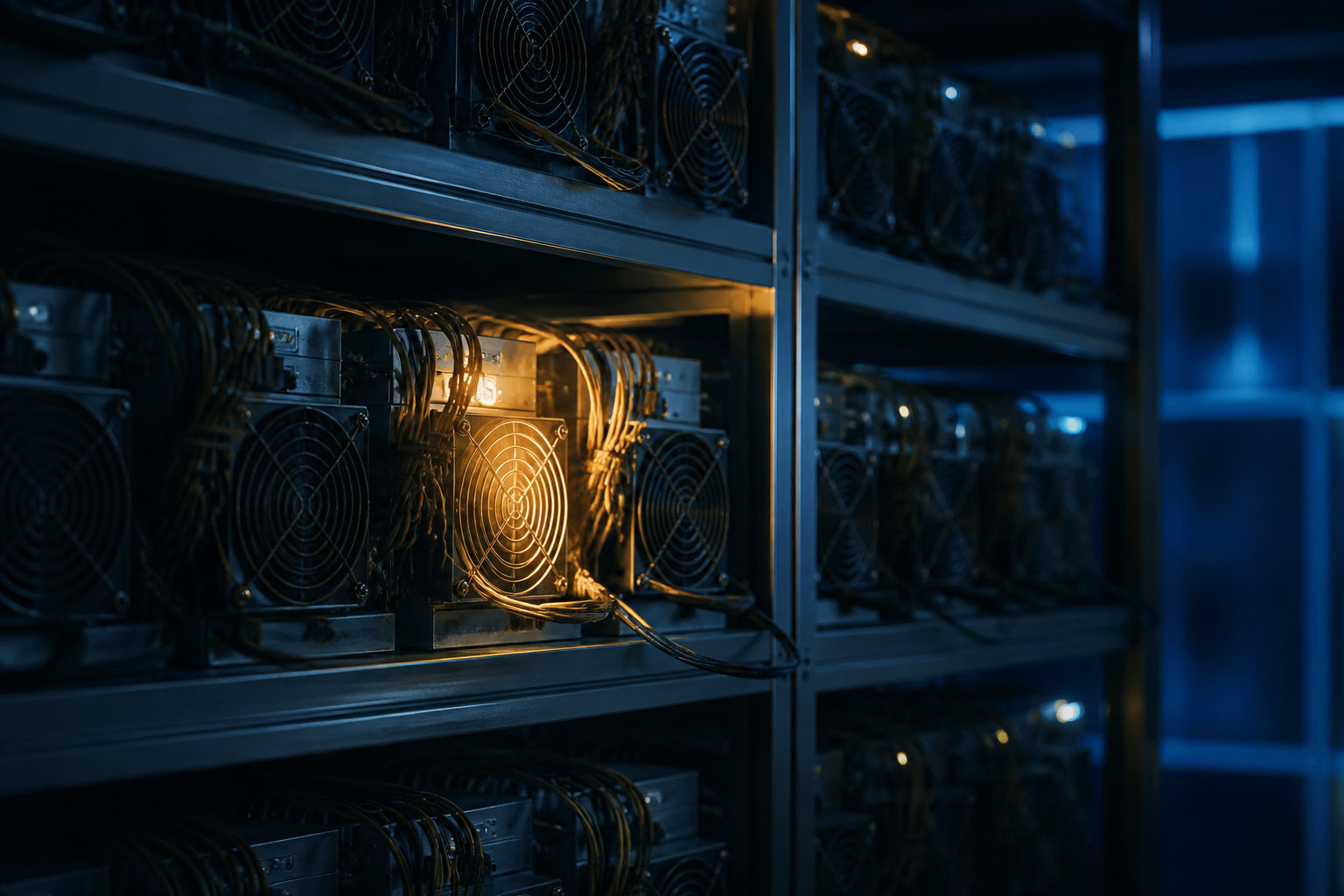
MARA does not mine a fixed number of bitcoins per day. Its daily bitcoin output changes with network competition, machine performance, uptime, and operating conditions, so the right way to answer this question is to explain how a mining company actually earns coins.
MARA is competing for blocks, not collecting a daily paycheck
People often picture bitcoin mining as a steady production line: turn on machines, wait, and coins come out at a predictable rate. That picture misses how mining works. A company like MARA is using computing power to compete for the right to add blocks to the Bitcoin blockchain.
When one of its machines, usually through a mining pool setup, helps find a valid block, the reward comes from that block plus transaction fees. That means the question “how many bitcoins does MARA mine a day” has no permanent fixed answer. One day may look strong, another may look weak, even if the company did not change its strategy at all.
This is why daily output should be read as a short snapshot, not as a guaranteed production promise. If you want to understand MARA, the useful question is what affects its chances of winning blocks over time.
What changes MARA’s daily bitcoin output
| Factor | What it affects | Why daily output can change |
|---|---|---|
| Network hash competition | Chance of finding blocks | More competing hash power means a smaller share of block wins for each miner |
| Mining difficulty | How hard it is to find a valid block | Higher difficulty can reduce output from the same fleet of machines |
| Machine efficiency | Hash rate per unit of power | Hardware generation, wear, and tuning all affect real performance |
| Power and site conditions | Uptime and stability | Maintenance, cooling issues, curtailment, or outages can take machines offline |
| Pool and payout method | How production appears in reports | Different payout structures can smooth or reshape short-term results |
| Halving cycle | New bitcoin issued per block | Bitcoin halves the block subsidy about every 4 years, or every 210,000 blocks |
That table explains why a headline number can mislead. A company may have large installed capacity on paper, yet actual output on a given day still depends on whether machines were online, how the network behaved, and how rewards were accounted for.
Bitcoin adds a block about every 10 minutes, but those blocks are not distributed evenly across miners in short windows. Probability matters. Even a large public miner can have daily swings that look surprising if you expect factory-style consistency.
Why a large miner can look steady without having a fixed daily number
Scale helps. A company with more machines, more sites, and deeper operating support can usually smooth out some of the noise that a small home miner would face. Over a longer period, that often makes results look more stable. Still, stable does not mean constant.
A simple comparison helps: imagine a long series of public drawing rounds, where each ticket represents hash power. MARA may hold many more tickets than a hobby miner, so its odds over time are better. Yet no rule says it must win the same amount every day. Short-term variation is built into the process.
This also explains why monthly production figures often say more than a single day. A longer time frame captures real operating trends, such as whether machines were added, whether sites ran smoothly, or whether downtime became a problem.
Another common point of confusion is the difference between bitcoins mined and bitcoins held. Mined bitcoin refers to production. Held bitcoin depends on treasury choices as well, including whether the company sold coins, retained them, or used them for broader corporate purposes. Mixing those ideas can lead to poor conclusions about the business.
Can an individual participate the way MARA does?
In theory, yes. In practice, it is much harder than many newcomers expect. Anyone can study the mining process, buy hardware, and connect to a pool. Running mining equipment in a sustainable way is the difficult part.
| Path | Best for | Main benefit | Main reality check |
|---|---|---|---|
| Buy your own mining hardware | People who want direct hands-on exposure | Full control over setup and operation | You must handle power, heat, noise, repairs, and deployment |
| Join a mining pool | People who want less visible payout volatility | Smoother reward distribution than solo mining | You still carry hardware and operating burdens |
| Buy shares of a mining company | People who want exposure to mining as a business | No need to run machines yourself | You are buying company risk, not directly owning bitcoin |
| Buy bitcoin directly | People who mainly want price exposure | Far simpler path to holding BTC | This is not mining and teaches little about mining operations |
Many readers who ask about MARA’s daily mining output are really asking a broader question: how should I take part in bitcoin? The answer depends on your goal. If you want to understand block production, mining is worth studying. If you mainly want exposure to BTC, direct ownership or other market routes may fit better.
Cost is the part many people skip too quickly. Mining is not just about plugging in a machine. Power access, cooling, maintenance, hardware selection, and downtime can matter more than the first setup step. Without those pieces, it is easy to overestimate what mining looks like outside a large industrial operation.
When judging MARA, daily production is only one piece
It is easy to focus on a single question: how many bitcoins did MARA mine today? That number matters, but it does not stand alone. A stronger reading comes from looking at operating quality: machine deployment, uptime, site reliability, power access, and how the company handles the tighter economics that follow each halving cycle.
Bitcoin has a capped supply of 21 million coins. The subsidy schedule changes over time, with halvings in 2012, 2016, 2020, and 2024. As new issuance slows, miners face a tougher environment where efficiency and discipline carry more weight.
So if you are trying to track MARA, the practical move is to check the company’s public disclosures or widely used market data sources for recent production updates. Then ask what stood behind the number: more machines online, operational interruptions, changes in network competition, or a mix of all of them.
FAQ
Does MARA mine the same amount of bitcoin every day?
No. Bitcoin mining has a probabilistic element, so daily output can move around even when the company’s fleet stays largely the same. A longer reporting window usually gives a cleaner view of actual performance.
Why can a mining company have strong output but still be a risky investment?
Because production is only one part of the picture. Investors also need to think about operating costs, fleet quality, downtime, balance sheet choices, and how management responds when mining conditions get tighter.
Can home miners compete with a company like MARA?
Home miners can participate, but matching industrial scale is unrealistic for most people. The gap is not only about machine count; it also includes power terms, cooling design, maintenance capacity, and operating discipline.
Does joining a pool decide how much bitcoin MARA mines in a day?
A pool can change how rewards are distributed and how smooth results appear, but it does not remove the core drivers. Hash rate, uptime, difficulty, and block-finding probability still shape the outcome.
What should I watch if I want to follow MARA more intelligently?
Look beyond one-day output. Production trends over time, deployment progress, uptime, and signs of operating strain usually tell you more than an isolated daily figure.
If you want a useful next step, define your goal first. If you are studying MARA as a miner, focus on operating conditions. If you are trying to gain bitcoin exposure, compare mining, mining stocks, and direct BTC ownership before you act.
Disclaimer: This article is for informational and educational purposes only and is not investment, financial, or legal advice. Crypto assets are highly volatile and you could lose your entire investment. Do your own research and decide carefully.