
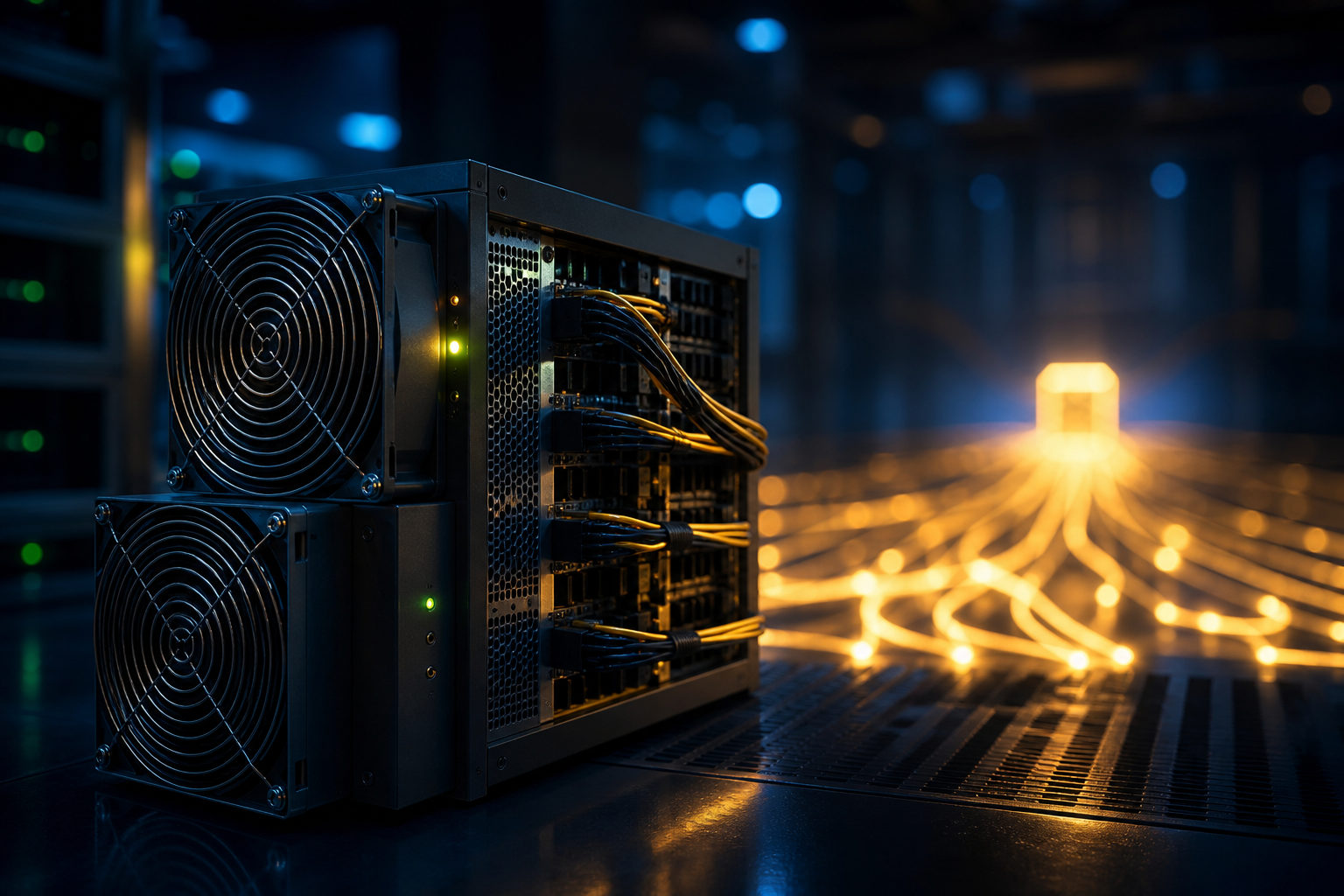
If you want to know how to mine bitcoin faster, focus on three things: raise effective hash rate, reduce downtime, and use a mining setup that stays stable under load.
First, define what “faster” means in bitcoin mining
Bitcoin mining is a nonstop race to add the next block. The network produces a block about every 10 minutes, and miners compete by making huge numbers of guesses until one valid result is found. In that context, “faster” means increasing the number of useful attempts your hardware can make and submit over time.
That sounds simple, but many beginners aim at the wrong target. A louder fan, a busier dashboard, or higher power draw does not automatically mean better mining performance. What matters is effective hash rate: the portion of your machine’s work that stays online, avoids errors, reaches the pool on time, and keeps running for long stretches.
What actually affects mining speed
The most obvious factor is hardware capability, but it is only one part of the job. A miner with strong advertised specs can still perform badly if it overheats, disconnects, or runs unstable settings. Speed in bitcoin mining comes from a chain of conditions working together, not from one headline number.
| Factor | Why it matters | Common mistake |
|---|---|---|
| Hash rate | More computing attempts increase your chance of finding valid work | Looking only at peak output |
| Uptime | An offline miner contributes nothing at all | Treating short disconnects as harmless |
| Cooling | Heat can trigger throttling, errors, or reboots | Assuming fan speed alone fixes thermal issues |
| Power stability | Bad power can lead to crashes and hardware faults | Ignoring the quality of the electrical setup |
| Pool latency | Slow connections can delay or reduce accepted work | Choosing a pool by name alone |
| Firmware and settings | Poor tuning can create more rejects and instability | Chasing screenshots instead of long-run output |
So when people ask how to mine bitcoin faster, the useful answer is often less dramatic than they expect. You are trying to increase accepted work over time. A machine that looks impressive for a short burst but crashes later is usually worse than one that runs cleanly all day.
Practical ways to mine bitcoin faster
Choose the right participation model
For most individuals, the first real improvement is not a hardware tweak. It is deciding whether to mine solo or join a pool. Solo mining means your hardware competes on its own, which can lead to long waits and very uneven results. Pool mining combines many miners, then distributes outcomes according to the pool’s rules.
| Method | How “fast” it feels | Best fit | Main concern |
|---|---|---|---|
| Solo mining | Can feel very slow for long periods | Operators with strong hardware and technical control | Very high variance |
| Pool mining | Usually gives a steadier sense of progress | Most individual miners | Pool quality and connection path matter |
Joining a pool does not create extra hash rate out of thin air, but it often makes your work show up in a more regular way. For many readers, that is the most realistic meaning of mining bitcoin faster.
Improve uptime before touching performance settings
A lot of miners start with overclocking because it feels like a direct shortcut. In practice, stable uptime is often the better first move. Check your network path, backup pool addresses, restart behavior after a power event, and any monitoring tools that can warn you when the machine drops offline.
This work is less exciting than changing frequency values. It is also where many gains come from. If your miner is disconnected, your theoretical speed does not matter.
Cooling often does more than aggressive tuning
Mining hardware runs under heavy load for long periods, and thermal control affects real output. If intake airflow is poor, dust builds up, or hot air is trapped around the machine, performance can fall even when the settings look correct. Heat can also shorten stable operating windows, which hurts accepted work.
A better approach is to fix the environment first. Clear airflow paths, keep vents clean, and watch for signs that the unit is throttling or restarting under stress. Once the machine can hold its operating state, tuning becomes more meaningful.
Use tuning carefully and judge it by accepted work
Overclocking can raise hash rate, but it can also increase hardware errors, rejected shares, and unexpected restarts. That tradeoff is why “faster” should be measured by sustained accepted performance, not by a brief number on a screen.
Make one change at a time and let the machine run long enough to expose weaknesses. If a setting produces more faults, more stale work, or more downtime, then it is not a real speed gain even if the displayed hash rate rises.
The hard limit: cost and operating reality
Bitcoin has a fixed supply cap of 21 million coins, and mining competition exists inside that rule set. For individual operators, the biggest barrier to mining faster is often not software skill. It is access to suitable power, enough cooling, noise tolerance, hardware maintenance, and the discipline to keep the setup reliable.
That is why it helps to separate two ideas. One is mining faster in the technical sense: more accepted work over time. The other is getting better economic results. The first can improve through engineering choices; the second depends on outside conditions as well, so there is no single switch that solves it.
| Action | Possible benefit | Tradeoff |
|---|---|---|
| Upgrade hardware | Higher raw hash rate | Higher purchase, cooling, and power demands |
| Move to a better pool | Smoother submission and fewer connection issues | Requires comparing rules and endpoints |
| Improve ventilation | Less throttling and fewer thermal faults | Noise and space management |
| Raise tuning values | Potentially more peak output | More errors and stability pressure |
| Add monitoring | Faster response to downtime | Needs setup and maintenance |
Many failed attempts to speed up mining follow the same pattern: settings go up, temperatures rise, faults increase, and uptime falls. The setup looks more aggressive, but real performance slips. In mining, durability often beats drama.
FAQ
Can a normal PC mine bitcoin faster with software tweaks?
In most cases, no. Bitcoin mining is dominated by specialized hardware, so software alone cannot turn a regular computer into a competitive miner.
A PC can still help you learn the process, but learning and competitive mining are different goals.
Does joining a pool mean I will get bitcoin faster?
A pool usually gives you a steadier view of your contribution, so it can feel faster. What it changes is variance, not the physical computing power of your machine.
Pool choice still matters. A poor connection or unclear rules can cancel out part of that advantage.
Is overclocking the fastest way to improve bitcoin mining?
It is one possible tool, but not always the best one. If higher settings create more rejects or downtime, then the apparent gain is misleading.
Many miners get better results by fixing uptime and cooling first, then tuning with caution.
Does fan speed alone make bitcoin mining faster?
Not by itself. Fan speed is only one part of thermal management, and bad airflow, dust, room heat, or cramped placement can still hold performance back.
If the root problem is unstable power or poor tuning, a louder fan will not solve it.
How should I think about bitcoin price if my goal is faster mining?
Price can shape expectations, but it does not change how quickly your machine can produce accepted work. To check live price, use a major market data platform; to improve mining speed, look at hardware behavior and operating discipline.
Keeping those questions separate leads to better decisions.
If you plan to optimize your setup, start with a short checklist: confirm stable pool connections, add a backup endpoint, watch for offline periods, clear airflow paths, and keep settings conservative until the machine proves it can run cleanly. Those steps are less flashy than a hard tune, but they are closer to what actually helps you mine bitcoin faster.
Disclaimer: This article is for informational and educational purposes only and is not investment, financial, or legal advice. Crypto assets are highly volatile and you could lose your entire investment. Do your own research and decide carefully.