
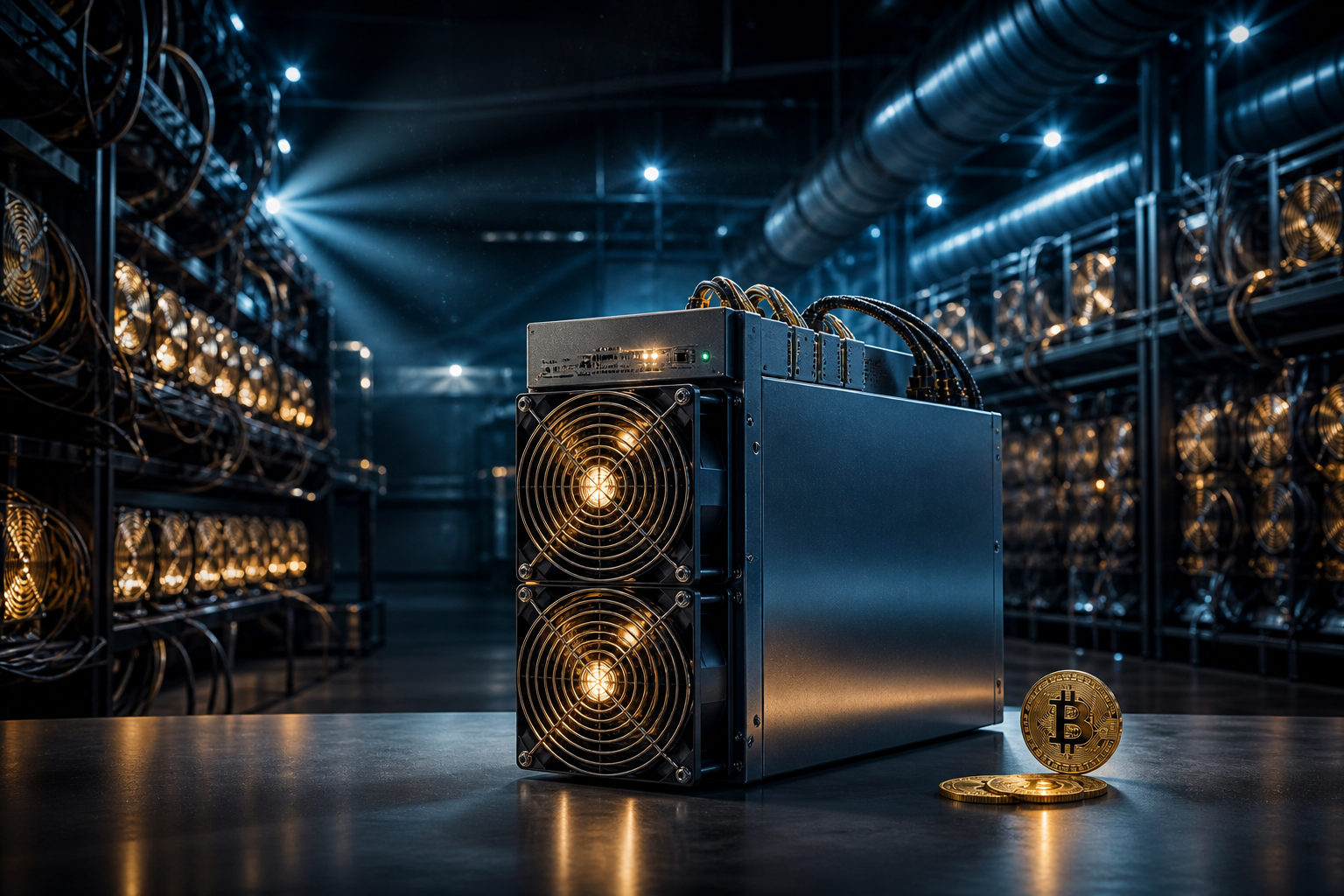
Yes, Bitcoin is still being mined. As long as new blocks keep getting added to the network, mining continues, even though the way people participate today is very different from the early years.
Why Bitcoin is still being mined
A simple way to picture Bitcoin is to treat it as a public ledger that many computers check together. Roughly every 10 minutes, the network groups pending transactions into a new block, and miners compete for the right to add that block to the chain. That competition is what people mean when they talk about Bitcoin mining.
Bitcoin is still being mined because its supply was not released all at once. The protocol sets a hard cap of 21 million coins, and new coins enter circulation through block rewards over time. Until that issuance is fully exhausted, miners keep competing for rewards and transaction fees.
There is also a second point that matters. Mining is not only about releasing new bitcoin. Miners also validate and package transactions into blocks, helping the network maintain a shared version of the ledger. In practice, they are part of the system that keeps Bitcoin running without a central operator.
This is where many readers get tripped up. “Still being mined” is a different question from whether mining is easy, cheap, or suitable for an individual. Mining still exists. The economics of doing it well are a separate issue.
Think of mining as a bookkeeping race
The bookkeeping race analogy works because it shows what miners are actually doing. The network presents a set of rules. Miners take candidate transactions and keep trying different inputs until one of them finds a result that matches the required conditions. When that result is broadcast, other nodes can check it quickly. If it passes verification, the block is accepted and the next round starts.
This system is known as proof of work. The process does not reward clever guessing in the usual sense. It rewards the ability to keep performing valid computational work at scale. That is why modern Bitcoin mining has become closely tied to specialized hardware, reliable power, cooling, uptime, and operational discipline.
Miners are typically paid from two sources. One is the block reward set by the protocol. The other is transaction fees paid by users. Over time, the block reward declines through halving events. Bitcoin halvings took place in 2012, 2016, 2020, and 2024. A halving does not mean mining stops; it means the newly issued part of the reward gets smaller, which puts more pressure on efficiency and cost control.
Bitcoin is also divisible. Its smallest unit is the satoshi, and 1 satoshi equals one hundred millionth of 1 BTC. That matters because the network can support very small denominations even though people often talk about bitcoin in whole coins. It also helps explain why mining rewards, fees, and user balances can all be handled with fine precision.
Can individuals still mine Bitcoin today?
Yes, individuals can still participate, but that does not mean solo mining is practical for most people. Today, Bitcoin mining usually involves specialized machines, a stable internet connection, a suitable place to run hardware, and a wallet that you control. Heat, noise, maintenance, and power bills are part of the job from day one.
Most people who enter mining look at two broad paths. The first is solo mining, where you run your own machines and try to find blocks on your own. That gives you full control, but it also exposes you to very uneven results. The second is joining a mining pool, where many participants combine computing power and receive payouts based on the pool’s rules. A pool does not change Bitcoin’s protocol. It changes how results are distributed among participants.
For beginners, pools are often easier to understand in practice because they smooth out the randomness of block production. Still, pools are not a shortcut around risk. Different pools use different payout methods, fee structures, withdrawal rules, and operating policies. You need to read those terms with care.
Another area that needs caution is cloud mining or hosted mining offers. These may sound like simple ways to access Bitcoin mining without running hardware yourself, but the details matter a lot. Contract terms, machine ownership, downtime handling, fees, and payout calculations can vary widely. If you do not understand what exactly you are buying, you are not really assessing the risk.
What to check before you even consider mining
- Hardware: Bitcoin mining usually depends on specialized mining machines rather than ordinary home computers.
- Power cost: Electricity is often one of the biggest ongoing expenses.
- Cooling and noise: Mining hardware produces heat and noise that many living spaces cannot handle well.
- Pool rules: Payout models, fees, and withdrawal conditions differ from one pool to another.
- Wallet security: You need a wallet you control, along with sound private key management.
- Local compliance: Power use, equipment deployment, and tax treatment depend on where you live.
Why people think Bitcoin might already be “mined out”
That belief usually comes from mixing up scarcity, difficulty, and issuance. When people hear that mining is harder or more competitive than it used to be, they may assume the process is nearly over. What has changed, though, is the competitive environment, not the fact that new blocks are still being created.
Another source of confusion is the halving schedule. A halving reduces the block reward on a set timetable, about every 210,000 blocks, or roughly every four years. It does not drop the reward to zero overnight. Bitcoin began with the genesis block in January 2009, and its issuance schedule has been part of the design from the start.
The early design was introduced in the 2008 white paper, Bitcoin: A Peer-to-Peer Electronic Cash System, by the pseudonymous creator Satoshi Nakamoto. That document explains the core idea of a peer-to-peer cash system that does not depend on a central party to maintain the ledger. Mining is central to that design because it ties transaction ordering and network security to measurable computational work.
It also helps to avoid a narrow view of mining as nothing more than coin creation. Miners are part of the mechanism that confirms transactions and extends the blockchain. Even if someone focuses only on supply, the operational role of miners still matters to how Bitcoin functions.
Mining is real work, not a one-click income stream
Many readers who ask whether Bitcoin is still being mined are really asking whether it is worth doing. That question cannot be answered without looking at costs. Mining is closer to an infrastructure business than a casual hobby. Buying a machine is only the first step; after that come electricity, cooling, maintenance, downtime risk, internet stability, and hardware wear.
There are market risks as well. The value of the bitcoin you receive can change. Pool terms may not match what a new user expected. A machine can fail. A hosted arrangement may be less transparent than the sales page suggests. Even without quoting any return figures, one fact is clear: Bitcoin mining today is a competitive, operationally demanding activity.
For many ordinary users, the more sensible first step is not buying mining equipment. It is learning how Bitcoin works at a base level: how wallets work, how private keys should be protected, how transaction confirmation works, and why fees can vary. Once you understand those pieces, you are in a much better position to judge whether mining itself makes sense for you.
FAQ
Are new bitcoins still being created?
Yes. New bitcoin continues to enter circulation through block rewards as new blocks are added to the blockchain.
That said, “still being created” does not mean mining is easy for individuals. Participation has become much more specialized and cost-sensitive.
Can I mine Bitcoin with a regular home computer?
You can study the concept with ordinary hardware, but that is not the same as being competitive in actual Bitcoin mining. In practice, Bitcoin mining today usually depends on specialized machines.
If your goal is education, a home setup can help you understand the process. If your goal is real mining, you need to evaluate the full operating picture.
Is joining a mining pool better than mining alone?
For many newcomers, a pool is easier to work with because payouts are less uneven than solo mining. It gives you a clearer view of fees, payout rules, and how day-to-day participation works.
Still, a pool is not risk-free. You should review its terms, fee model, withdrawal conditions, and custody practices before committing your hardware.
Does halving mean Bitcoin mining is ending?
No. Halving means the block reward is reduced on a fixed schedule. Bitcoin halvings took place in 2012, 2016, 2020, and 2024.
Mining continues after each halving because blocks are still produced. What changes is the reward structure and the pressure on operating efficiency.
If I do not plan to mine, is this still worth learning?
Yes. Mining helps explain how Bitcoin confirms transactions, orders them into blocks, and keeps a decentralized ledger consistent.
Even if you only want to hold or use bitcoin, understanding mining gives you a better grasp of confirmation, fees, and network security.
If you want to explore Bitcoin mining seriously, start by writing down five things: hardware source, electricity setup, cooling plan, pool terms, and wallet security. If any one of those is still fuzzy, stop there and clear it up before spending money.
Disclaimer: This article is for informational and educational purposes only and is not investment, financial, or legal advice. Crypto assets are highly volatile and you could lose your entire investment. Do your own research and decide carefully.