
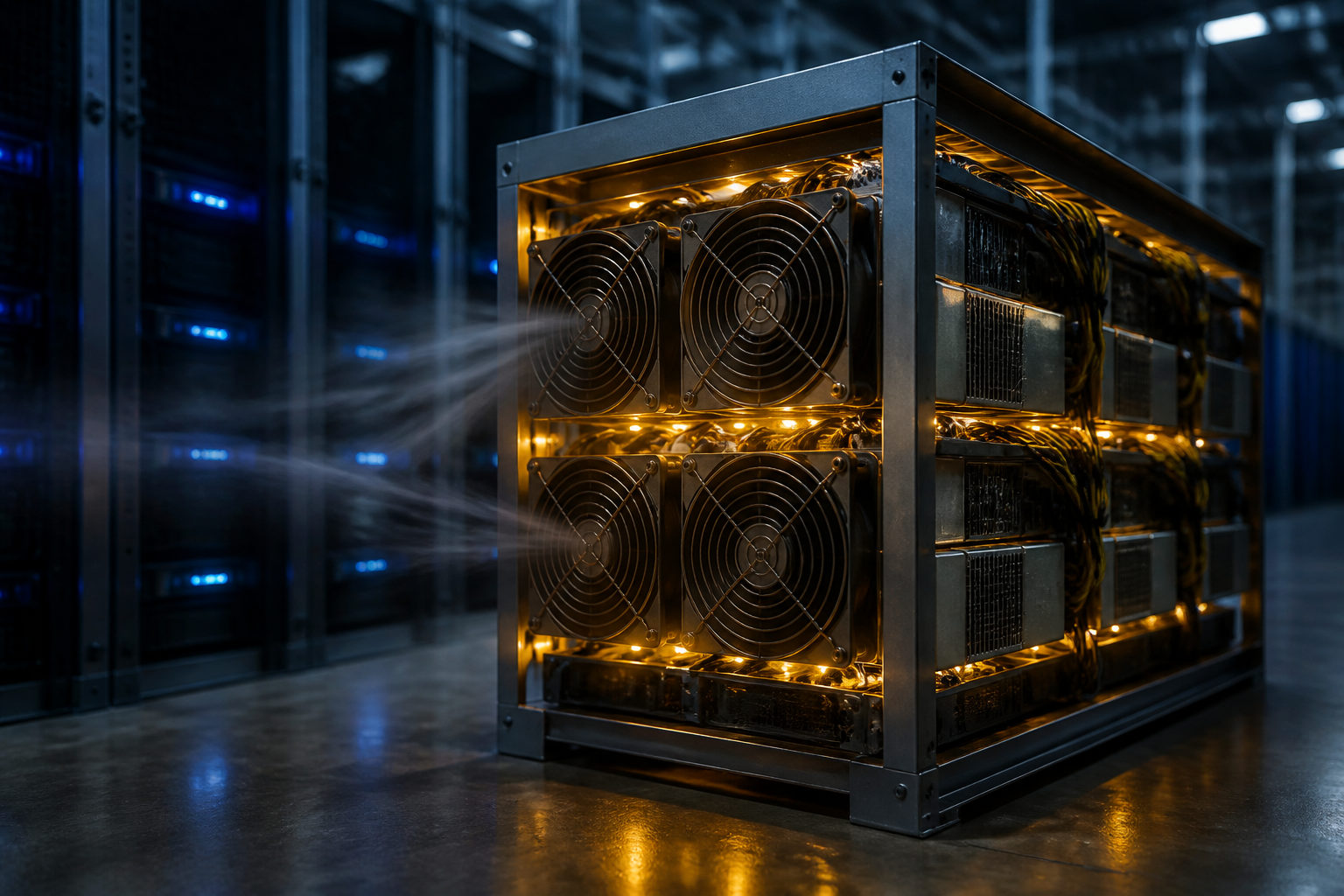
Bitcoin mining uses so much energy because the network secures itself through an open computing race. The heavy power draw comes from nonstop competition for block production, not from simply writing transactions into a ledger.
Think of mining as a public bookkeeping contest
Bitcoin is a shared ledger open to anyone who wants to verify what happened on it. Roughly every 10 minutes, a new block is added, becoming the next accepted page in the record.
No editor picks who adds it, and no central operator assigns turns. Miners compete by running repeated calculations until one finds a result that fits the network’s rules. The energy story comes from scale: the same kind of attempt, over and over, across a huge number of machines.
Many people picture mining the wrong way and assume each transaction is so hard to process that the system burns power on bookkeeping itself. What actually burns the power is the race. Everyone is competing at once, and only one participant wins each round.
Why the design pushes energy use upward
Bitcoin uses proof of work. The system requires participants to spend real-world resources before they can win the right to produce a block. That cost is part of the security model.
If rewriting the ledger were cheap, attacking the network would also be cheaper. Proof of work raises that barrier by forcing competitors to commit computing power and electricity first.
Three features turn that trade-off into high energy use. First, the contest is open, so if mining remains attractive, more hardware can enter. Second, the contest never stops; the network keeps going day and night. Third, difficulty adjusts. Even if extra machines come online, block creation still stays near the same rhythm, about one block every 10 minutes, so added hardware does not make the process finish sooner. It often means more total power is being spent to compete for the same flow of block opportunities.
| What you see | What is happening underneath | Why energy use rises |
|---|---|---|
| Many miners compete at once | Block production is awarded through competition | Large numbers of machines run in parallel |
| The network keeps running | Blocks continue on a fixed rhythm | Mining hardware stays active for long periods |
| More machines can join | Participation is open | Total power committed to mining can grow |
| Blocks do not arrive much faster | Difficulty adjusts | Extra computing power does not remove the race |
The shortest honest answer is this: electricity acts as a real cost that helps defend the ledger against cheap manipulation.
What a mining machine actually does
A mining machine has a narrow job. It keeps trying new hash outputs to see whether one meets the current network target. It is doing specialized, repetitive work at high speed.
Once competition got tougher, general-purpose computers lost ground to specialized machines built for this exact task. A home computer may still run mining software, but that does not mean it is likely to compete well in practice.
In practice, mining involves heat, noise, power bills, and hardware wear.
| Way to participate | Main trait | Practical limit |
|---|---|---|
| Home computer | Easy to try in theory | Low efficiency and noticeable heat and power costs |
| Specialized mining machine | Built for mining work | Needs equipment, space, cooling, and upkeep |
| Mining pool | Combines computing power with others | Does not erase competition or operating costs |
Mining pools are a coordination method, not a magic shortcut. Many miners combine their computing power so the group has a steadier chance of earning block rewards, then the result is split by the pool’s rules. That can smooth volatility in outcomes, but it does not make electricity disappear.
High energy use is part of the model, but personal costs are another matter
From a protocol standpoint, the power draw is tied to how Bitcoin makes attacks expensive in the physical world.
For an individual miner, the tougher question is cost. Electricity is only the first line on the list. Cooling, noise, space, hardware aging, maintenance, and downtime matter too.
Real participation is closer to running hardware under continuous pressure. Anyone thinking about joining needs to understand that first.
Network-wide energy use does not guarantee personal success. The whole network can be consuming vast resources while a small operator still struggles with efficiency, operating conditions, or equipment quality.
You do not need to mine Bitcoin to use or study it
Many people asking this question are also asking whether they have to mine Bitcoin to get exposure to it. No. Mining is a specialized activity tied to network security. Someone who mainly wants to hold Bitcoin, send it, or understand how it works may be better served by learning wallets, private key handling, and transaction risk first.
If your question is really about price, check a major market data service for the live quote that day. Mining is not the only path into Bitcoin, and for many people it is not the sensible one to start with.
If you are still curious about mining, put three things on paper before you go further: the kind of hardware available to you, your electricity cost, and your cooling setup. Miss badly on any one of those, and the conversation changes very quickly.
| Your goal | What to focus on first | Do you need to mine? |
|---|---|---|
| Learn how Bitcoin works | Blocks, hashes, and proof of work | No |
| Use Bitcoin for transfers | Wallets and private key management | No |
| Assess mining participation | Electricity, cooling, hardware, and pool rules | Yes, with careful review |
FAQ
Why can’t Bitcoin mining use much less electricity?
Because proof of work depends on real, verifiable cost. If the computing effort were close to free, it would also be easier for an attacker to reproduce the same competitive power at lower cost.
Does more Bitcoin transaction activity always mean higher mining energy use?
No. Mining energy use is shaped more by network competition, hardware deployment, and difficulty adjustment than by the raw number of transfers on a given day.
Is mining Bitcoin with a regular computer still meaningful?
It can be useful as a hands-on way to understand the concept. As a practical mining setup, a regular computer usually runs into the limits of efficiency, heat, and power cost very quickly.
Does joining a mining pool reduce the energy problem?
Not by itself. A pool mainly changes how results are shared and how uneven outcomes feel over time; it does not automatically lower your machine’s electricity use.
Why do people compare Bitcoin mining with gold mining?
Because both involve spending real-world resources to obtain a scarce asset. The comparison helps with the idea of cost and scarcity, though the production process and network properties are very different.
Before you spend money on mining hardware, check power cost, ventilation, and machine type first.
Disclaimer: This article is for informational and educational purposes only and is not investment, financial, or legal advice. Crypto assets are highly volatile and you could lose your entire investment. Do your own research and decide carefully.