
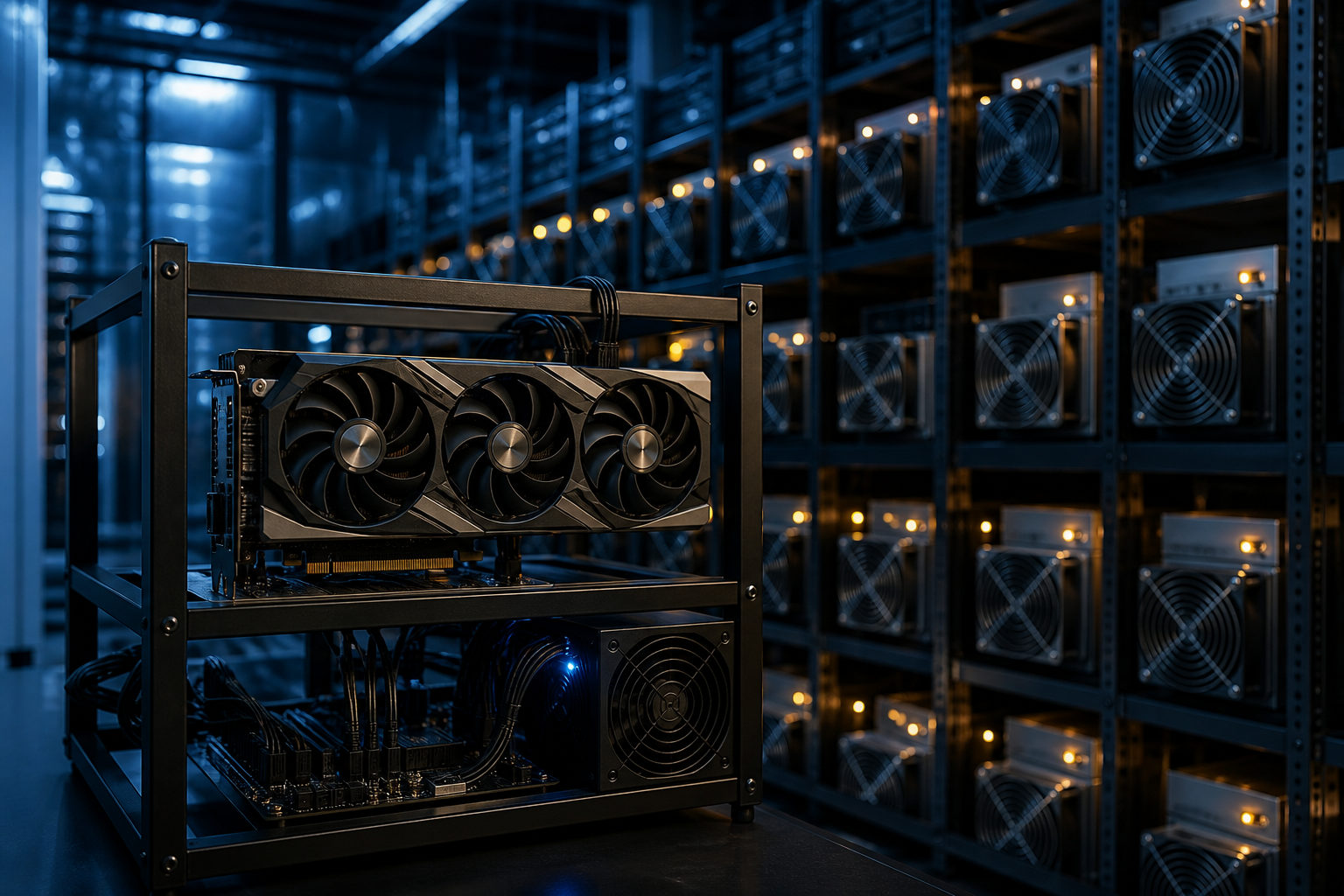
In 2026, GPU mining Bitcoin is usually not profitable. The main reason is simple: Bitcoin mining is built around hardware efficiency, and GPUs are generally a poor fit compared with specialized machines designed for Bitcoin’s proof-of-work process.
Think of Bitcoin mining as a nonstop bookkeeping race
A useful way to understand Bitcoin mining is to picture a constant race for the right to write the next page of a shared ledger. Many machines compete at the same time. The one that finds a valid result first gets the chance to package transactions into a new block and receive the block reward plus transaction fees.
Bitcoin’s system adjusts mining difficulty so that a new block is produced about every 10 minutes. That means the race never really gets easier in any lasting way. As more participants enter, competition increases, and weaker hardware falls behind.
That is why the question is not just whether a GPU can participate in Bitcoin mining. It can, in a technical sense. The real question is whether a GPU still has an economic edge in that competition by 2026. In most cases, it does not.
Why GPUs are not the standard tool for Bitcoin mining
Bitcoin uses the SHA-256 proof-of-work algorithm. In the early days, people experimented with general-purpose hardware such as CPUs and GPUs. Over time, mining shifted toward ASICs, which are application-specific integrated circuits built for one task: running that exact type of computation as efficiently as possible.
This distinction matters more than many beginners expect. A GPU is flexible. It can handle graphics, parallel workloads, and many kinds of computing tasks. That flexibility is valuable in several contexts. Bitcoin mining, though, rewards specialization. When a general-purpose device has to compete against hardware made for one narrow job, flexibility stops being a strength and starts becoming a handicap.
That is why articles, videos, or old forum posts about “mining with a graphics card” can be misleading if they are read without context. Mining is not one single activity across all crypto assets. Different networks use different algorithms, and the hardware that makes sense on one network may be a poor choice on another. For Bitcoin, the market has long been shaped by dedicated mining equipment rather than consumer GPUs.
What decides profitability in 2026
If someone asks whether GPU mining Bitcoin is profitable in 2026, the only useful answer is one that breaks profitability into parts. There is no honest shortcut. Without real-time market data, the right approach is to explain the structure of the decision instead of pretending there is a universal yes or no that applies to everyone.
Power cost is a permanent pressure
Mining hardware runs for long periods, so electricity is not a side expense. It is one of the central variables. Even if a setup looks manageable on day one, ongoing power consumption can erase any potential upside over time.
People also tend to underestimate indirect power use. Heat management matters. Extra fans, ventilation, and cooling can raise total consumption. In a home setting, there is also the practical issue of circuit limits, noise, and the effect on daily living conditions.
Hardware depreciation is real
A GPU is not a static asset. It wears down under sustained load, its fans and cooling components age, and its competitive position can weaken as more efficient alternatives dominate the market. Even if the card still works, that does not mean it still makes sense for Bitcoin mining.
This is where opportunity cost enters the picture. If you already own a GPU, the relevant question is not just “can I use it for Bitcoin mining?” It is also whether using it that way is better than keeping it for gaming, creative work, computing tasks, or resale. “I already have the card” is not the same as “the card is free.”
Mining pools can smooth payouts, not fix bad hardware fit
Solo mining is highly impractical for most individuals because they are competing against the entire network on their own. Mining pools allow participants to combine computing power and receive smaller, more regular payouts according to pool rules. That can reduce the feeling of randomness.
Still, a mining pool does not transform inefficient hardware into efficient hardware. It changes payout variance, not the underlying competitiveness of your machine. Pool fees, payout terms, and operational reliability also matter, especially when the hardware you are using is already at a disadvantage.
Price and difficulty are separate forces
Many people focus only on Bitcoin’s market price when they think about mining returns. Price does matter, but it is only one side of the picture. Mining difficulty reflects how intense network competition is. If price rises while competition rises as well, weaker hardware may still struggle.
That is why a GPU setup should not be judged by market enthusiasm alone. In a mature mining environment, specialized efficiency often matters more than a hopeful story about future upside.
If your goal is exposure to Bitcoin, mining is not the only route
A lot of people searching this topic are not committed to mining as a lifestyle or business. They are trying to figure out whether there is a practical way to participate in Bitcoin using hardware they already own. That is a fair question, but it helps to separate “I want Bitcoin” from “I want to operate mining hardware.” Those are not the same goal.
Owning Bitcoin is different from mining Bitcoin
If the end goal is simply to gain exposure to Bitcoin, buying through a compliant exchange or broker is often more direct than trying to produce Bitcoin with unsuitable hardware. That path still involves market risk, but it avoids a long list of operational problems such as electricity planning, maintenance, thermal control, and hardware failure.
For many retail users, that distinction matters. Mining appeals to people who want to run infrastructure, not just hold the asset. If your interest is mainly in holding Bitcoin, GPU mining may be a detour rather than a solution.
Learn the mining model before buying equipment
If you are interested in mining itself, start with the business logic. Learn how block production works, how mining pools pay, how wallets are managed, how downtime affects results, and how heat, dust, and hardware maintenance shape real-world operations. Once you understand those basics, it becomes easier to see why ASICs became dominant in Bitcoin mining.
Many bad decisions start with the wrong first purchase. A person buys a GPU setup because it feels familiar, then tries to force it into a Bitcoin mining role that no longer suits it. The better order is the reverse: understand the network first, then decide whether any hardware commitment makes sense.
In many cases, a GPU is better used elsewhere
None of this means GPUs are useless. It means they are usually not the right economic tool for mining Bitcoin. A GPU may deliver more value in gaming, rendering, video work, machine learning tasks, or other workloads where its flexibility is actually an advantage.
That is an important framing shift. Profitability is not only about whether a device can generate something. It is also about whether that device is being used where it is strongest. In Bitcoin mining, a GPU is usually entering a race designed for a different class of machine.
Common mistakes beginners make
- Confusing technical possibility with economic sense: A setup that can run mining software is not automatically a setup that can make money.
- Looking only at Bitcoin’s price: Hardware efficiency and electricity costs often decide the outcome.
- Ignoring home operating conditions: Heat, noise, dust, and electrical strain are practical issues, not minor details.
- Assuming pools solve everything: Pools can change payout timing, but they do not erase weak hardware economics.
- Skipping security basics: Wallet setup, payout handling, and account protection matter even at the hobby level.
FAQ
Can a graphics card still mine Bitcoin in 2026?
Yes, in a narrow technical sense, a GPU can still take part in Bitcoin-related mining activity. The bigger issue is competitiveness, and in that respect GPUs are generally outmatched by ASIC miners.
Is home Bitcoin mining with a PC still worth trying?
It can be useful as a learning exercise if your aim is to understand pools, wallets, and proof-of-work mechanics. If your goal is ongoing profit, a home PC setup usually runs into power, noise, and heat limits quickly.
Does joining a mining pool make GPU Bitcoin mining profitable?
A pool can make payouts feel steadier because rewards are shared across participants. It does not change the fact that a GPU is usually not an efficient Bitcoin mining device in the first place.
What should I do if I want Bitcoin exposure but not mining headaches?
For many people, buying Bitcoin through a regulated service and learning safe wallet practices is more practical than trying to mine with consumer hardware. That approach does not remove risk, but it removes a large operational burden.
Before you decide, run this checklist
Make sure you are talking about Bitcoin specifically, not another crypto asset with a different mining algorithm. Check whether your hardware is actually a GPU rather than dedicated mining equipment. Then list your electricity cost, cooling needs, noise tolerance, maintenance time, pool fees, downtime risk, and the value of alternative uses for the card. If you cannot explain those factors clearly, GPU mining Bitcoin in 2026 is probably not the right move for you.
Disclaimer: This article is for informational and educational purposes only and is not investment, financial, or legal advice. Crypto assets are highly volatile and you could lose your entire investment. Do your own research and decide carefully.