
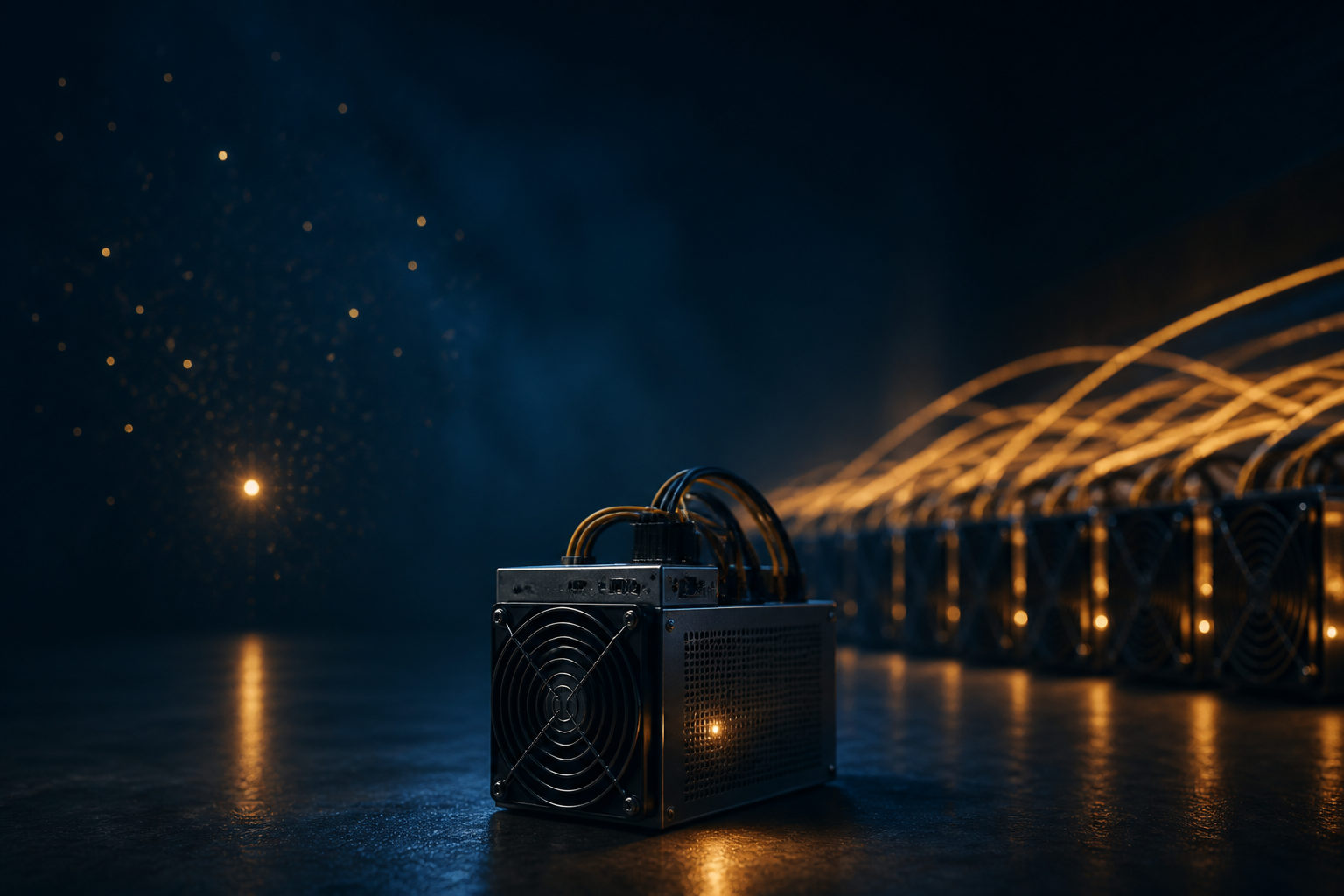
You can get lucky mining Bitcoin, but luck matters far less than hash power, costs, and your setup. For most people, the real question is not whether luck exists, but whether their equipment, power bill, and mining method make participation realistic.
Think of Bitcoin mining as a bookkeeping race
Bitcoin mining helps the network confirm transactions and add new blocks to the chain. A simple way to picture it is a nonstop bookkeeping race: miners run machines that keep trying to find a valid result, and the one that succeeds gets the right to add the next block.
That process has a random element, which is why people ask whether they can get lucky mining Bitcoin. A new block appears about every 10 minutes, but that does not mean every participant gets a fair turn on a neat schedule. Your chance depends on how much hash power you control compared with the rest of the network.
If the whole network is a giant draw, your “tickets” are your hash rate. More hash power means more chances in each round. Less hash power means a much rougher experience, where long waiting periods are possible even if your machine is working exactly as intended.
Where luck actually shows up
Luck shows up in the timing of block discovery. Even with the same machine and the same operating conditions, the moment a miner finds a valid block can vary a lot because each attempt is independent.
That is why mining often feels like chance, especially to newcomers. You cannot choose which attempt wins. You can only keep contributing hash power and increase the odds that one of those attempts lands at the right time.
Short-term results can look dramatic. Over a longer stretch, though, outcomes tend to reflect your share of hash power, your uptime, and how well you control operating costs. Luck affects the path. It does not remove the economics.
| Question | How much luck matters | What matters more |
|---|---|---|
| Will you find a block on a given day? | High | Solo vs pool mining, share of network hash power |
| Can you stay in mining for the long term? | Low | Electricity cost, hardware efficiency, cooling, maintenance |
| Will your results be volatile? | High | Payout structure, pool rules, downtime |
| Is mining practical for a typical user? | Low | Location, noise tolerance, technical management |
So if someone asks whether mining Bitcoin is about luck, the useful answer is this: luck matters in the short run, but it is not the main driver over time. Many people imagine mining as a queue where rewards simply arrive if they wait long enough. Real mining does not work like that.
Solo mining and pool mining feel very different
Most participation falls into two broad categories: solo mining and pool mining. Both involve chance, but they place that chance on the miner in very different ways.
With solo mining, you are competing on your own. You only get the full result if your own operation finds a block. That creates large swings and can mean very long stretches with nothing to show, especially if your hash power is small relative to the network.
With pool mining, many miners combine hash power and share results according to the pool’s payout rules. This does not remove chance from the network, but it usually smooths the experience for each participant. In exchange, you need to understand fees, payout methods, and how transparent the pool is about its rules.
| Method | Best suited for | What it feels like | Main thing to check |
|---|---|---|---|
| Solo mining | Operators with significant hash power and tolerance for long dry spells | Rare, uneven outcomes | Scale, uptime, ability to handle variance |
| Pool mining | People who want smoother payouts and lower personal variance | Smaller but steadier distributions | Pool rules, fees, reputation, reporting |
When people say they hope to “get lucky,” they are often picturing solo mining and landing a block against the odds. For a typical participant, pool mining changes the experience from waiting for one dramatic hit to receiving a share tied more closely to steady contribution.
The hard part is usually cost, not chance
Anyone thinking about Bitcoin mining should look at the practical side before thinking about luck. Mining is no longer something most people can do seriously with an ordinary computer sitting under a desk. Real participation usually involves dedicated hardware, constant power use, cooling, noise, dust, and regular troubleshooting.
Buying equipment is only the start. You also need a place to run it, a plan for heat removal, stable internet access, and some way to deal with outages or machine failures. People who focus only on whether they might get lucky often miss the fact that mining is an operational activity as much as a probabilistic one.
If your living situation has strict limits on noise, power load, or heat, mining can become uncomfortable very quickly. A machine that can turn on is not the same as a machine that can run well over time. Frequent interruptions can wipe out any benefit from a brief stretch of good luck.
| Cost or constraint | Why it matters | Common mistake |
|---|---|---|
| Hardware spending | Determines how much effective hash power you bring | Assuming a standard computer is enough |
| Electricity | Shapes whether continuous mining makes sense | Looking only at purchase cost |
| Cooling and noise | Affects stability and daily livability | Underestimating heat and sound |
| Maintenance | Downtime and faults reduce real output | Thinking mining is fully hands-off |
Bitcoin launched with the genesis block in January 2009, and its total supply is capped at 21 million coins. The network produces a block about every 10 minutes and goes through a halving about every 4 years, or every 210,000 blocks. Those rules shape the mining system, but they do not change the basic reality for a newcomer: your personal outcome still depends on costs, operating conditions, and your share of the competition.
What miners are really competing for
People often describe mining as “creating Bitcoin,” but that is only part of the picture. Miners are competing to add valid blocks and maintain the order of the ledger. The reward exists inside that system; it is not separate from it.
Bitcoin’s design ties issuance and transaction confirmation together. Miners secure the network by performing proof-of-work, and that is why mining has both a random feel and a strict structure. You may see variation from round to round, but the process itself follows fixed rules.
Bitcoin can also be divided very finely: 1 satoshi is one hundred millionth of 1 BTC. That matters for how Bitcoin works as money, yet for mining decisions, the more important question is simpler. How much of the total hash power do you control, and is that share worth the cost of sustaining it?
FAQ
Can I mine Bitcoin with a regular PC today?
In theory, any machine that performs the calculations is participating. In practice, Bitcoin mining is highly specialized now, so a regular PC usually does not offer meaningful competitiveness and may still generate power and heat costs.
Does pool mining remove luck?
No. A pool still experiences variance because block discovery remains random at the network level. What changes is your personal exposure to that variance, since payouts are usually distributed across many participants.
Why do some miners feel like they get nothing for a long time?
This often happens in solo mining, where waiting periods can be long and uneven. It can also happen when hardware is offline, overheating, or disconnected without the operator noticing right away.
What should I check before trying Bitcoin mining?
Start with the basics: power availability, noise tolerance, cooling, and internet stability. After that, look at hardware options and pool terms, because operating conditions often matter more than first-time miners expect.
Does the Bitcoin price decide whether mining is worth it?
Price matters, but it is only one part of the decision. If you want a current quote, check a major market data platform; then weigh that against electricity, machine efficiency, downtime risk, and payout rules before making any call.
If you want the shortest honest answer, here it is: you can get lucky mining Bitcoin, but you cannot build a plan on luck alone. Before you participate, choose a mining method and check whether your location, power setup, cooling, and maintenance ability are actually suitable.
Disclaimer: This article is for informational and educational purposes only and is not investment, financial, or legal advice. Crypto assets are highly volatile and you could lose your entire investment. Do your own research and decide carefully.