
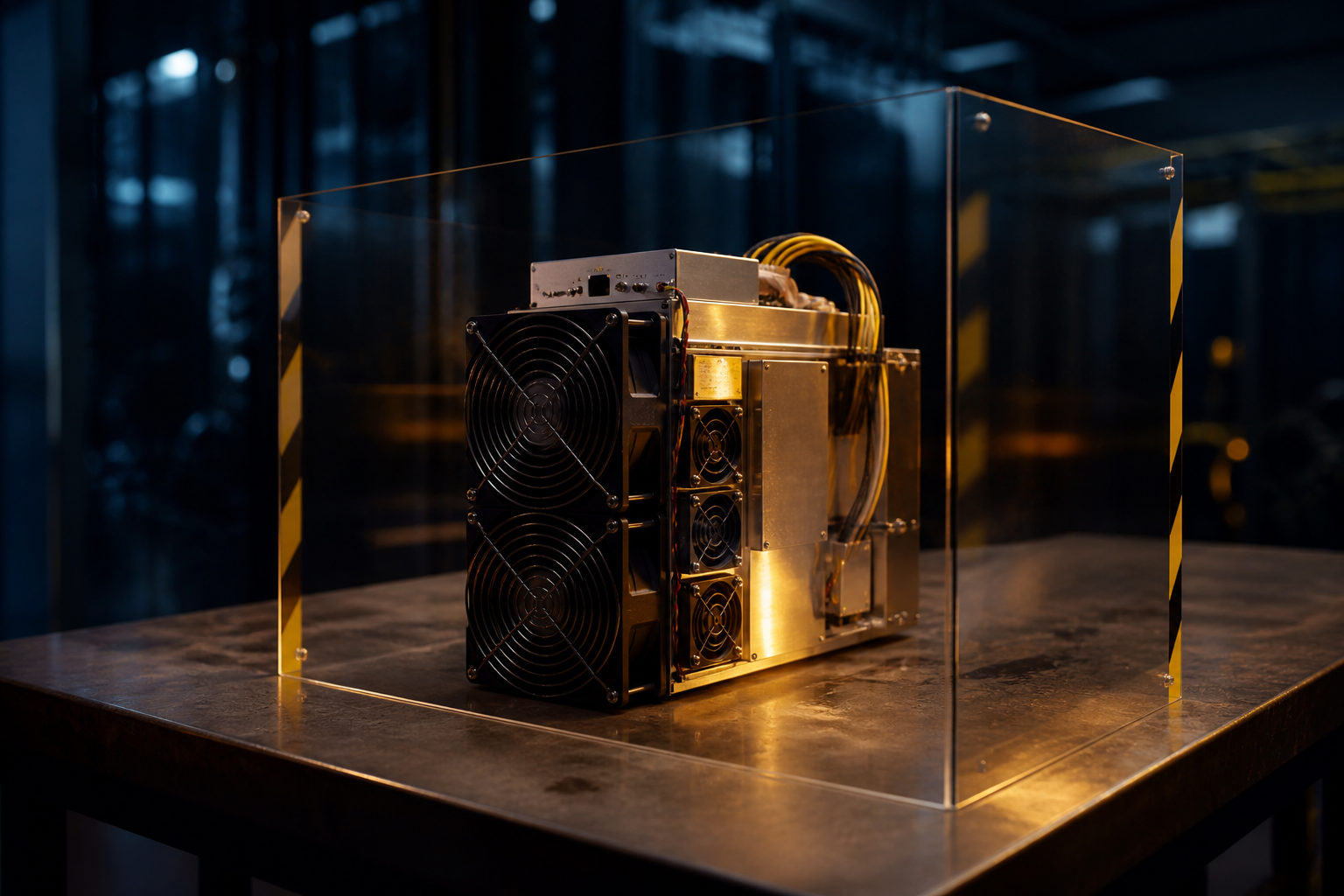
Is mining bitcoins safe? The Bitcoin network itself is built on a well-known set of rules, but mining as an individual can be risky if you do not control hardware quality, power conditions, account security, and the third parties involved.
Think of mining as a nonstop race to write the next page of a ledger
Bitcoin does not rely on one company to update its transaction history. Miners use specialized machines to compete for the right to add a new block of transactions. The winner gets the block recorded on the chain and receives the current block reward plus transaction fees.
This design was described by Satoshi Nakamoto in the white paper published on 2008-10-31, titled Bitcoin: A Peer-to-Peer Electronic Cash System. The genesis block followed on 2009-01-03. The network aims for a new block about every 10 minutes, and the reward is cut in half every 210,000 blocks, which works out to roughly every 4 years. The latest halving took place on 2024-04-19, so the current block reward is 3.125 BTC, with the next halving expected around 2028.
Those rules matter because they explain what mining really is. You are joining a competitive process with fixed issuance rules and open participation, not buying a machine that automatically prints money. Once that is clear, the safety question becomes much easier to answer.
“Safe” means different things depending on what you are asking
Many beginners use one sentence to cover several separate concerns. One person is worried about whether Bitcoin can be stolen. Another is worried about whether mining hardware can fail. Someone else is really asking whether a hosting company or cloud mining contract can be trusted.
| Safety layer | What to examine | Typical problem | Practical test |
|---|---|---|---|
| Protocol | Whether Bitcoin’s rules are stable and public | Confusing platform risk with Bitcoin itself | Separate the network from the service provider |
| Hardware | Miner condition, power supply, cooling, dust, maintenance | Used machines failing under continuous load | Check source, testing records, and repair support |
| Power and site | Electrical load, airflow, heat handling, fire safety | Trips, overheating, unsuitable home setups | Inspect the location before buying equipment |
| Account security | Mining pool login, email, payout wallet | Weak passwords, phishing, poor account separation | Use independent accounts and two-factor protection |
| Counterparty | Hosting firm, operator, cloud mining seller | Opaque terms, poor reporting, withdrawal trouble | Read the contract and payout process in detail |
That is why there is no single yes-or-no answer. The Bitcoin protocol and individual participation risks sit in different buckets. The first is about how blocks are produced and how the network stays in sync. The second is about whether you can operate safely in the real world.
Where personal mining usually becomes risky
Hardware risk starts before the machine is switched on
Mining hardware runs under sustained heavy load. A machine that powers on during a quick demonstration may still have aging fans, weak power components, heat damage, or poor maintenance history. Used units deserve extra caution because a clean exterior tells you very little about internal wear.
If you cannot test, repair, or monitor the machine, hardware risk quickly turns into downtime risk. The issue may be simple on paper, such as cooling trouble or unstable power, but each interruption creates another operational task that someone must handle.
Power and cooling are not side issues
Home miners often focus on the idea of “getting started” and ignore whether the environment can support continuous operation. Electrical capacity, airflow, ambient heat, dust, and noise all affect safety. These are not minor details. They shape whether the setup can run at all.
For many people, the biggest risk is not a technical flaw in Bitcoin. It is the assumption that a home space can handle specialized hardware without proper planning. If the site is a poor match, problems can appear well before any mining results are discussed.
Hosting and cloud mining shift the risk to another party
Some people avoid on-site problems by sending their machines to a hosting provider. Others buy cloud mining contracts and never touch hardware. That may remove noise and maintenance from your daily life, but it adds a different set of concerns: whether the machines exist, whether the service terms are fair, how downtime is handled, and how payouts are calculated.
If a company sells “easy mining” while staying vague about fees, machine ownership, maintenance duties, payout timing, and withdrawal rules, that is a warning sign. In these cases, the main danger may come from the counterparty, not from Bitcoin mining as a process.
Wallet and account security still decide where the coins end up
Even if your hardware runs properly, the payout path can still fail. Mining pool accounts, email addresses, and payout wallets should not be treated as one bundle. If one part is exposed, the rest can be dragged into the same problem.
Mining gives you a route to acquire bitcoin, but it does not remove the need to protect private keys, recovery phrases, backups, and device access. Many newcomers spend most of their time comparing machines and almost none planning how to secure what they receive.
Different ways to mine carry very different risk profiles
People often say they are “mining bitcoin” as if every setup were the same. It is not. Running your own machine, sending equipment to a host, joining a pool, and buying cloud mining contracts each place the risk in a different location.
| Approach | What you control | Main advantage | Main risk | Best fit |
|---|---|---|---|---|
| Own machine at your own site | Hardware, power, cooling, network, maintenance | High control and direct visibility | Site demands, noise, heat, and upkeep | People comfortable with hardware operations |
| Own machine with third-party hosting | You own equipment, host handles daily operation | No need to manage the site yourself | Contract terms, downtime handling, host transparency | People who want real hardware exposure without local setup |
| Mining through a pool | Your machine or hosted machine contributes hash power | Smoother payout pattern than solo mining | Pool account security, fees, payout rules | Anyone who already has access to hash power |
| Cloud mining | Usually only a contract, not a physical machine | Low visible entry barrier | Authenticity, opaque terms, limited exit options | Only those who can assess contract risk clearly |
Mining pools also deserve a clear explanation. A pool is not a special issuer of bitcoin. It groups miners and shares results according to pool rules. The current block reward is 3.125 BTC, and the network adds about 450 BTC per day in total. That figure belongs to the whole network, not to any individual miner or company. What one participant receives depends on hash power contributed, uptime, pool rules, fees, and the competitive state of the network, so there is no fixed personal output number that fits everyone.
A practical checklist before you decide to mine
Start by identifying what you are actually buying. Is it a machine, rack space, hosting, a service contract, or a cloud product dressed up with mining language? If you cannot describe the product in plain words, do not send money or bitcoin yet.
Then inspect the operating conditions. Can the site handle sustained electrical load? Is there enough cooling? Who will fix faults when the machine stops? A setup that looks simple in marketing materials can become difficult very quickly once hardware is running day and night.
After that, read the rules. Hosting charges, maintenance responsibility, downtime handling, migration rights, payout timing, and withdrawal procedures all need to be clear before you commit. Verbal promises are not enough when your machine is somewhere else and someone else controls access.
Last, secure the payout path. Decide who controls the receiving wallet, how backups are stored, whether the login email is separate, and whether two-factor protection is active. Mining success means very little if the coins arrive in an insecure account structure.
| Decision step | What to confirm | If you cannot answer it |
|---|---|---|
| Identify the model | Whether you are buying hardware, hosting, or a contract | You may not understand where the risk sits |
| Check the site | Power, cooling, noise, maintenance support | The setup may be unstable from day one |
| Read the terms | Fees, downtime rules, payouts, withdrawals, machine access | You will have little protection in a dispute |
| Protect the coins | Wallet control, account separation, recovery planning | Operational success can still end in asset loss |
There is one more reality worth facing early: bitcoin mining is operationally demanding. The network rules are clear enough. Supply is capped at 21,000,000 BTC, and issuance continues until around 2140. What separates a workable plan from a bad one is not whether the protocol exists. It is whether you can manage the machine, the environment, the service provider, and the custody setup without cutting corners.
FAQ
Is home bitcoin mining dangerous for beginners?
It can be, mainly because of power load, cooling, and noise rather than the Bitcoin protocol. A poor site can create problems long before mining performance becomes the main issue.
Does joining a mining pool make mining safe?
A pool can smooth how rewards are distributed, but it does not remove hardware, hosting, or account security risk. You still need to examine pool rules, fees, and payout controls.
Is cloud mining the safest option?
Not automatically. It may reduce hands-on complexity, but it raises contract and counterparty risk because you usually do not control the hardware directly.
Can an individual still mine bitcoin today?
Yes, individuals can still take part, but there is no universal output formula for one person. The current block reward is 3.125 BTC and the network adds about 450 BTC per day in total, yet that does not translate into a fixed personal result.
Should mined bitcoin stay in a pool account?
Pool accounts are often part of the payout path, but they are not ideal for long-term storage. It is safer to plan custody separately and keep receiving control in your own hands.
Do I need to study mining if I only want to hold bitcoin?
Basic mining knowledge helps you understand how Bitcoin issues new coins and secures block production. That does not mean you need to mine yourself, but it does improve your judgment.
If you are close to taking action, write down six things first: hardware source, site power, cooling plan, hosting terms, pool rules, and wallet control. If any one of those is still vague, pause there and do not rush into payment, transfer, or setup.
Disclaimer: This article is for informational and educational purposes only and is not investment, financial, or legal advice. Crypto assets are highly volatile and you could lose your entire investment. Do your own research and decide carefully.