
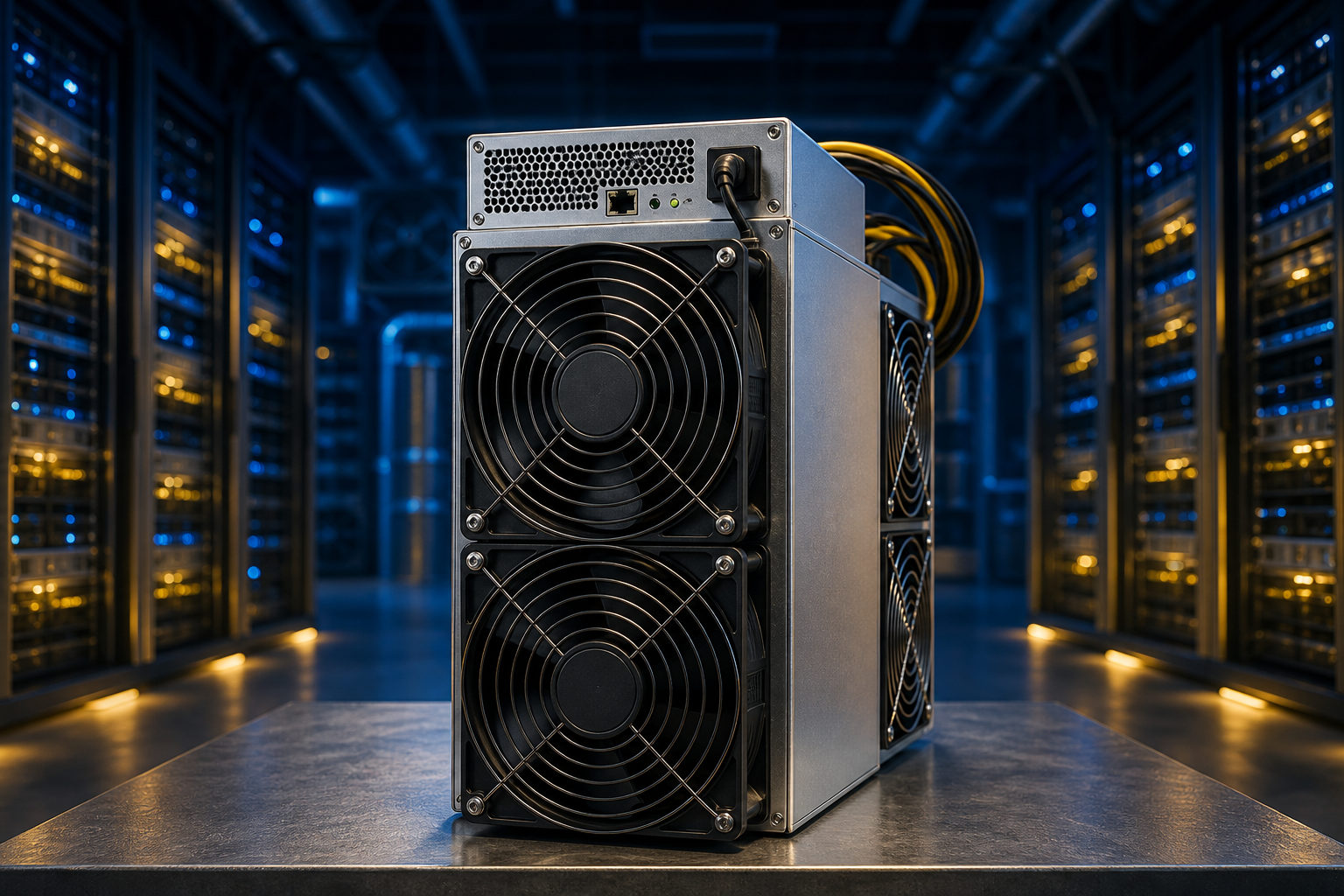
If you want to mine Bitcoin in 2026, the real task is not installing an app and waiting for coins. It is joining a global block-finding race with ASIC hardware, then dealing with power, cooling, noise, pool setup, and custody from day one.
What Bitcoin mining actually does
A simple way to think about Bitcoin mining is to picture a nonstop bookkeeping contest. People broadcast transactions to the network, and someone has to collect them, verify them, and package them into a new block that can be added to the chain. Miners compete to do that work under the network's rules.
They do not “dig up” bitcoin in a physical sense. They run machines that perform repeated calculations in search of a valid result. Bitcoin produces a new block about every 10 minutes, and the protocol adjusts difficulty so the process stays close to that pace over time. As more computing power joins the network, the competition gets harder.
This system matters because it turns block production into an open contest instead of a private privilege. A bad actor cannot change records just by making claims. They would need enough sustained computing power to beat honest participants, which makes attacks expensive. For a new miner, that means the job is really about contributing hash power to network security and transaction confirmation.
Why ASIC mining is the main path now
Many beginners first search for ways to mine Bitcoin with a gaming PC, laptop, or even a phone. That may help explain the basic idea, but it does not describe the practical reality of modern Bitcoin mining. In real-world conditions, ASIC mining dominates.
ASIC stands for application-specific integrated circuit. In plain English, it is a chip built for a narrow task rather than general computing. Bitcoin mining rewards efficiency in that exact task, which is why dedicated hardware has a major edge over normal consumer devices.
That difference shapes almost every decision a newcomer has to make. An ordinary computer may be good for learning, but it is usually not a realistic long-term setup for Bitcoin mining. ASIC miners are designed for this work, and they come with trade-offs that beginners need to understand before spending anything.
- They are highly specialized. An ASIC miner is built for a specific mining algorithm, not broad everyday use.
- Efficiency matters as much as raw performance. Power use is part of the business, not a side issue.
- They produce serious noise and heat. Most units are not a natural fit for a quiet home or office.
- They need ongoing care. Airflow, dust, stable power, and basic maintenance all affect uptime.
That is why “buy a miner and plug it in” is not much of a plan. The hard part often starts after the machine arrives.
Common ways to participate in ASIC mining in 2026
There is more than one way to get involved with ASIC mining. The right path depends on your space, your tolerance for hands-on work, and how much operational risk you want to take.
Buy your own ASIC and run it yourself
This is the most direct route. You buy the machine, prepare a suitable power and network environment, connect it to a mining pool, and manage it on your own. The upside is control. The hardware is yours, and you decide when to reboot, repair, move, or retire it.
The downside is that every practical problem becomes your problem. Home electrical setups may not be ideal for continuous high-load hardware. The noise can be difficult to live with. Heat has to be removed consistently or stability suffers. Dust buildup, internet outages, and power interruptions can all knock the machine offline.
For someone who likes hardware and wants to learn by doing, this path can make sense. For someone who only wants exposure to Bitcoin, it may feel much heavier than expected.
Buy the machine but place it with a hosting provider
Hosted mining means you own the ASIC, but it runs in a facility that provides rack space, electricity, networking, cooling, and basic support. For people without a suitable home or workspace, this is often the most realistic way to use real hardware.
Still, hosting does not remove the need for judgment. It shifts the challenge from room setup to vendor selection and contract review. You need to understand who controls the machine physically, how downtime is handled, what support is included, how fees are charged, and what process applies if you want the unit returned.
In other words, hosted mining replaces some technical friction with counterparty risk. That trade may be acceptable, but it has to be recognized.
Rent hash power or use cloud-mining style products
These offers tend to look easy because you do not touch the hardware at all. You pay online, choose a plan, and the service claims to handle the rest. The problem is that this category has wide quality differences and often limited transparency.
A beginner may struggle to confirm whether the product represents real operating machines, a revenue-sharing contract, or marketing wrapped around vague promises. If your goal is to understand how Bitcoin mining works in practice, this route can hide the most important moving parts: the machines, the facility, the cooling, the maintenance, and the operational risk.
Convenience is not always a red flag, but “too easy” should make you slow down and ask better questions.
The parts of mining that beginners often underestimate
Most first-time buyers focus on the machine itself. In practice, a mining setup succeeds or fails on the details around the machine.
Mining pools and why most people use them
In theory, you can mine Bitcoin on your own and try to find blocks alone. In practice, a small operator usually prefers a mining pool. Pools combine the hash power of many miners and distribute proceeds according to set rules, which makes results less lumpy than solo mining.
That does not mean all pools are the same. A miner should look at payout structure, connection stability, account controls, transparency in the dashboard, and withdrawal rules. A mining pool is best understood as a coordination layer for hash power, not as a wallet and not as an exchange account.
Wallets and payout addresses
Whatever the pool allocates to you usually needs to be paid out to a Bitcoin address you control. This is where beginners need to separate two ideas: a wallet where you control the private keys, and a platform account where someone else holds the assets for you.
That distinction affects security, recovery, and long-term control. A mining setup is not complete when the machine starts hashing. It also includes how funds are received, stored, backed up, and protected from account mistakes.
Cooling, dust, and environmental stability
ASIC miners are built for sustained heavy workloads. They need proper airflow and a stable environment. Excess heat can reduce stability, dust can hurt cooling performance, and poor power quality can trigger repeated restarts or hardware stress.
This is one reason many home setups disappoint their owners. The issue is not only that the machine is loud. It is that residential spaces are rarely designed around constant heat output and continuous hardware operation. Even a strong miner can become a weak setup in a bad room.
Electricity is not your only cost
Electricity gets most of the attention in any Bitcoin mining discussion, and for good reason. But it is only one part of the picture. Hardware purchase, shipping, installation, hosting fees, repairs, downtime, and the time spent managing problems all belong in the same conversation.
A cheap power source does not solve everything if the environment is unstable or the machine sits offline too often. If you do not want to do basic operations work yourself, then outsourced support is part of your cost structure too.
How to decide whether ASIC mining fits you in 2026
Before asking whether mining is “worth it,” ask whether it fits your situation. Bitcoin mining is closer to operating specialized hardware than buying a passive income product. Even at a small scale, it demands ongoing decisions.
- If you have suitable space and power access, self-operation may be possible, but you need to accept noise, heat, and maintenance.
- If you want hardware ownership without running it at home, hosting may be the more practical route, but contracts and custody details matter.
- If you mainly want Bitcoin exposure, buying and storing bitcoin may be simpler than running mining gear.
- If you only want to learn, start with pools, wallets, payout flows, and machine basics before committing to equipment.
There is also a protocol-level fact worth keeping in view. Bitcoin has a supply cap of 21 million coins, and the block subsidy halves about every 4 years, or every 210,000 blocks. Halving years so far have included 2012, 2016, 2020, and 2024. That does not mean mining stops after a halving. It means efficiency and cost discipline matter even more over time.
Another useful reminder: one bitcoin is divisible into 100 million satoshis, with 1 satoshi being the smallest unit. This matters less for machine operation than for accounting and payouts, but it helps beginners understand that mining rewards and wallet balances do not need to appear in whole BTC units to be valid.
The broader point is simple. ASIC mining is not impossible for a small participant, but it is not light, effortless, or purely financial. It sits at the intersection of hardware, operations, custody, and cost control.
FAQ
Can I still mine Bitcoin with a regular PC?
A normal computer can help you understand the concept of mining, but modern Bitcoin mining is generally centered on ASIC hardware. For practical participation, consumer PCs are usually not the main route.
Is Bitcoin mining just a matter of leaving a machine on?
No. Powering on the device is only the start. Pool connection, wallet setup, cooling, power stability, and fault handling all affect whether the operation actually works over time.
Do I need to join a mining pool?
You do not have to, but many smaller miners do. Pool mining usually makes results more predictable than trying to find blocks alone with limited hash power.
Is hosted mining safer than running an ASIC at home?
It can solve practical issues like noise, cooling, and space, but it introduces trust and contract risk. You still need to check who controls the equipment, how downtime is treated, and what rights you have if something goes wrong.
Where should I check the live Bitcoin price before making a mining decision?
This guide does not include live market prices. If you want the current market price, check a major market data platform, then weigh that information alongside power conditions, hardware efficiency, hosting terms, downtime risk, and wallet security instead of relying on one number alone.
If you plan to start Bitcoin mining in 2026, make a checklist before you buy anything: power capacity, heat removal, noise tolerance, pool setup, wallet control, maintenance ability, and hosting terms if someone else will run the machine. If those pieces are unclear, the hardware purchase can wait.
Disclaimer: This article is for informational and educational purposes only and is not investment, financial, or legal advice. Crypto assets are highly volatile and you could lose your entire investment. Do your own research and decide carefully.