
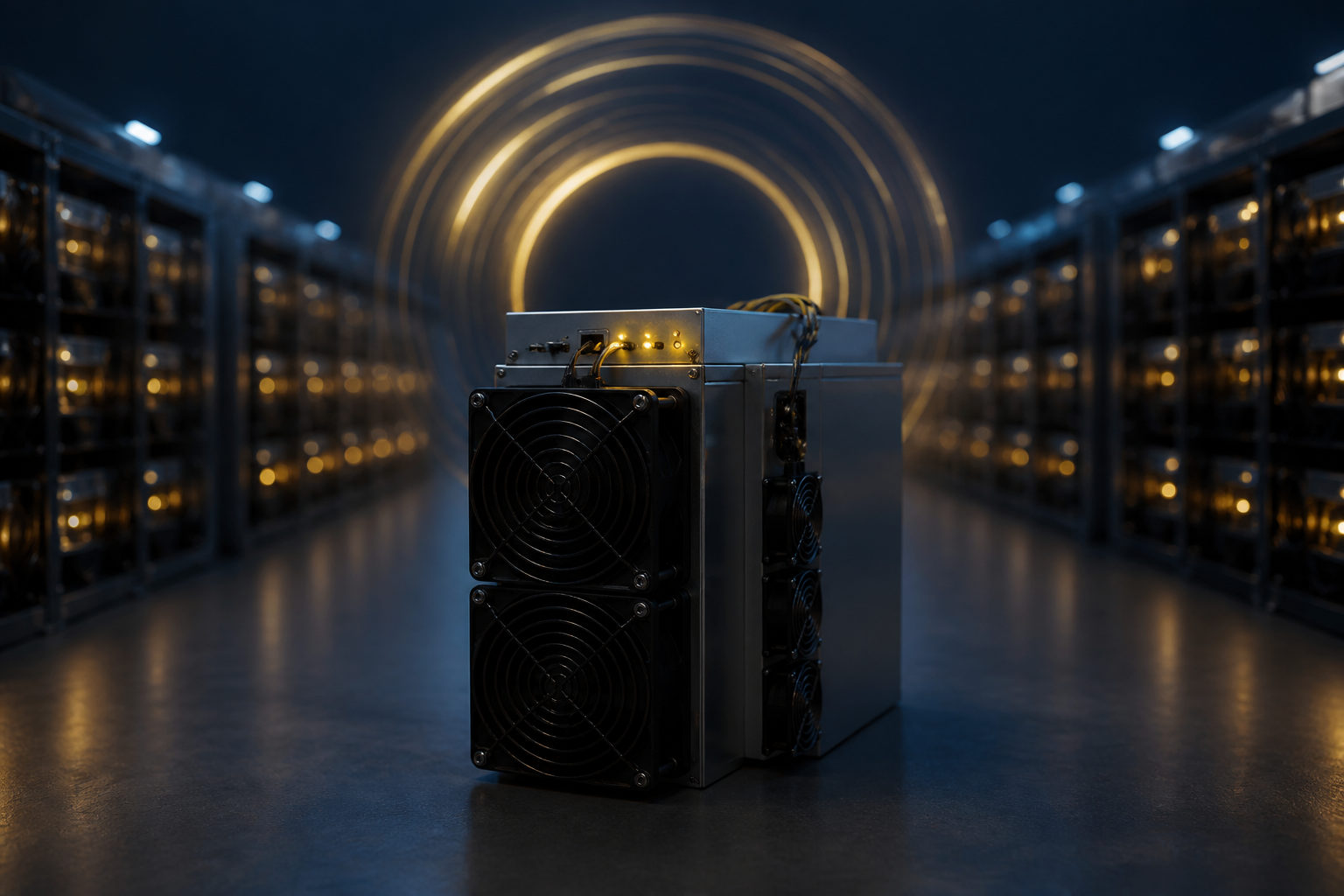
How long does bitcoin mining take? At the network level, a new Bitcoin block is produced about every 10 minutes. For an individual miner, though, there is no fixed wait time. It depends on your hash rate, the network difficulty, uptime, and whether you mine solo or through a pool.
What people mean by “mining time”
This question often hides several different questions inside one sentence. Some people want to know how long the Bitcoin network takes to add a block. Others want to know how long their own machine would need before it finds a winning result. Some are really asking when they would see any balance credited to their mining account.
A good way to picture Bitcoin mining is a bookkeeping race. Miners compete to earn the right to package transactions into the next block. You are not digging coins out of the ground one by one. You are running repeated computations in a global contest for the next valid block.
| Common question | What it actually means | Type of answer |
|---|---|---|
| How long for a new block? | The network's block production rhythm | Usually about 10 minutes |
| How long until I mine bitcoin? | Your own chance of finding a block | No fixed time |
| How long until I get paid? | Pool payout and account credit timing | Depends on the service rules |
Once you separate those meanings, the topic gets much easier. Bitcoin can keep producing blocks on a fairly steady schedule while one miner waits a very long time for a personal result. Those two facts can both be true at the same time.
Why Bitcoin blocks take about 10 minutes
Bitcoin was designed to aim for a steady block interval of about 10 minutes. That target is part of the system itself, not a promise made by any one miner or machine. The network uses proof of work, where miners keep trying different hashes until someone finds a result that meets the current target.
You can think of it as a hard puzzle that is easy to check once a valid answer appears. Finding that answer takes repeated attempts, and the network adjusts the difficulty so blocks do not come too fast or too slow over time. If more miners join and total hash power rises, the system raises the challenge. If conditions weaken, it can move the other way.
That is why buying stronger equipment does not make the whole network produce blocks endlessly faster. Better hardware changes your position in the competition. It does not rewrite Bitcoin's basic block rhythm.
How long an individual miner may wait
If you are asking about your own result, there is no single timeline that applies to everyone. Your wait depends on how much hash power you control relative to the rest of the network, whether your machine stays online, and how you choose to participate.
Solo mining is the most unpredictable setup. You are competing on your own for a low-probability event. That means your waiting period can be extremely uneven. A miner might wait a long time without finding a block, then get lucky, but that kind of variance is part of the setup.
Mining through a pool changes the experience. A pool combines the hash rate of many participants, competes for blocks as a group, and then distributes rewards based on its own method. You are less likely to feel the long droughts that define solo mining, because pool payouts tend to arrive in smaller and more regular pieces.
| Factor | What it affects | Why it matters for time |
|---|---|---|
| Your hash rate | Your share of the competition | More hash rate usually means shorter average waits |
| Network difficulty | The threshold for a valid block | Higher difficulty makes the same machine less competitive |
| Mining method | How results reach you | Pools usually smooth the waiting experience |
| Uptime | How often your machine is actually working | Downtime stretches your wait |
| Pool rules | When balances are credited or paid | Different services feel very different in practice |
For many beginners, the real question is not “How long until Bitcoin is mined?” but “How long until I see something arrive in my account?” Those are related, but they are not the same. Pool accounting, payout thresholds, and machine stability all shape what you experience.
The practical timeline from setup to payout
Anyone considering mining should look beyond block timing and think about the full process. Mining starts long before a machine begins hashing, and it does not end the moment a pool records a reward. There are several stages where time matters in different ways.
| Stage | What happens | Time issue to watch |
|---|---|---|
| Hardware and environment | You prepare the miner, power, cooling, and internet connection | Can the setup run reliably for long periods? |
| Network connection | You configure pool access or a solo node | Is the machine submitting valid work? |
| Active mining | The machine performs hash calculations continuously | Are there outages, heat issues, or failures? |
| Reward accounting | The pool records your share according to its rules | How often are balances credited? |
| Withdrawal | You move available funds to a wallet | Are there thresholds or waiting conditions? |
Home miners often focus on the machine and forget the operating conditions around it. Noise, ventilation, heat, power consistency, and internet stability all affect how much useful work the machine can actually deliver. A miner that looks active on a screen may still produce a disappointing result if it keeps dropping offline or throttling.
Another point that gets missed: seeing a balance inside a mining dashboard is not always the same as having freely usable bitcoin in your wallet. A pool may credit earnings on one schedule and allow withdrawals on another. If someone asks how long bitcoin mining takes, that payout layer is often the part they really care about.
Cost reality matters more than a simple time estimate
People often search for a clean answer measured in days or weeks, but mining does not work like a timer you can start and stop with predictable output. It is an equipment-heavy activity with ongoing power, cooling, maintenance, and wear costs. Your waiting period carries a real operating burden.
That is why a practical mining decision starts with conditions you control. Can you run hardware continuously? Can you manage the heat and sound? Are you prepared for maintenance and possible downtime? If those pieces do not fit, the question of mining time becomes less useful on its own.
The halving cycle also shapes the mining business. Bitcoin's block subsidy is cut roughly every 4 years, or every 210,000 blocks, and halvings have occurred in 2012, 2016, 2020, and 2024. That changes the reward structure for miners, but it does not replace the network's usual target of about 10 minutes per block.
FAQ
Does a home computer need a long time to mine bitcoin?
In real-world Bitcoin mining, a normal home computer is generally not competitive. The first problems most people run into are heat, power use, and weak performance rather than steady mining results.
Does joining a pool mean bitcoin mining becomes faster?
It is more accurate to say that pool mining makes your payouts feel more regular. The Bitcoin network does not speed up for you; the pool simply spreads results across participants according to its rules.
Why is my miner running but I am not seeing much credited?
Check whether your machine is submitting valid work, then review the pool's accounting and withdrawal rules. A device being powered on is not the same as producing effective mining output.
If blocks take about 10 minutes, should I get paid every 10 minutes?
No. That figure describes the network's average block interval, not your personal payout cycle. Your share depends on your contribution, your pool arrangement, and how the service handles accounting.
What should I evaluate before trying bitcoin mining?
Start with electricity, cooling, noise, uptime, and maintenance demands. Once those basics make sense, you can compare solo mining and pool mining with a clearer view of the actual waiting time involved.
The simplest way to answer how long does bitcoin mining take is this: Bitcoin blocks are usually produced about every 10 minutes, but your own wait has no fixed schedule. Separate network timing from personal probability and pool payouts before deciding whether mining is something you really want to do.
Disclaimer: This article is for informational and educational purposes only and is not investment, financial, or legal advice. Crypto assets are highly volatile and you could lose your entire investment. Do your own research and decide carefully.