
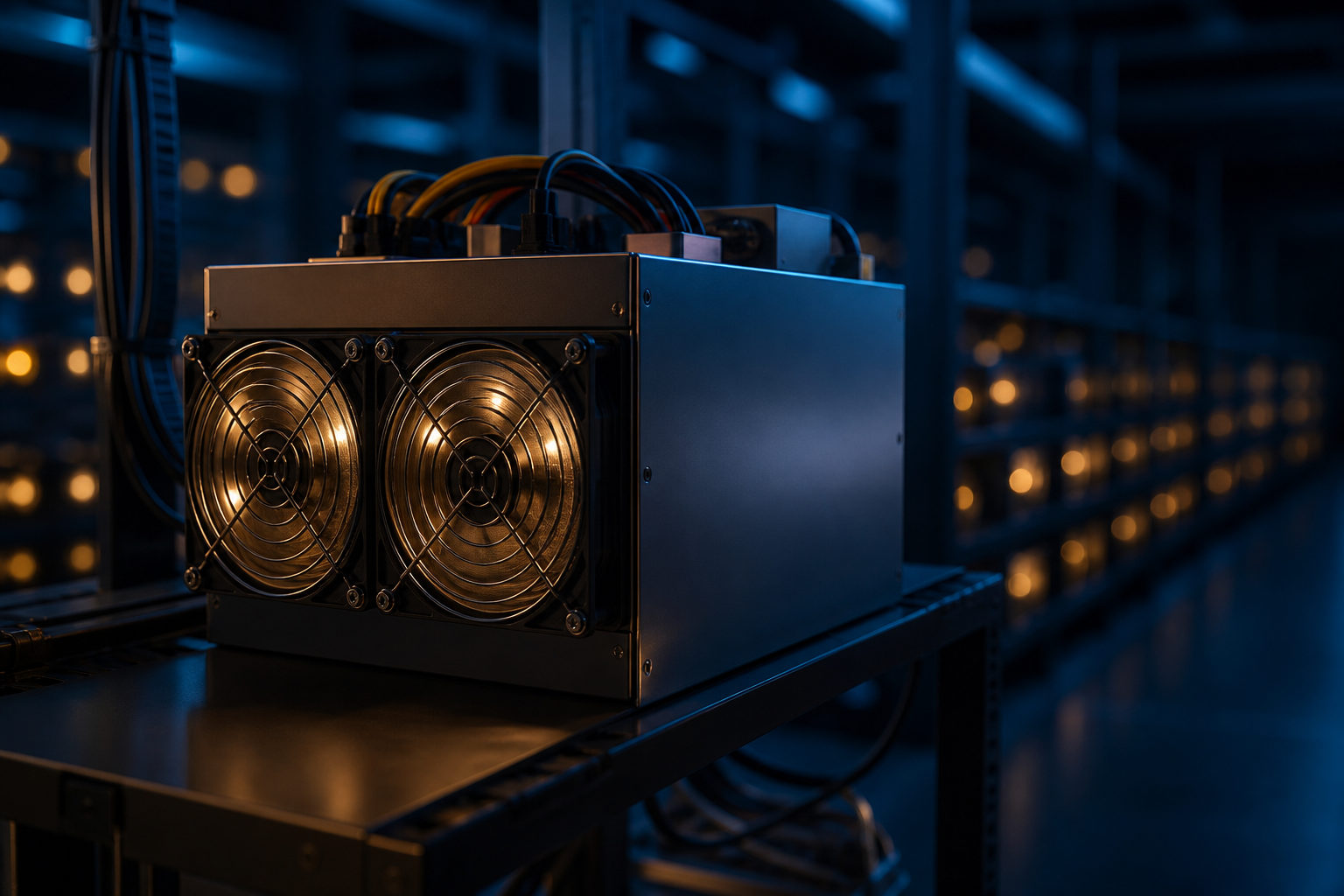
Yes, people still mine Bitcoin, and mining is still how new blocks are added to the network. What changed is the way people take part: Bitcoin mining is now a competitive business built on specialized machines, electricity access, cooling, and steady operations.
Why Bitcoin still needs mining
A simple way to picture Bitcoin is to think of a public ledger that anyone can inspect. New transactions keep arriving, so the network needs a method for deciding who gets to package them into the next block and in what order that block becomes part of the chain.
Mining is that method. Miners gather pending transactions, build a candidate block, and compete to produce a valid hash that meets the network rules. The winner gets the block added to the blockchain and receives the current block reward plus the transaction fees included in that block.
Bitcoin has worked this way since the genesis block on 2009-01-03. New issuance is tied to block production rather than released all at once. The hard cap is 21,000,000 BTC, and the full supply is expected to be issued around 2140. The network targets about 10 minutes per block.
After the halving on 2024-04-19, the current block reward is 3.125 BTC. With about 144 blocks per day across the network, daily new issuance is roughly 450 BTC. That figure describes the whole network, not what any one miner, machine, or company produces on a given day.
People still mine Bitcoin, but the field is far more specialized
If the question is simply whether mining still exists, the answer is easy: yes. If the real question is whether an ordinary person can still jump in casually and expect meaningful results, the answer needs more context.
In Bitcoin’s early years, the barrier to entry was much lower. Today, mining is a mature competition. Success depends less on knowing how to install software and more on whether you can run efficient equipment with stable power, workable cooling, and disciplined maintenance.
The halving cycle explains part of this shift. Bitcoin cuts the block reward in half every 210,000 blocks, or about every 4 years. The halving dates so far are 2012-11-28, 2016-07-09, 2020-05-11, and 2024-04-19, with the next one expected around 2028. As the subsidy gets smaller, weaker operators have less room for mistakes.
| Period | Typical participation | Main competitive edge | What makes it hard for individuals |
|---|---|---|---|
| Early period | More hobbyist-style participation | Understanding the system and staying online | Tools and infrastructure were less developed |
| Current period | Professional operators, mining farms, pools | Machine efficiency, power cost, cooling, uptime | Low solo odds and higher operating demands |
So yes, people absolutely still mine Bitcoin. The big difference is that mining is now usually treated as an operational business rather than a casual experiment.
What miners are actually doing in the “ledger race”
Mining is often described in a way that makes it sound like people are digging coins out of a digital ground. That image is catchy, but it misses the real job. Miners are competing for the right to append the next valid block to Bitcoin’s ledger.
To do that, they assemble a block from pending transactions and keep changing block inputs while hashing again and again. The goal is to find an output that satisfies the network difficulty target. More computing power means more attempts in the same amount of time, which raises the chance of finding a valid block first.
This is why there is no fixed answer to how much a single person can mine in a day. The network may issue roughly 450 BTC per day in total right now, yet an individual miner’s outcome is probabilistic and can vary widely. A solo miner can go a long time without finding a block.
That is one reason mining pools became so common. A pool combines the work of many miners and distributes proceeds according to the pool’s rules. It smooths the payout pattern for participants, but it does not change the network-wide reality: block creation still follows Bitcoin’s schedule, and the total new issuance remains limited by protocol rules.
| Term | What it means | Why it matters |
|---|---|---|
| Block reward | New BTC issued to the miner who finds a valid block | Core part of miner revenue |
| Transaction fees | Fees paid by users to get transactions included | Additional income source in each block |
| Mining pool | A group of miners combining hash power | Reduces payout volatility for individuals |
| Halving | A reward cut every 210,000 blocks | Changes supply issuance and operating pressure |
How people can still participate today
There is a difference between being able to mine and being well positioned to mine. Many people focus on the first question and ignore the second one. In practice, participation usually falls into three buckets: running your own machines, connecting your machines to a pool, or studying the process before committing capital.
Running your own hardware means taking responsibility for the full operating stack. That includes equipment setup, noise, heat, networking, monitoring, maintenance, and replacement planning. Buying a machine is only the start; keeping it productive over time is the real task.
Joining a mining pool is common because it makes rewards less erratic. Even then, the pool choice matters. Participants need to read how payouts are calculated, what fees are charged, how downtime is handled, and what conditions apply to withdrawals. “Online hash rate” by itself does not tell the full story.
Another area that deserves caution is any arrangement marketed as remote or cloud-based mining. If you cannot independently verify the hardware, hosting terms, maintenance deductions, and counterparty obligations, you are taking on more than mining exposure. You are also taking on business and contract risk tied to the operator.
| Approach | Who it suits | Main hurdle | What to evaluate first |
|---|---|---|---|
| Run your own miner | People ready for long-term technical operations | Power, cooling, noise, upkeep, downtime | Electricity conditions and maintenance ability |
| Use a mining pool | People with hardware who want smoother payouts | You still need real hash power and stable uptime | Pool rules, fee model, payout method |
| Learn before acting | Beginners who want to understand the system first | Requires time and careful study | Blocks, wallets, fees, reward mechanics |
The hard part is not pressing start
For most people, the central issue is not whether mining software can run. The harder question is whether the operation can stay viable day after day. Electricity cost is a major factor, but it is not the only one. Cooling, ventilation, uptime, replacement cycles, and repair logistics all shape the real outcome.
Heat and noise are often underestimated. Mining hardware is built for sustained heavy work, not quiet home use. A setup that looks manageable on paper can become frustrating if the space is unsuitable or if outages and thermal stress keep interrupting the machines.
There is also the management burden. Firmware updates, network problems, pool switching, power events, and hardware wear all need attention. Mining can be technical, repetitive, and operationally demanding even before someone starts thinking about profitability.
That is why the question “do people still mine bitcoin” leads to a practical answer, not just a yes or no. People still mine it every day, but the people who stay in the field are usually the ones who can control costs, maintain uptime, and handle the routine friction of running machines over the long term.
FAQ
Can an individual still mine Bitcoin today?
Yes, an individual can still participate, but the experience is very different from Bitcoin’s early years. The main limits are usually power access, machine efficiency, cooling, and the time needed to manage the setup.
Do I need a mining pool to mine Bitcoin now?
No pool is required at the protocol level, but many individuals use one because solo results can be very uneven. A pool does not remove competition; it mainly changes how rewards are distributed among participants.
Can a normal PC mine Bitcoin in a meaningful way?
Under current conditions, a normal PC usually does not have practical mining competitiveness. Modern Bitcoin mining is dominated by specialized hardware built for this exact task.
Will Bitcoin mining continue for a long time?
Yes. Bitcoin has a fixed cap of 21,000,000 BTC, with full issuance expected around 2140. Before then, the block subsidy keeps declining through halvings every 210,000 blocks.
What is a satoshi in relation to one bitcoin?
A satoshi is the smallest unit of bitcoin. 1 satoshi equals 0.00000001 BTC, which is one hundred millionth of a bitcoin.
If you are trying to decide whether mining is realistic for you, start with a narrow checklist: power stability, cooling conditions, tolerance for noise, and your willingness to handle ongoing maintenance. Those answers matter more than the simple fact that people still mine Bitcoin.
Disclaimer: This article is for informational and educational purposes only and is not investment, financial, or legal advice. Crypto assets are highly volatile and you could lose your entire investment. Do your own research and decide carefully.