
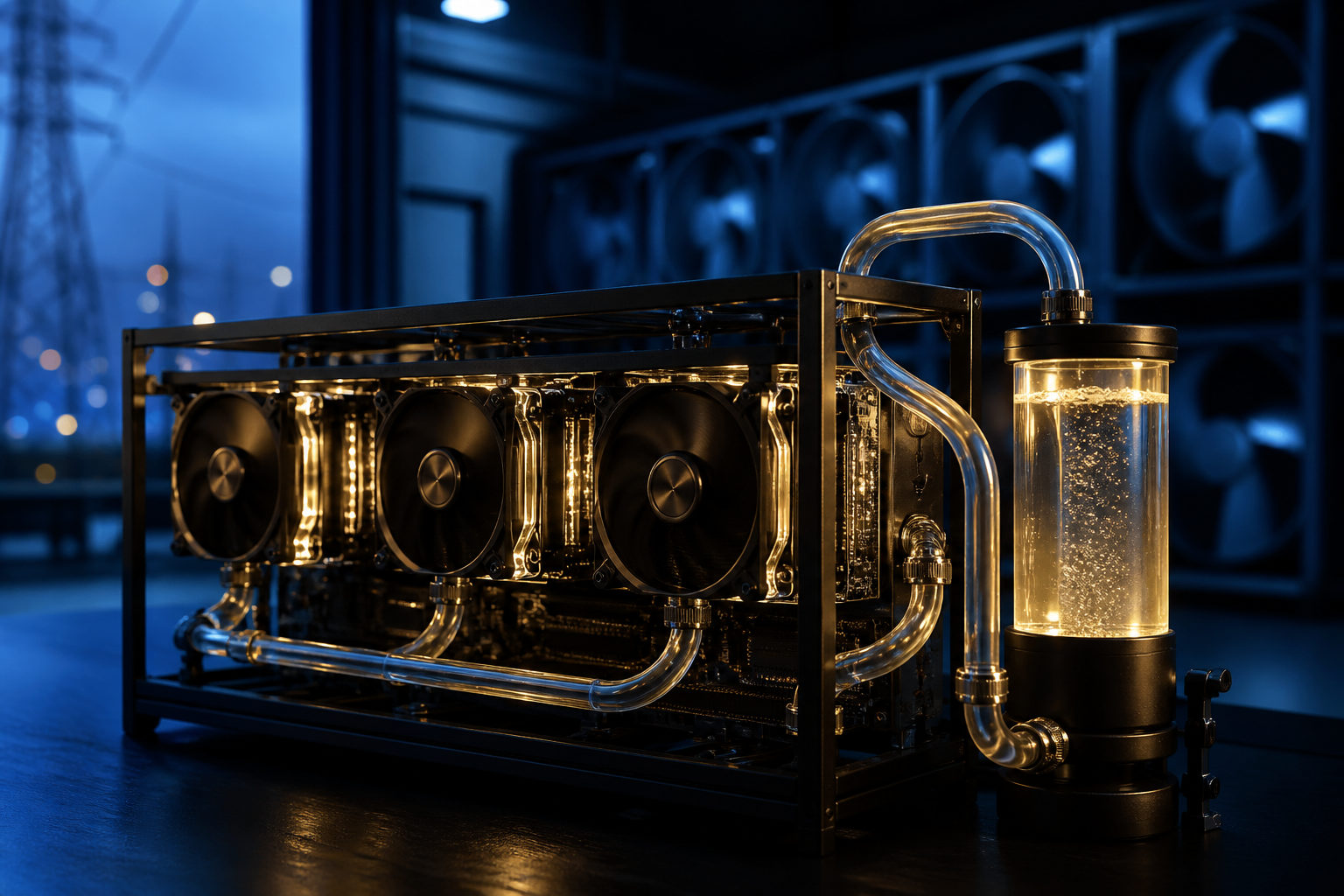
Bitcoin mining uses water, but there is no single fixed number that fits every operation because water use depends on power generation, cooling design, and local conditions.
A simple way to understand this is to picture Bitcoin as a nonstop bookkeeping race. Mining machines compete to solve a proof-of-work puzzle, and the winner earns the right to add a new block to the blockchain. The machines mainly consume electricity, while water often enters the picture through two separate paths: the power system behind that electricity and the cooling system that removes heat from the hardware.
Where water use actually happens
Many readers assume the water question starts and ends with the machine sitting in a warehouse. That is only part of the story. A mining rig directly draws power, but its water footprint may be linked to systems that are physically far away from the mining site.
The first path is electricity production. If a mining operation uses power from generation sources that rely on water for cooling or other plant processes, then the mining activity can carry indirect water use even if the mine itself has very little on-site water consumption. If the electricity comes from sources with lower water dependence, the picture changes.
The second path is cooling at the facility. Some mining sites use air cooling, where fans and airflow remove heat from the machines. Others use liquid-based systems or other thermal management setups that can make water more relevant on site. So when people ask how much water Bitcoin mining uses, they are often combining two different issues without separating them first.
| Stage | How water is involved | On-site or off-site | Why it varies |
|---|---|---|---|
| Power generation | Cooling and plant processes tied to electricity supply | Usually off-site | Different power sources have different water needs |
| Mining facility cooling | Removing heat from machines during operation | Usually on-site | Air cooling and liquid cooling work differently |
| Maintenance | Cleaning and site management | On-site | Operating practices differ by facility |
Why there is no universal answer
The biggest reason is that people measure different things. One discussion may count only direct water use at the mining site. Another may include the water tied to electricity generation. A third may focus on water per unit of output. Those are not interchangeable frames, so the final figures can point in very different directions.
Location matters as well. Bitcoin mining is global, and equipment can move when operators chase lower power costs, better weather, or friendlier infrastructure. A site built in a cool region can face a very different cooling burden from a site running in a hot and dry area. That means the same type of machine may carry very different water implications depending on where it runs.
There is also a context problem. Water use is not only about volume. In a place with tight water supply, even modest direct use may draw stronger criticism. In another place, a mining facility could be plugged into an industrial setup with a different cooling structure, and the environmental discussion changes again. A single headline number rarely captures those differences well.
| Why estimates differ | What it looks like in practice | How to read the claim |
|---|---|---|
| Different boundaries | Some count only the mine, others count the power system too | Check what is being measured first |
| Regional variation | Climate, water stress, and infrastructure are not the same | Do not generalize from one location |
| Cooling design | Air-cooled and liquid-based systems do not use water in the same way | Avoid treating all mines as identical |
| Operational change over time | Equipment moves and facilities upgrade | Static claims can become outdated fast |
What the bookkeeping race analogy says about participation
In that bookkeeping race, operators usually increase their chance of finding blocks by deploying more computing power. More computing power means more electricity use, and more electricity use means more heat that must be managed. Once heat rises, cooling stops being a side issue and becomes part of the business model.
That is why joining Bitcoin mining is not as simple as buying a machine and plugging it in. A participant also has to deal with airflow, heat removal, power stability, noise, physical space, and ongoing maintenance. Water may become part of the equation when the cooling setup grows more complex or when the local power supply carries a meaningful water footprint.
Small home mining and industrial mining do not face the same reality. A home user usually runs into room temperature, noise, and electrical limits first. A large facility may design its entire site around continuous high-heat operation. Both are mining Bitcoin, but the water story behind each setup can be very different.
| Participation model | Cooling profile | Water connection | Main practical limit |
|---|---|---|---|
| Home-scale mining | Usually air cooling with basic ventilation | Direct on-site water use may be limited | Noise, heat, and household power constraints |
| Hosted mining | Managed by a third-party facility | Depends on the host's cooling and energy setup | You need clear operating details from the provider |
| Industrial mining | Built for continuous high-density heat output | Water exposure depends on the technical design | High operating and management demands |
What to check before judging water impact
If you want to evaluate a mining site instead of repeating a headline, start with a short list of questions. Where does the electricity come from? How is heat removed from the machines? Is the operation located in an area where water is already under stress? Does the operator describe any heat reuse or resource management strategy?
Those questions are more useful than chasing one abstract total. Bitcoin mining does not create the same water outcome everywhere. The answer is shaped by the combination of energy sourcing, cooling architecture, and geography.
Cost also matters. Extra cooling systems, site modification, and long-run thermal control all increase operational complexity. New entrants often focus on hardware specifications first, then discover that heat management and infrastructure are the harder problems. That is where the water question starts to become practical rather than theoretical.
| Checkpoint | Why it matters | Common mistake |
|---|---|---|
| Power source | Indirect water use can sit upstream of the mining site | Looking only at the machine |
| Cooling method | Direct water use depends heavily on thermal design | Assuming all cooling works the same way |
| Local conditions | Climate and water stress shape environmental impact | Applying one region's case to the whole network |
| Operating design | Stable running requires more than raw hash hardware | Ignoring long-term site management |
FAQ
Does Bitcoin mining always use a lot of water?
Not always. Bitcoin mining always uses electricity, but water intensity depends on the power mix and the way heat is managed at the site.
In some cases, the bigger issue is upstream power generation. In others, the mining facility's own cooling setup deserves more attention.
Do mining machines directly consume large amounts of water?
That depends on the setup. Air-cooled systems may use little direct water on site, while some liquid-based or evaporative designs can make water a more visible part of operations.
So the machine alone does not tell you the full answer.
How should I research a mining site's water impact?
Start with the power source, then look at the cooling method and the local environmental conditions. If the operator talks only about machine performance and says nothing about heat management, the picture is incomplete.
Resource use claims make more sense when the operating structure is explained clearly.
Does this matter if I only want to mine at home?
Yes, because the water question connects to the broader issue of heat management. Even if you never install a water-based cooling system, the machine's heat output, ventilation needs, and noise can still shape whether home mining is realistic.
For most people, site conditions matter earlier than hardware marketing suggests.
Why do online claims about Bitcoin mining water use vary so much?
Most of the gap comes from mixed measurement boundaries. Some claims cover only direct water use, while others also count water tied to electricity production.
Without a clear boundary, two estimates may sound like they disagree even when they are describing different parts of the same system.
If you are comparing mining options, make a checklist for power source, cooling method, and site conditions before you think about hardware. That will tell you more than any stand-alone water figure.