
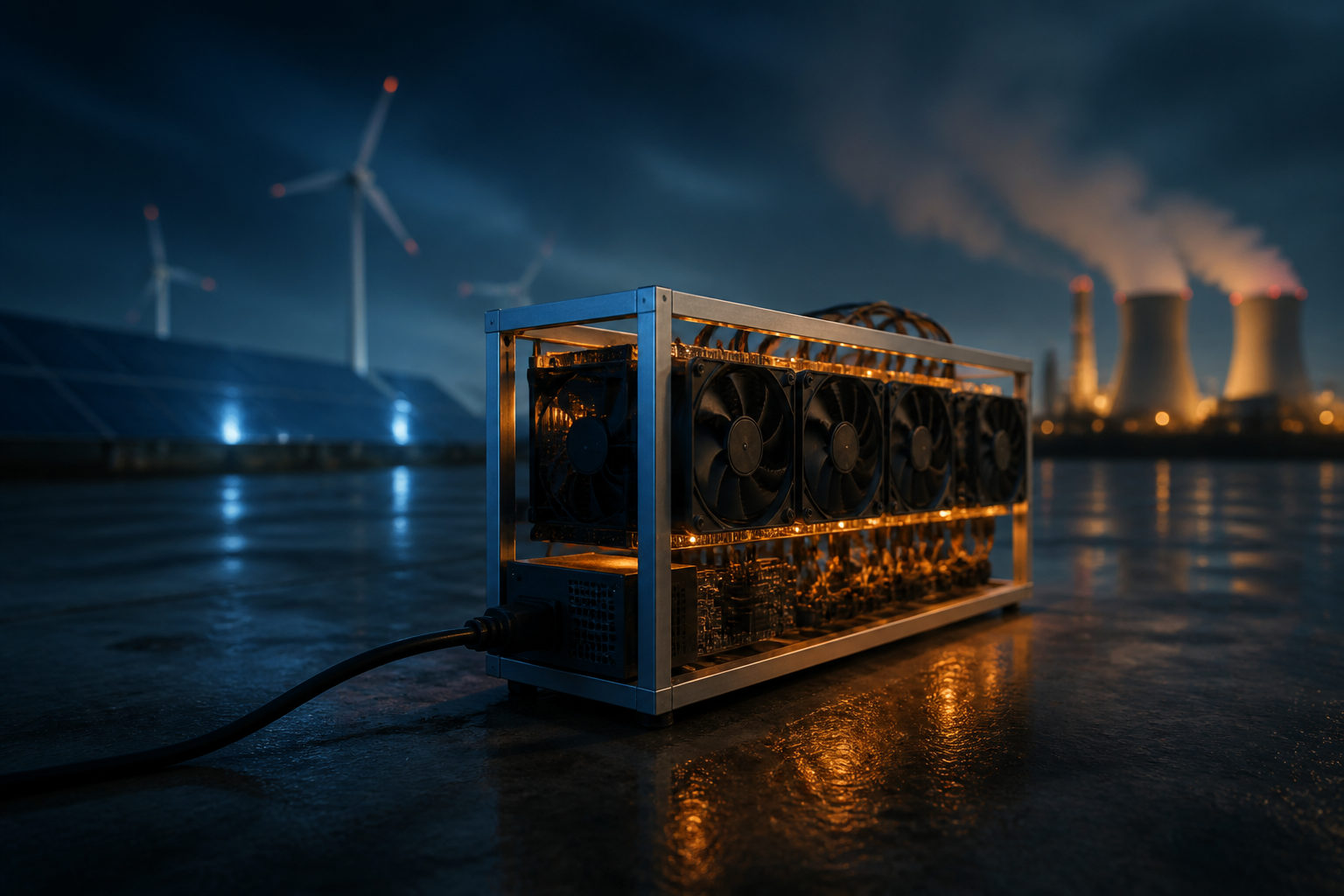
The environmental impact of Bitcoin mining comes down to where the electricity comes from, how efficient the hardware is, and whether mining adds pressure to a local grid. Looking at power consumption alone gives only part of the picture.
Why mining uses energy in the first place
Bitcoin mining is often described as a race, and that image is useful. The network keeps a public ledger, and miners compete for the right to add the next block of transactions. To do that, they run repeated calculations until one machine finds a result that meets the protocol rules.
This is the proof-of-work system. It turns computing effort into a real-world cost, which helps protect the ledger from tampering. Verifying a valid block is easy for the network, but producing one requires sustained computation. That design is why environmental questions stay attached to Bitcoin mining.
The important distinction is that the network asks for costly computation, not a specific fuel type. Electricity is the bridge between digital security and physical resources. Once that bridge is in place, the environmental impact of Bitcoin mining depends on how each mining operation gets and uses that electricity.
Where the environmental impact actually comes from
Power generation shapes the emissions profile
Two mining sites running similar hardware can have very different environmental outcomes if they draw from different power systems. A site connected to a grid with higher-emission generation will carry a heavier carbon burden than one supplied by lower-emission sources. That is why broad claims about mining can miss the regional reality.
Power use and pollution are related, but they are not identical measurements. Energy consumption tells you how much electricity is used. Environmental impact also depends on the mix behind that electricity and on whether extra demand changes how the grid dispatches its generation.
Grid stress matters as much as total consumption
Mining can create local pressure when it operates in places where electricity supply is already tight or where peak demand is difficult to manage. In those cases, the issue is not just added consumption. The extra load can reduce flexibility for households, businesses, or industry, and it can lead to dirtier backup generation entering the mix.
In other settings, miners act as interruptible demand. If they operate where power is abundant at certain times and agree to shut down when the grid needs relief, their role looks different from a facility that pushes constant demand regardless of conditions. That does not erase environmental cost, but it changes how the cost should be evaluated.
Hardware turnover creates waste beyond the power bill
Environmental discussions often focus on electricity and stop there. Mining hardware adds another layer. Bitcoin mining is highly competitive, so machines can lose economic value before they stop functioning. A miner may still run, yet no longer make sense to keep online if power costs and network difficulty leave little room for error.
When older machines are retired, moved, stripped for parts, or discarded, electronic waste becomes part of the environmental story. Repairability, resale markets, refurbishment, and recycling all affect that outcome. Any serious look at the environmental impact of Bitcoin mining should include the hardware life cycle.
Cooling, noise, and site selection also matter
Mining machines produce heat continuously, which means ventilation and cooling are operational necessities. Those systems can add their own energy demand. They also influence where mining can realistically take place without causing disruption.
Noise is not a minor detail for people living or working near a site. Even a mining operation using relatively clean electricity can trigger local opposition if it creates constant sound, heat management issues, or strain on nearby infrastructure. Environmental impact is not only a global emissions question; it also has a local footprint.
Why the debate keeps returning
Part of the reason is that Bitcoin ties network security to external cost. Supporters see that cost as the price of a ledger that is hard to censor or rewrite. Critics ask whether the same security justifies the energy and material burden. These are different starting points, so arguments often pass each other instead of meeting directly.
Another reason is mobility. Mining activity tends to move toward cheaper electricity, friendlier operating conditions, and locations that can support large hardware deployments. When miners relocate, the energy mix behind the network changes as well. A snapshot from one period does not settle the issue for every later period.
There is also a habit of treating all miners as one group. In practice, some operators run large industrial sites, some work with stranded or excess power, and some individuals experiment on a much smaller scale. Those differences affect environmental outcomes, business risk, and how claims should be judged.
What participation looks like for individuals
Anyone reading about Bitcoin mining may wonder whether they can take part directly. In a technical sense, mining is open to participants who follow the protocol. In practical terms, modern Bitcoin mining usually means specialized hardware, reliable electricity, heat management, ongoing maintenance, and tolerance for downtime risk.
For most households, the challenge is not starting a machine once. The challenge is running it consistently in a space that can handle the noise, heat, and power draw. Home setups also raise questions about wiring, ventilation, and whether the local electricity arrangement makes sense for long-term operation.
Mining pools are a common path for participation. A pool lets many miners combine their efforts and share rewards according to the pool's rules, which smooths out the uncertainty that solo miners face. That changes how rewards are distributed, but it does not make proof-of-work itself use less computation across the network.
Cloud mining is often marketed as an easier route because the user does not host machines directly. The convenience comes with a different problem: limited visibility. If you cannot clearly see where the hardware sits, what power source it uses, how the contract works, and who carries the operating risk, it becomes much harder to judge both the environmental profile and the business risk.
Anyone thinking about mining should treat environmental factors as part of the operating reality, not as a side issue. What kind of electricity is being used, whether the activity runs during strained grid conditions, and what happens to hardware at the end of its useful life are all part of the decision.
How to judge whether a mining operation is relatively cleaner
- Ask for energy source transparency. A serious operator should be able to explain, in plain terms, what kind of power it mainly uses.
- Check whether the load is flexible. A site that can reduce or stop consumption when the grid is under stress is different from one that demands steady power at all times.
- Look at hardware efficiency. Better machines do not remove environmental cost, but poor efficiency can increase resource use for the same competitive goal.
- Review the cooling setup. Cooling design affects added power demand, site suitability, and local disturbance.
- Look for a plan for old machines. If there is no discussion of resale, repair, refurbishment, or recycling, the environmental picture is incomplete.
- Consider the site itself. A region with fragile infrastructure or limited spare capacity is likely to face sharper trade-offs than a site with more room to absorb interruptible demand.
These checks will not give a perfect answer in every case, but they help separate marketing claims from operational substance. The environmental impact of Bitcoin mining is too complex to reduce to a slogan.
FAQ
Is Bitcoin mining always bad for the environment?
No. The answer depends on the energy mix, machine efficiency, timing of electricity use, local grid conditions, and hardware disposal practices. Similar mining activity can have very different outcomes in different places.
Can a regular home computer still mine Bitcoin?
It can attempt to participate at a technical level, but that is different from being competitive in practice. Specialized mining machines are built for this job, and home users still have to deal with heat, noise, and electricity costs.
Does joining a mining pool reduce energy use?
Not across the Bitcoin network as a whole. A mining pool changes how results are shared among participants, which can reduce reward variance for individuals, but the proof-of-work process still requires real computation.
How can I tell if a mining company uses cleaner energy?
Look for clear disclosure about where the operation is located, what power sources it relies on, whether it can curtail demand, and how it handles old equipment. Green claims without operational detail should be treated carefully.
Can I be involved with Bitcoin without mining it?
Yes. Many people choose to buy Bitcoin, hold it, study the network, or use a wallet for self-custody without running mining hardware. Mining is only one way to participate in the broader ecosystem.
If you are evaluating a mining opportunity, list the power source, grid conditions, cooling needs, hardware replacement plan, and local impact before anything else. Those factors shape both the environmental cost and the practical cost of taking part.
Disclaimer: This article is for informational and educational purposes only and is not investment, financial, or legal advice. Crypto assets are highly volatile and you could lose your entire investment. Do your own research and decide carefully.