
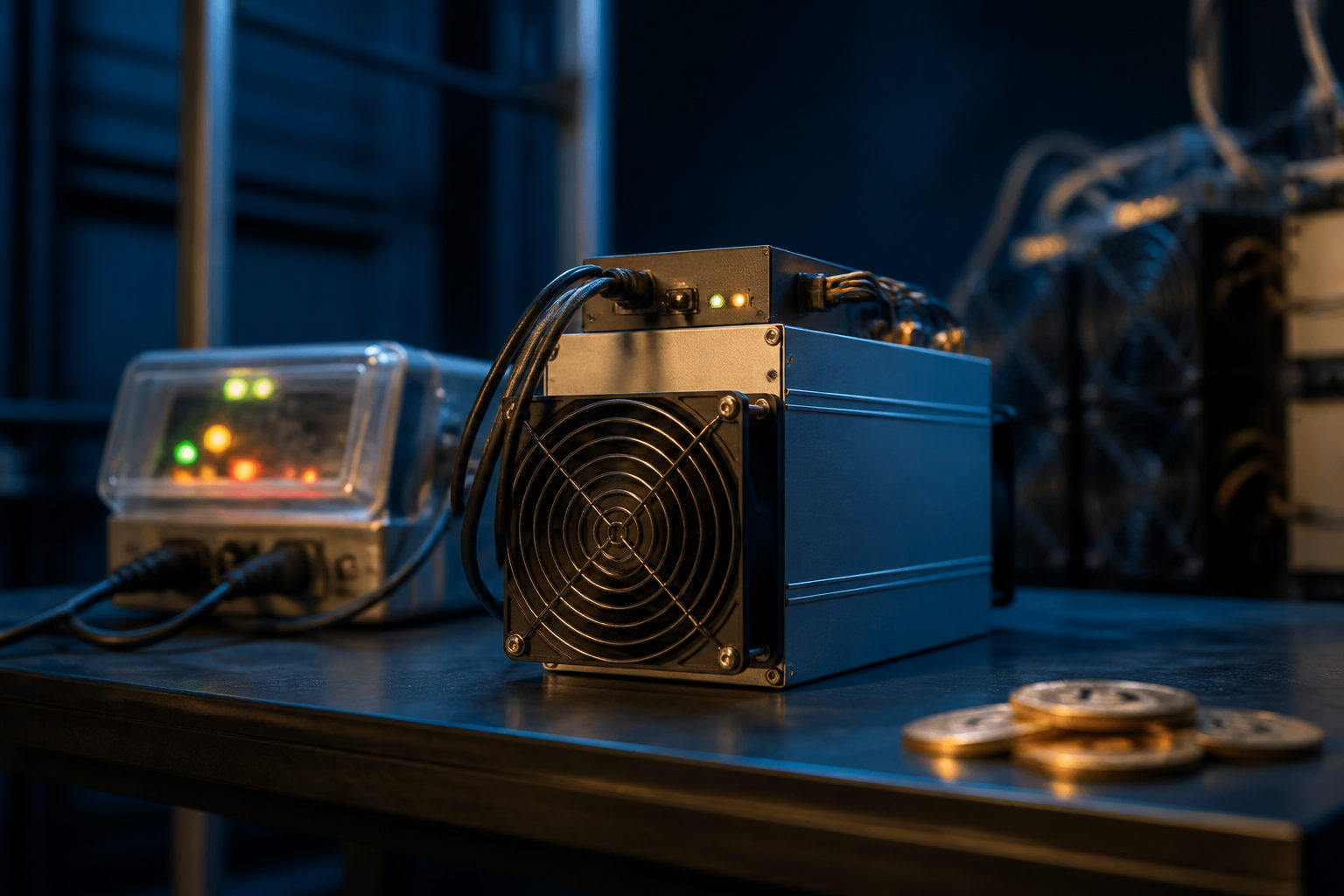
How profitable is bitcoin mining? It can be profitable, but only when power costs, machine efficiency, network difficulty, hosting terms, and sell discipline line up well enough to leave room after expenses.
Think of mining as a nonstop bookkeeping race
A simple way to understand bitcoin mining is to picture a global bookkeeping race. Many machines compete at the same time, each trying to find a valid result that lets a new block be added to the blockchain. The miner that succeeds gets the block reward plus transaction fees tied to that block.
This process is based on repeated computation, not quick reflexes. The Bitcoin network produces a block about every 10 minutes, so miners are always spending electricity and hardware life for a chance to win part of that ongoing contest. In business terms, mining is less like collecting passive income and more like running equipment that must perform day after day.
That framing matters because profitability is never just about how much bitcoin a machine produces. Real mining economics sit on top of power bills, cooling, uptime, maintenance, site conditions, pool fees, and the timing of when mined coins are sold. A setup can look attractive on paper and still disappoint once those moving parts show up in practice.
Where mining profit comes from, and what erodes it
Newcomers often start with the question of output. A better first step is cost structure. Mining does not pay a fixed yield, and the competitive environment keeps changing as other miners upgrade machines, switch locations, or operate under cheaper power contracts.
| Factor | How it affects profitability | What people often miss |
|---|---|---|
| Electricity cost | Directly shapes ongoing operating expense | A small difference in power price can decide whether the operation survives |
| Machine efficiency | Determines how much work a miner gets from each unit of power | A cheaper older unit may cost more over time |
| Network difficulty | Changes the share of bitcoin a miner can expect from the same hardware | A model that works today may weaken later without any fault in the machine |
| Cooling and repairs | Affects uptime and unexpected expense | Downtime is not neutral; it removes earning hours |
| Hosting fees | Adds fixed costs and contractual constraints | Service terms can matter as much as the headline rate |
| Sell timing | Changes how mined coins turn into actual cash flow | Production alone does not equal realized profit |
Bitcoin has a hard cap of 21 million coins. Its block subsidy falls on a set schedule, with a halving about every 4 years, or every 210,000 blocks. That means miners cannot assume the same reward structure will continue unchanged. Operational discipline becomes more important as the issuance side gets tighter.
There is also a gap between paper profit and realized profit. A miner may produce bitcoin every day, yet cash flow can still get squeezed by hosting invoices, repairs, unstable power, or a poor sale decision. People who focus only on mined output often miss this difference until they are already committed.
How individuals can participate in bitcoin mining
For an individual, participation does not always mean putting a machine at home. There are several ways to enter, and each one changes the balance between control, transparency, convenience, and risk. Picking the wrong path can make the economics hard to judge from the start.
| Method | Who it suits | Main advantage | Main drawback |
|---|---|---|---|
| Buy hardware and run it yourself | People comfortable with noise, heat, and maintenance | High control over equipment and wallet setup | Power, cooling, and upkeep can become a heavy burden |
| Use a hosting facility | People who do not want on-site operations | Less hands-on management | Terms around downtime, service, and removal need careful review |
| Join a mining pool | Miners who want steadier payout patterns | Reduces the luck factor of solo mining | Pool fees and payout rules differ |
| Buy cloud mining contracts | People seeking remote access with low setup effort | Looks simple at first glance | Transparency is often weak, making true economics hard to verify |
Mining pools are common because solo mining creates highly uneven outcomes. A pool combines the work of many participants and distributes rewards according to its own method. That can smooth the payout pattern, which helps planning, but it does not create profit by itself.
Home mining deserves a reality check before any purchase. The machine has to run in a place that can handle heat, noise, and continuous power demand. Internet stability matters too, and repair logistics matter even more once something fails. For many households, those issues become the real barrier long before profit calculations do.
How to judge whether mining is worth it for you
People often treat mining as a simple price bet on bitcoin. That misses the operational side. Two miners can buy the same model and end up with very different results because one has better power pricing, less downtime, clearer hosting terms, or a stronger maintenance setup.
| Decision area | What to examine | Common mistake |
|---|---|---|
| Cash flow | Whether monthly fixed costs are manageable | Assuming mined coins automatically solve short-term bills |
| Equipment cycle | How long the machine may stay competitive | Looking only at purchase price |
| Operational stability | Heat issues, outages, repair frequency, network interruptions | Expecting full uptime as a default |
| Exit flexibility | How easy it is to stop and dispose of equipment | Ignoring resale conditions |
| Contract and rule risk | Local rules, hosting terms, payout methods | Reading promotional material without checking details |
Bitcoin began with the genesis block in January 2009, and its issuance rules are public. Halving years include 2012, 2016, 2020, and 2024. For miners, these are not trivia points. They shape expectations around recovery time, competition, and margin pressure.
If you are trying to answer whether bitcoin mining is profitable, a practical sequence helps. First learn the bookkeeping race behind mining. Then map out costs. After that, compare participation models. Only then does it make sense to ask whether your setup has a realistic chance to work. Many mistakes happen because people skip to profit dreams before they understand what they are operating.
FAQ
Can a small individual miner still make money?
Yes, but it is closer to operating a cost-sensitive hardware business than collecting easy passive income. Without favorable power rates, reliable uptime, and careful review of service terms, pressure can build quickly.
Is home bitcoin mining worth trying?
It depends on power cost, noise tolerance, cooling conditions, and the machine itself. In many homes, the real issue is not whether the miner can run for a day, but whether it can run well for a long stretch.
Does joining a mining pool increase profit?
A pool mostly changes the payout pattern by reducing the randomness of mining alone. It can make income feel steadier, though fees and payout methods still affect the final result.
Why are cloud mining offers treated with caution?
Because buyers often cannot inspect the hardware, site conditions, or true operating costs behind the contract. If downtime, maintenance, or early termination terms are vague, the risk becomes hard to price.
What should I check before buying a mining machine?
Start with efficiency, power fit, repair support, hosting conditions if any, and resale options. A machine that looks cheap upfront can become expensive once electricity use and downtime enter the picture.
Before you commit, list every recurring cost, read hosting and pool terms line by line, and test your plan against conservative assumptions about downtime and difficulty. That work is far more useful than chasing someone else’s mining success story.
Disclaimer: This article is for informational and educational purposes only and is not investment, financial, or legal advice. Crypto assets are highly volatile and you could lose your entire investment. Do your own research and decide carefully.