
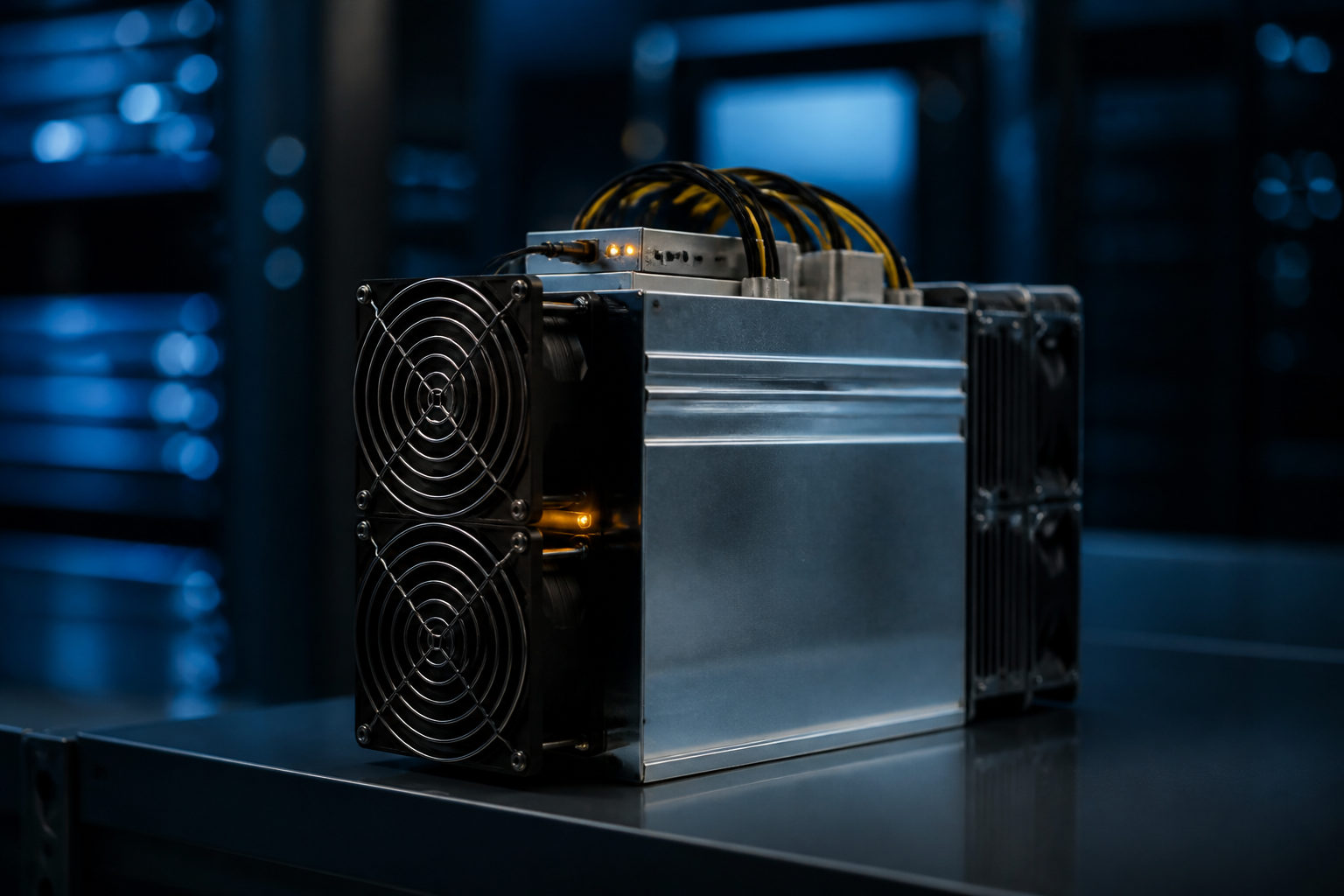
Yes, you can farm bitcoins, but in practice Bitcoin mining is a competitive process of adding blocks to the network, and whether you should do it depends on hardware, power, heat, noise, and ongoing operations.
What “farming bitcoins” really means
People often say “farm bitcoins,” but the standard term is Bitcoin mining. A simple way to picture it is a nonstop bookkeeping contest: transactions are waiting to be grouped into a block, and miners compete to produce a valid result that the network accepts.
That work is tied to proof of work. Mining machines keep trying hashes until one meets the current requirement. When a valid block is found, the miner who found it can receive the block reward plus transaction fees from that block. Bitcoin produces a block about every 10 minutes, and the network adjusts mining difficulty over time, so competition does not stay fixed.
New bitcoin is released through this process rather than appearing all at once. The total supply is capped at 21 million coins. The block subsidy is cut in half about every 4 years, or every 210,000 blocks, with halving years including 2012, 2016, 2020, and 2024. That schedule matters because lower issuance puts more weight on machine efficiency, electricity terms, and operational discipline.
How people participate today
There is more than one way to take part. You can run your own mining machine, connect that machine to a mining pool, place your equipment with a hosting provider, or stop at the research stage and decide that mining is not the right route for you.
| Approach | Who it fits | Main benefit | Main constraint |
|---|---|---|---|
| Run your own machine | People with space and technical control | Direct control over setup and operation | Heat, noise, power, and maintenance are your problem |
| Join a mining pool | People who want pooled participation | More consistent payout structure than solo mining | You must understand pool fees, rules, and reporting |
| Use hosted mining | People without a suitable site | Professional power and cooling environment | Less control and more dependence on a third party |
| Study first, do nothing yet | Beginners | Clearer understanding before spending money | No hands-on experience at the start |
For most individuals, mining pool participation is the practical path if they decide to mine at all. Solo mining leaves you exposed to very uneven outcomes because finding a block on your own is highly uncertain. A pool combines many participants’ hashpower and distributes results according to its own payout method.
That does not mean every pool is equally suitable. You need to read how it pays, what fees it takes, how transparent its dashboard is, and whether the service stays stable. A pool can make participation smoother, but it also adds another layer you must trust and monitor.
Hosted mining changes the setup again. You own or lease equipment and place it in a facility built for heavy power draw and cooling. This can remove the biggest home-mining headaches, yet it introduces contract risk, downtime risk, and the basic problem of relying on someone else to manage machines you do not physically control.
Why a normal home computer is usually not enough
A common beginner question is whether a laptop or desktop can mine Bitcoin. In a strict technical sense, a computer can run mining-related software. In a real-world sense, general-purpose hardware is not competitive in modern Bitcoin mining.
The issue is not whether the machine can stay on. The issue is how much useful hashing work it can perform relative to the electricity and wear involved. Bitcoin mining has long moved toward specialized hardware because proof of work rewards efficient, sustained computation. A regular home computer can consume power, generate heat, and make noise without offering meaningful mining performance in return.
| Hardware type | Can it do computation? | Practical role in Bitcoin mining | Typical drawback |
|---|---|---|---|
| Home PC or laptop | Yes | Very weak in practice | Poor efficiency for this use, added heat and wear |
| GPU-based setup | Yes | Not the standard choice for Bitcoin | Does not match the current Bitcoin mining environment well |
| ASIC miner | Yes | Mainstream hardware for Bitcoin mining | Higher entry barrier in purchase, deployment, and upkeep |
This is where many people get the wrong impression. They focus on whether mining software exists for their machine, when the real filter is operating efficiency. If your setup cannot handle the power draw, cooling load, and constant runtime, it is hard to call it a workable mining plan.
The costs and constraints people underestimate
Mining can look simple from a distance: buy hardware, plug it in, connect to a pool. In reality it behaves more like running equipment continuously. The important questions show up before you buy anything.
| Checkpoint | What to ask | What happens if you ignore it |
|---|---|---|
| Electricity | Can you secure stable power terms for long uptime? | Operating costs can become hard to justify |
| Cooling | Can your location remove heat continuously? | Thermal stress, throttling, or shutdowns |
| Noise | Can your home or work site tolerate mining noise? | The setup may become unusable in daily life |
| Network | Will your connection stay stable? | Interrupted submissions and poorer pool performance |
| Maintenance | Who fixes faults when hardware stops working? | Long downtime and idle machines |
| Storage of mined bitcoin | Where will you keep the coins safely? | Asset handling becomes sloppy and risky |
There is also a mindset issue. Some people want to understand how Bitcoin stays secure through proof of work. Others want to operate mining equipment as an ongoing activity. Those are different goals. The first goal calls for learning how blocks, pools, halvings, and wallets fit together. The second one adds procurement, deployment, monitoring, repair, and counterparty risk.
If your only goal is getting exposure to Bitcoin, buying and holding may be simpler for many people. Mining has its own value because it gives direct contact with how the network is maintained, but it also brings a layer of operational reality that spot ownership does not.
FAQ
Can I still mine Bitcoin at home?
You can try, but a home setup often runs into heat, noise, and power limits quickly. The question is less about starting the machine and more about whether you can keep it running in a sensible way.
Does joining a pool mean I will always receive bitcoin steadily?
A pool can smooth the experience compared with mining alone, but it does not remove all uncertainty. You still need to check its payout model, fee structure, and reporting quality.
Can I use a regular computer to farm bitcoins?
You can use a regular computer to perform computation, but that is different from being competitive in Bitcoin mining. For most people, general-purpose hardware is not an efficient route for this network.
Is mining better than buying bitcoin directly?
That depends on your goal. Mining is useful if you want hands-on involvement with Bitcoin’s bookkeeping process, while direct purchase is often the simpler path if you mainly want to hold bitcoin.
What should a beginner learn first before spending money?
Start with proof of work, mining pools, and wallet storage. Once those three pieces make sense, it becomes much easier to judge whether hardware, hosting, or no mining at all is the right decision.
If you want a practical next step, read mining hardware specifications, compare pool rules in a structured way, and decide where mined bitcoin would be stored before you think about placing an equipment order.
Disclaimer: This article is for informational and educational purposes only and is not investment, financial, or legal advice. Crypto assets are highly volatile and you could lose your entire investment. Do your own research and decide carefully.