
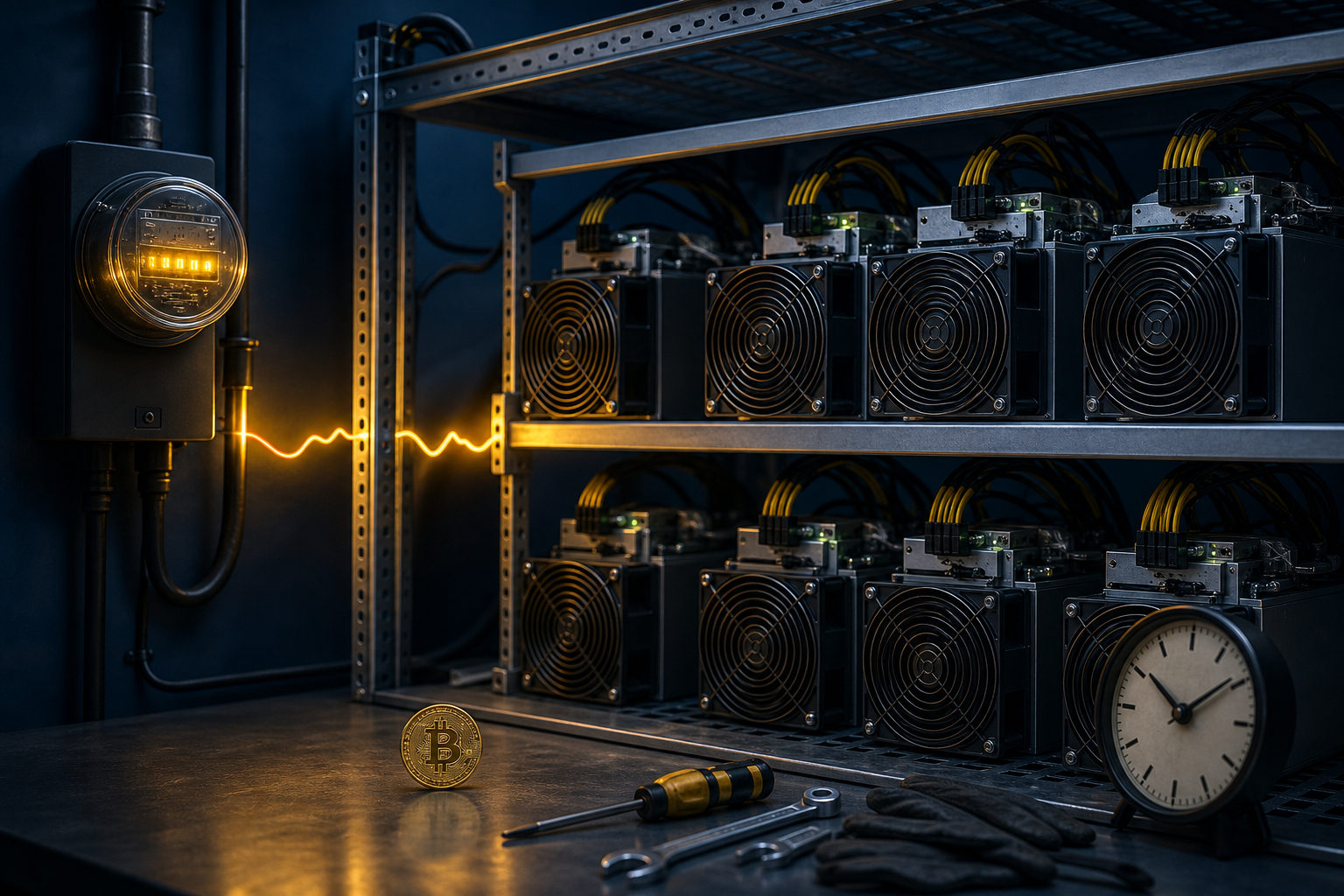
Bitcoin mining is not free. It is a competition to win the right to add a new block, and anyone who takes part has to deal with real costs such as hardware, electricity, cooling, maintenance, and time.
Why bitcoin mining is not the same as getting free coins
The word “mining” can give beginners the wrong picture. It sounds as if bitcoin is sitting somewhere in the network waiting to be picked up. That is not how the system works. Miners help process transactions, package them into blocks, and secure the chain through proof of work.
A better way to think about it is a public bookkeeping contest. Many participants are trying to earn the next turn to write a fresh page of the ledger. The rules are open, no one can skip the line, and no one can simply declare a block valid without meeting the network’s conditions. To compete, miners must commit resources. That is the reason the answer to “is mining bitcoin free” is no from the start.
Bitcoin began with the genesis block in January 2009. Since then, block production has been tied to proof of work, with a new block appearing about every 10 minutes. Miners keep trying different hashes until one participant finds a valid result first. The rest of the network can then verify that block against the protocol rules.
The point of this design is not to make the calculations useful in the everyday sense. The point is to make cheating expensive. If someone wants to rewrite records or attack the chain, they have to compete against the wider network’s computing power. That cost is part of what gives bitcoin its security.
Where the real costs come from
When people ask whether bitcoin mining is free, they often focus on one item: electricity. Power does matter, but it is only one part of the picture. A realistic view has to include equipment, operating conditions, upkeep, and the value of your own time.
First, there is hardware. In practice, bitcoin mining today is usually associated with specialized machines built for this type of computation. A regular home computer may help someone understand the idea of mining, but that is very different from being an effective way to compete on the network. If you buy hardware, you face upfront spending. If you rent computing power or use a hosted service, the cost has not vanished; it has just been packaged into a fee.
Next comes electricity and cooling. Mining machines run continuously and produce heat. Heat has to be managed. That can mean ventilation, cooling equipment, noise handling, and a location that can support long periods of operation. Even if a person already has access to space and internet, mining still consumes resources that could be used elsewhere.
Maintenance is another layer. Machines need setup, monitoring, firmware management, cleaning, and troubleshooting. Connections can fail. Hardware can stop working as expected. Pool settings can be misconfigured. None of that is free, even when the out-of-pocket cost looks small at first glance.
Then there is opportunity cost. Money spent on mining equipment, hosting, or service contracts cannot be used for another strategy. This is why mining and simply buying bitcoin are not interchangeable choices. One is an operating activity with technical and logistical demands. The other is a market transaction followed by storage and risk management.
Typical cost buckets
- Hardware: mining machines, power supplies, networking gear.
- Electricity: the ongoing power needed to keep machines running.
- Cooling and ventilation: heat management is part of normal operation.
- Maintenance: setup, monitoring, repairs, cleaning, and adjustments.
- Pool or hosting fees: third-party services usually charge for access or management.
- Time: learning, configuring, checking, and responding to problems.
How the reward works, and why it is not “free money”
Miners can receive two forms of compensation: the block reward and transaction fees included in the block. That does not make mining free. It means the network uses incentives to motivate participants to provide security and ordering of transactions.
Bitcoin has a fixed supply cap of 21 million coins. The issuance schedule is built into the protocol, and the block subsidy is cut in half about every 4 years, or every 210,000 blocks. The halving years so far are 2012, 2016, 2020, and 2024. That schedule matters because it shows that mining is a competitive process shaped by efficiency, not a faucet anyone can tap without cost.
The smallest unit of bitcoin is one satoshi, equal to one hundred millionth of a BTC. Even that detail is useful for beginners because it reminds them that holding or earning bitcoin does not require getting a whole coin at once. Still, whether someone receives a small amount or a large one, the process is tied to network rules and operating costs, not to a free giveaway.
This is where marketing language can become misleading. A service may advertise “free bitcoin mining” because it removes the need to buy a machine directly. Another may offer a trial, credits, or bonus hash power. Those offers do not prove that bitcoin mining itself is free. They usually mean the cost is hidden, shifted, limited in scope, or covered temporarily for promotional reasons.
Ways people participate in mining today
For most readers, the practical question is not just “is bitcoin mining free” but “how can someone take part at all?” There are a few common paths, and each comes with different trade-offs.
Solo operation with your own equipment
This route gives the operator the most direct control. You choose the hardware, decide where it runs, manage the setup, and handle the full process yourself. That also means you carry the full burden of noise, heat, power management, maintenance, and troubleshooting.
For a lot of people, especially those in ordinary home settings, this is not a simple hobby. It can be educational, but it is not a casual “set it and forget it” activity.
Mining through a pool
A mining pool combines the work of many participants. Instead of trying to win block production on your own, you contribute computing power to a collective effort and receive a share according to the pool’s rules. This can make results less uneven over time.
Still, a pool does not turn mining into a free activity. You still need equipment or a paid service, and you also need to understand the pool’s fee structure, payout rules, account protections, and operating reputation.
Cloud mining or hosted mining
This option is often marketed as easier because the provider handles hardware deployment and daily operation. That convenience can appeal to beginners, but it creates a different risk profile. You are relying on a third party for transparency, terms, and custody-related processes.
Cloud mining is not the same as zero-cost access. It is usually a paid contract or service arrangement. If the details are vague, or if the sales pitch makes mining sound effortless and guaranteed, that is a reason to slow down and read more carefully.
Common misunderstandings around “free bitcoin mining”
Many people who search “is bitcoin mining free” are really asking whether there is a no-risk shortcut to acquire bitcoin. In most cases, the answer is no. The main problem is not just optimism. It is category confusion.
One common issue is mistaking platform rewards for actual mining. Some apps offer points, vouchers, or internal balances for watching ads, completing tasks, or staying active. Those systems may use the word “mining,” but they are not the same as participating in Bitcoin’s block production process.
Another issue is hidden costs. A service may remove the upfront machine purchase yet charge management fees, withdrawal restrictions, contract spreads, or other conditions that recover the cost elsewhere. “Free to start” is not the same as “free to operate.”
There is also a security gap in beginner thinking. However someone receives bitcoin, they still need to understand wallets, private keys, backups, phishing risks, and account protection. Mining is not only about running machines. It also includes taking responsibility for any bitcoin you end up controlling.
One more misunderstanding comes from learning tools. Educational simulators, test environments, or simplified dashboards can help people grasp how blocks, pools, and rewards work. That is useful. It should not be confused with a realistic path to free bitcoin.
FAQ
Can you start bitcoin mining without spending money?
Not in a meaningful long-term sense. Some services may lower the entry barrier, but the cost usually reappears as hardware fees, service charges, withdrawal conditions, or time and effort.
You may be able to learn the process cheaply, but sustained participation in bitcoin mining still depends on real resources.
Is bitcoin mining free if I use a computer I already own?
No. You are still using hardware, electricity, time, and internet access. Those are costs, even if you did not buy new equipment on the same day.
For most people, an ordinary computer is better for learning the concept than for treating it as a practical plan to get bitcoin.
Does joining a mining pool make bitcoin mining free?
No. A pool changes how results are shared, not whether costs exist. It helps participants combine computing power and receive distributions according to pool rules.
You still need to account for equipment, electricity, hosting, or service-related expenses, plus the pool’s own fee structure.
Is cloud mining a zero-cost way to get bitcoin?
No. Cloud mining usually means paying a provider instead of buying and operating machines yourself. The cost is wrapped into a contract or service package.
Before using any such service, look closely at transparency, terms, payout rules, and whether the offer sounds much easier than the underlying activity really is.
If I only want to own bitcoin, do I need to mine it?
Not necessarily. Understanding mining is useful because it explains how Bitcoin secures its ledger and why certain marketing claims do not hold up.
But if your goal is simply to gain exposure to bitcoin, researching buying methods, wallet choices, and storage practices may be more practical than running mining operations yourself.
Before you do anything, decide whether your goal is education, network participation, or simply owning bitcoin. If you want to learn, study blocks, pools, wallets, and private keys first; if you want to participate, work through the equipment, electricity, hosting, and security questions one by one.
Disclaimer: This article is for informational and educational purposes only and is not investment, financial, or legal advice. Crypto assets are highly volatile and you could lose your entire investment. Do your own research and decide carefully.