
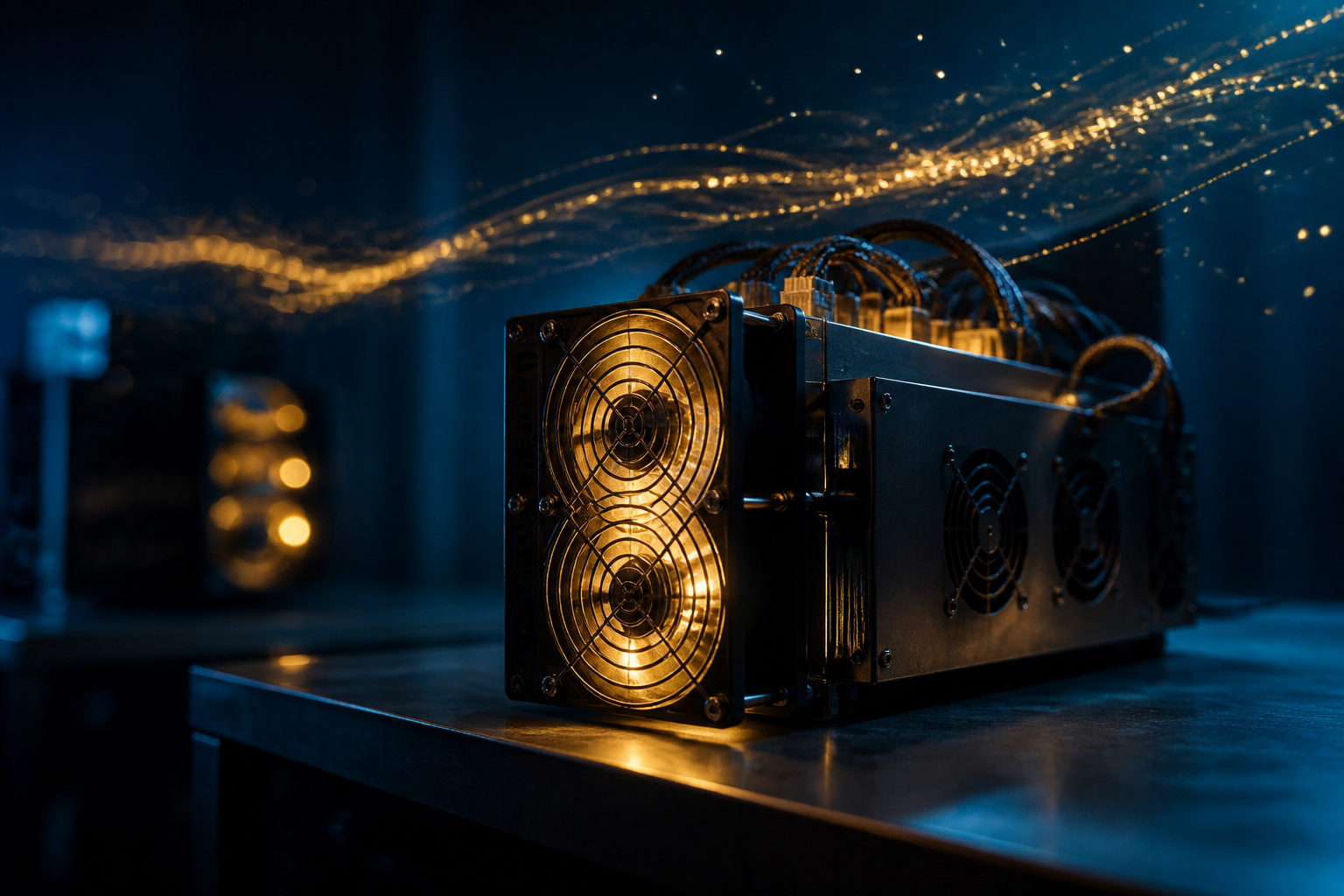
If you are asking "am I mining bitcoin," the answer is yes only when your device is performing hash calculations and taking part in the race to add a new block. Holding BTC, sending coins, running a wallet, or tapping a phone app that says "mining" does not automatically mean you are actually mining Bitcoin.
Think of mining as a bookkeeping contest
Bitcoin needs participants to package pending transactions into blocks and submit those blocks to the network. The winner is the participant who finds a valid result first and gets that block accepted by other nodes. That is where the block reward and transaction fees come from.
The key task is repeated hashing, not manual data entry and not a passive income button. Mining hardware keeps changing inputs and running SHA-256 calculations again and again until it finds a hash that meets the network target. If your setup is not doing that work, you are not mining in the native Bitcoin sense.
| Activity | Is it Bitcoin mining? | Why |
|---|---|---|
| Running a dedicated miner on SHA-256 and connecting to a pool | Yes | You are directly competing to help produce a block |
| Running a full node without mining hardware | No | You validate and relay data, but you do not compete for block rewards |
| Buying and holding BTC | No | Owning bitcoin is different from producing blocks |
| Using a phone app labeled mining | Usually no | Most do not have the device doing valid Bitcoin mining work |
| Buying a cloud contract | Maybe, maybe not | You may only be buying exposure to a provider, not controlling real machines |
What real Bitcoin mining machines are doing
Since the genesis block on 2009-01-03, Bitcoin has used proof of work. Miners build a candidate block from pending transactions, the previous block reference, and other required fields in the block header. Then they hash that header over and over, searching for a valid result.
The protocol aims for a block about every 10 minutes. Rewards are reduced every 210,000 blocks, which is roughly every 4 years. The halvings took place on 2012-11-28, 2016-07-09, 2020-05-11, and 2024-04-19. The current block reward is 3.125 BTC, and before the next halving around 2028, network issuance is about 450 BTC per day in total. That figure describes the whole network, not what any one person, rig, or company can expect to produce.
This is why many products use the word mining loosely. If a service cannot show what machines exist, what algorithm they run, how the pool is configured, and how payouts are derived, you should not assume you are looking at real Bitcoin mining. The physical side matters: electricity, heat, noise, maintenance, and downtime are part of the activity.
How to tell whether you are really participating
A good test is to trace the chain of work from device to payout. Ask yourself what hardware is doing the calculations, which algorithm it uses, who submits the block shares or blocks, and how rewards are calculated. If those questions do not have clear answers, the claim is weak.
| Question | What real participation usually looks like | Warning sign |
|---|---|---|
| What device is involved? | Usually dedicated ASIC hardware, not a basic phone or office laptop | Vague claims about easy background earning |
| What algorithm is used? | Bitcoin mining uses SHA-256 | No clear explanation of the algorithm |
| Where do payouts come from? | Block rewards and fees, often through a mining pool | The platform talks only about bonuses or referral rewards |
| How is work measured? | By contributed hashpower and pool accounting | No pool dashboard, no machine data, no payout method |
| What are the visible costs? | Power, cooling, noise, repairs, and machine wear | Claims of stable output with no meaningful costs |
People often mix up several different activities. Running a full node supports the network, but a node verifies and relays data rather than competing for a block. Staking belongs to other systems and is not how Bitcoin creates blocks. Simple custody is just ownership. Only one of these actions puts your hardware into the proof-of-work race.
You also do not need to own a full bitcoin to be involved. Bitcoin can be divided into very small units, and 1 satoshi equals 0.00000001 BTC. Mining rewards can be distributed in tiny amounts, especially in pool setups.
Main ways to participate and the cost reality
In practice, there are three broad paths: solo mining, pool mining, and buying third-party hashpower products. They differ in control, technical demands, and risk. For most individuals who want genuine participation, the pool model is the one they need to understand first because it turns a very uneven block-finding process into shared distribution based on contribution.
| Method | How it works | Who it fits | Main risk |
|---|---|---|---|
| Solo mining | You run your own hardware and keep the full result if you find a block | People with strong technical and operating resources | Long stretches with no block found at all |
| Pool mining | Many miners combine hashpower and split payouts by pool rules | Most real-world participants | Dependence on pool transparency and payout design |
| Third-party hashpower product | You pay someone else to provide machines or hashpower | People who want less direct hardware management | Counterparty risk and uncertainty about whether the machines are real |
The difficult part is rarely the start button. Hardware sourcing, electrical capacity, cooling, sound, maintenance, pool fees, and machine depreciation all matter. Bitcoin also adjusts difficulty over time so that blocks continue to arrive at roughly the same pace. As competition rises, the chance that one small setup earns meaningful rewards becomes thinner.
That is why an old desktop at home is usually not enough to make a serious attempt at Bitcoin mining today. The issue is not that the software cannot run. The issue is that Bitcoin mining is a global contest, and your machine is measured against specialized hardware built for one narrow task.
FAQ
Does leaving my computer on all day mean I am mining Bitcoin?
No, not by itself. Your computer would need to run actual Bitcoin mining calculations and be connected to a real mining workflow such as solo mining software or a pool setup.
My phone app shows daily output. Is that real Bitcoin mining?
Not automatically. Check whether there is real hashpower, a visible pool relationship, a payout record, and a verifiable BTC receiving address; without that, it may just be an internal points system or a marketing feature.
If I join a mining pool, am I still mining Bitcoin?
Yes. A pool is simply a coordination layer that combines many miners and distributes payouts by rules. Your hardware is still taking part in proof of work.
Why is running a full node different from mining?
A full node checks blocks and transactions against Bitcoin rules and helps relay valid data. It plays a valuable role, but it does not compete for the block reward through hash calculations.
Do I need to own one full BTC before I can mine?
No. Ownership and mining are separate. Rewards can be paid in very small fractions of bitcoin, down to satoshis, so holding a full coin is not a requirement.
If you want a quick reality check, inspect three things: the hardware model, the pool or mining software dashboard, and the payout trail to your wallet. If none of those can be verified, you should be careful about calling what you are doing Bitcoin mining.
Disclaimer: This article is for informational and educational purposes only and is not investment, financial, or legal advice. Crypto assets are highly volatile and you could lose your entire investment. Do your own research and decide carefully.