
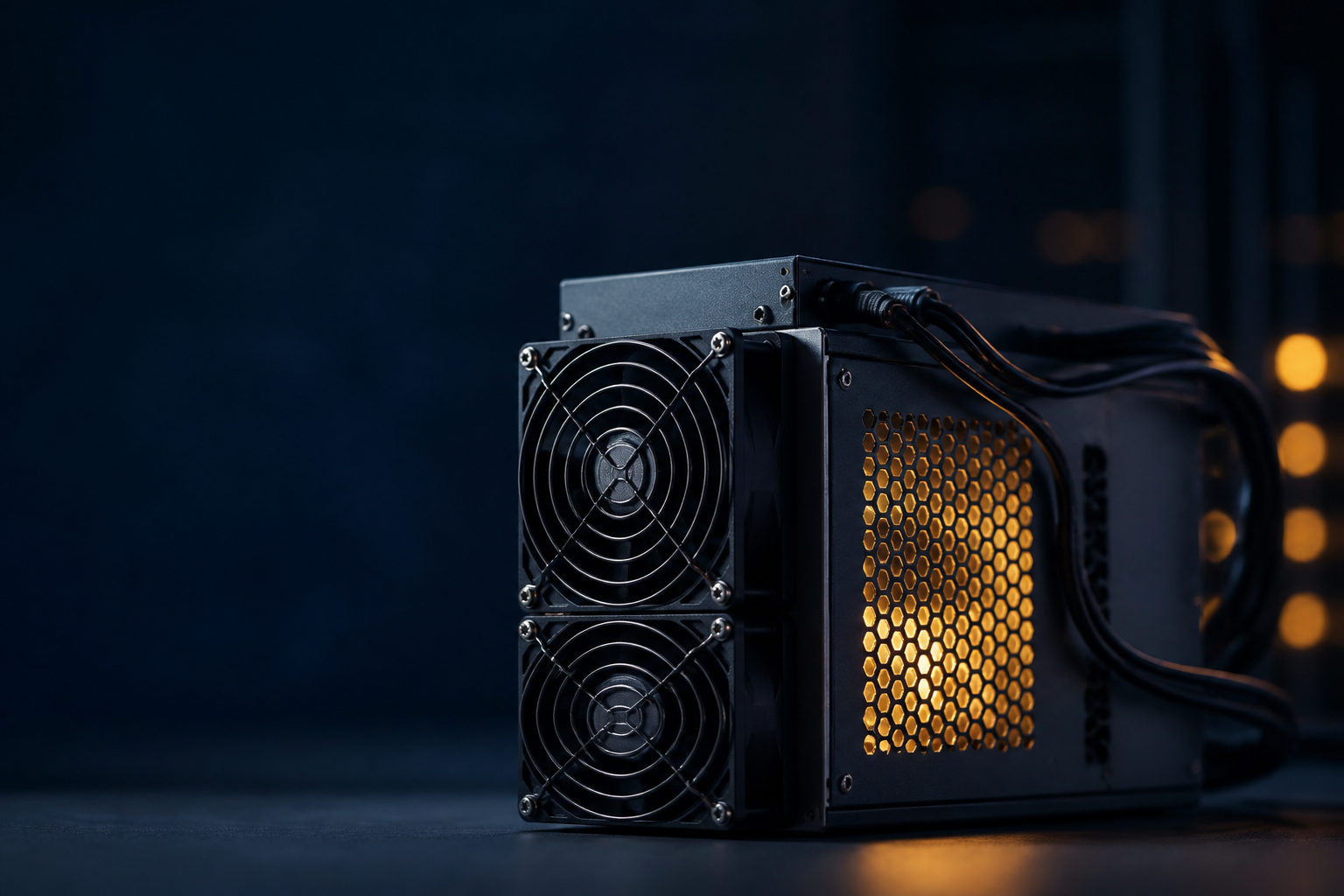
A gentle introduction to bitcoin mining starts with one idea: mining is a competition to record transactions. Machines race to earn the right to add a new block to the blockchain, and the winner receives the block reward plus transaction fees.
What bitcoin mining is actually doing
The word “mining” can mislead beginners. No one is digging coins out of a computer. In bitcoin, miners collect pending transactions, package them into a candidate block, and keep performing calculations until one participant finds a valid result under the network rules.
If you picture bitcoin as a public ledger shared across the internet, miners are competing for the right to write the next page. That page becomes part of the chain only if the rest of the network can verify it. This is why mining is tied to security as well as coin issuance: it helps decide transaction order and makes old records hard to rewrite.
Bitcoin began with the 2008 white paper Bitcoin: A Peer-to-Peer Electronic Cash System, and the genesis block appeared in January 2009. Since then, mining has remained part of the system’s core design. New bitcoins enter circulation through block rewards, but the same process also helps the network agree on one valid history.
Why the system uses a computing race
Bitcoin does not have a central bookkeeper. The network still needs a way for participants in different places to accept the same transaction history, and mining provides that ordering mechanism. A miner who commits real computing power has a better chance to produce the next valid block.
The network aims for a new block about every 10 minutes. To keep that pace over time, mining difficulty adjusts as overall participation changes. When more computing power joins, finding a valid block becomes harder for each machine. That is why mining moved from early hobbyist experimentation into a field where specialized hardware matters.
This point is important for anyone reading “a gentle introduction to bitcoin mining” and wondering if a household computer is enough. It may help you understand the workflow, but it usually does not put you in a strong position for actual competition on the bitcoin network. Hardware efficiency, electricity cost, cooling, and stable operation matter much more than curiosity alone.
How people participate today
There is more than one way to approach bitcoin mining. Some people want direct hands-on experience with machines. Others only want to understand how the process works before deciding whether it fits their budget and living conditions.
| Approach | Best for | Main feature | What to check first |
|---|---|---|---|
| Run your own miner alone | People willing to manage hardware closely | High control over setup | Noise, heat, power delivery, and maintenance |
| Connect hardware to a mining pool | Most beginners who want real participation | More regular payout pattern than solo mining | Pool rules, fee structure, and account setup |
| Learn through simulation and study | Newcomers building basic understanding | Low-cost learning path | Learning the process does not mean the economics work for you |
| Study mining without buying hardware | Readers focused on bitcoin mechanics | Lowest direct cost | You can judge fit before spending on equipment |
For most people, mining pools are the practical entry point. A solo miner may wait a very long time to find a block, because success depends on a tiny share of total network computing power. In a pool, many miners combine their work, the pool competes for blocks, and rewards are divided according to the pool’s rules.
Solo mining and pool mining are not the same experience
Solo mining gives you direct control. If your machine finds a valid block, the full block reward is yours under the network rules. The problem is variance: for a small operator, results can be extremely uneven.
Pool mining smooths that experience. You contribute a slice of computing power and receive a portion of what the pool earns. That makes participation easier to follow, but it also means you need to understand payout methods, operational reliability, and the trust boundaries around the service you choose.
What you need before starting
Bitcoin mining is not just a matter of plugging in a box and waiting. You need suitable hardware, stable electricity, network connectivity, a wallet for payouts, and a place that can handle heat and noise. Many beginners discover that their main obstacle is not the theory but the physical environment.
| Requirement | What matters | Common mistake |
|---|---|---|
| Mining hardware | Using equipment built for bitcoin mining | Assuming a regular PC or gaming GPU is enough |
| Electricity | Reliable power and manageable ongoing cost | Focusing on purchase price while ignoring power bills |
| Cooling | Airflow, heat removal, room conditions | Underestimating how much heat continuous operation creates |
| Noise | Whether the setup fits your living space | Treating a home like a server room |
| Internet connection | Stable uptime and low interruption risk | Thinking any connection is good enough for continuous use |
| Wallet setup | Correct payout address and proper backup | Loose handling of addresses or recovery records |
Bitcoin has a fixed maximum supply of 21 million coins. New issuance happens through block rewards, and that reward is reduced roughly every 4 years, or every 210,000 blocks. The halving years so far are 2012, 2016, 2020, and 2024. For a beginner, the practical takeaway is simple: mining conditions do not stand still. Reward structure changes over time, and hardware decisions have to be viewed in that context.
There is also a unit detail worth learning early. The smallest unit of bitcoin is 1 satoshi, equal to one hundred millionth of 1 BTC. You do not need to mine a whole bitcoin to receive payouts, and most pool participants think in smaller credited amounts rather than whole coins.
The hard part is usually long-term operation, not first-time setup
People often underestimate bitcoin mining because they focus on buying hardware and forget the routine that follows. Machines need monitoring. Fans and airflow need attention. Dust builds up. Power interruptions happen. Pool settings and wallet details have to stay correct. Mining is closer to running technical equipment over time than buying a consumer gadget once.
This is also why broad claims about mining returns can mislead. Any real result depends on your equipment, electricity situation, cooling setup, downtime, and maintenance habits. Without those details, a neat number tells you very little. A gentle introduction to bitcoin mining should leave you with a process for evaluating fit, not a fantasy that the machine does all the work by itself.
| Cost area | What it includes | Why beginners miss it |
|---|---|---|
| Upfront hardware | Miner, power supply, cables, supporting gear | Attention stays on the main machine only |
| Ongoing electricity | Continuous power draw during operation | Short tests do not show the long-run burden |
| Environment changes | Ventilation, heat handling, noise control | Needs become obvious only after the machine is running |
| Maintenance time | Monitoring, cleaning, resets, troubleshooting | People often do not count their own time as a cost |
| Decision risk | Choosing poor equipment or unclear pool terms | Newcomers may not spot weak options early |
Before you spend money, ask yourself a few plain questions. Can your location handle the heat and sound. Is your power situation dependable. Are you willing to keep checking on a machine instead of treating it like a set-and-forget appliance. Your answers matter more than excitement.
FAQ
Can I mine bitcoin with a normal home computer
You can use a regular computer to learn concepts and see how mining software works. For real participation on the bitcoin network, though, home computers usually lack the efficiency needed to compete with specialized mining hardware.
What does a mining pool actually do
A mining pool groups computing power from many participants and competes for blocks as one combined operator. When the pool earns rewards, it distributes them according to its payout rules, so reading those rules is part of basic due diligence.
Is mining bitcoin the same as buying bitcoin
No. Buying bitcoin gives you direct exposure to the asset, while mining means using equipment to help process and secure transactions. Mining adds hardware, electricity, and operational demands that buyers do not face in the same way.
Do I need to mine a whole bitcoin to get paid
No. Pool payouts are usually credited in smaller amounts based on your share of contributed work. Since bitcoin is divisible down to satoshis, whole-coin mining is not a requirement for participation.
What should I learn first if I am completely new
Start with block creation, pool payout logic, and wallet setup for receiving funds. Once those pieces make sense, hardware specifications and site conditions become much easier to judge.
If you want a practical next step, write down your own constraints first: power, space, heat, noise, and the time you can give to upkeep. That short checklist often answers the real question behind “a gentle introduction to bitcoin mining”: whether mining fits your situation at all.
Disclaimer: This article is for informational and educational purposes only and is not investment, financial, or legal advice. Crypto assets are highly volatile and you could lose your entire investment. Do your own research and decide carefully.