
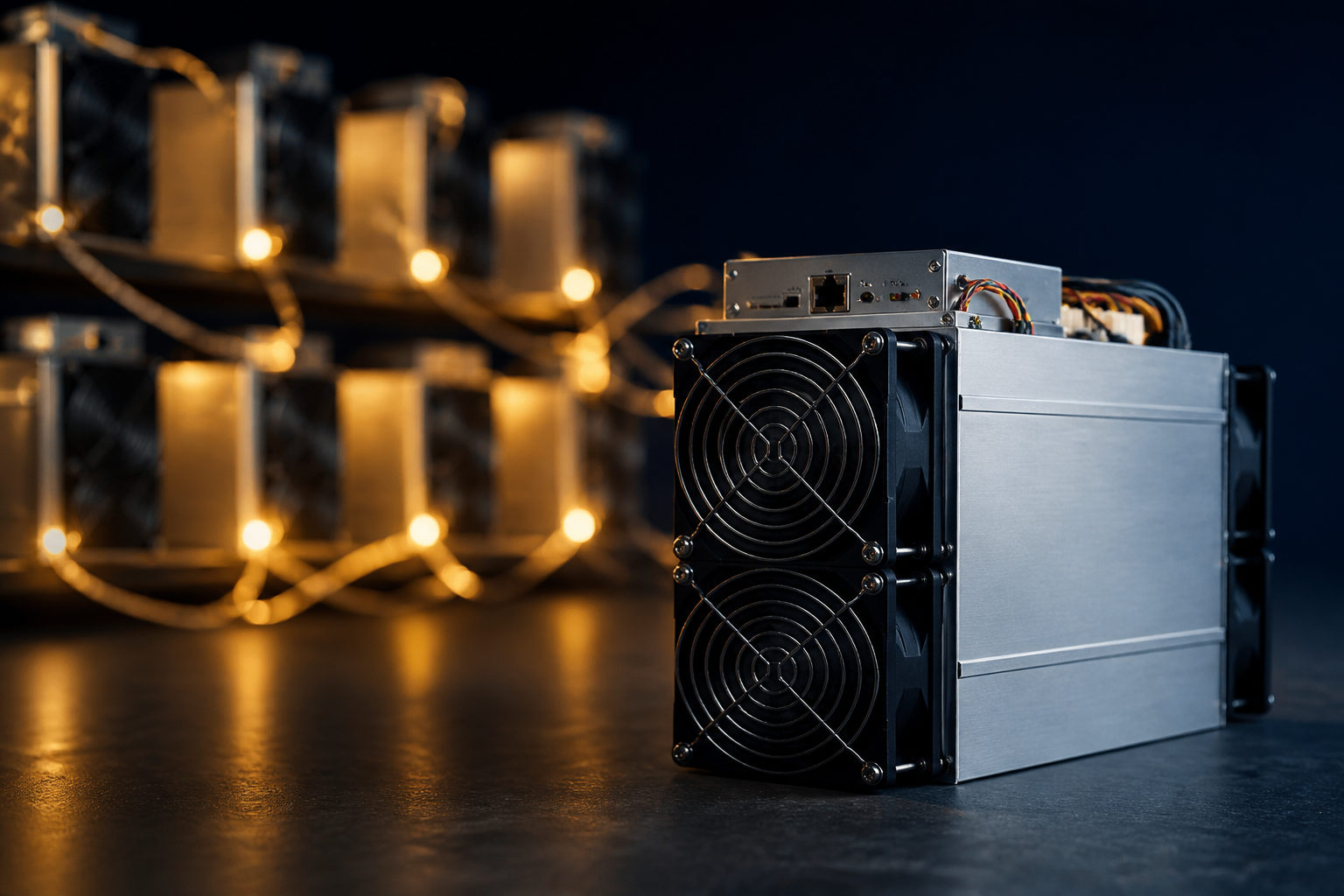
What equipment do I need to mine bitcoin? In practice, you usually need an ASIC miner, stable power, cooling, internet access, and a mining pool setup. A regular home computer is generally not the tool people use for Bitcoin mining today.
Start with the idea behind mining
Bitcoin mining is easiest to picture as a nonstop bookkeeping race. The network groups transactions into blocks, and miners compete by running repeated calculations to find a valid result under Bitcoin's rules. The miner that gets there first can add the next block to the blockchain and receive the block reward defined by the network.
That process shapes the hardware requirements. Mining is not a short burst of work like opening an app or exporting a file. It is continuous, repetitive computation that depends on uptime, heat control, and predictable power delivery. If any of those pieces fail, the machine may still turn on, but it stops being useful as a mining tool.
That is why the answer to what equipment do I need to mine bitcoin is bigger than a single product. You are really asking what kind of setup can stay online, stay cool, and stay connected long enough to compete in a network where everyone is trying to solve the same problem faster.
The core equipment list
Most beginners focus on the miner itself, which makes sense at first. Still, the miner is only the center of a working chain of equipment. Without the supporting parts, the system is incomplete.
| Item | What it does | What happens without it | What to pay attention to |
|---|---|---|---|
| ASIC miner | Performs the specialized computations used in Bitcoin mining | No usable mining hardware | Compatibility with Bitcoin mining, reliability, serviceability |
| Power supply and electrical setup | Keeps the machine running continuously | Shutdowns, instability, possible hardware stress | Power matching, safe wiring, sustained load handling |
| Cooling and ventilation | Removes heat produced during operation | Thermal throttling, stoppages, shorter hardware life | Airflow path, room ventilation, noise tolerance |
| Internet connection | Maintains communication with a mining pool or node | Disconnects can leave the machine idle or inefficient | Stability matters more than raw bandwidth |
| Mining pool account | Lets you contribute hash power to a shared pool | Solo mining is much harder in practice for most users | Payout rules, transparency, interface clarity |
| Monitoring tools | Track temperature, fans, connectivity, and errors | Problems get noticed late, downtime grows | Alerts, logs, remote management options |
| Physical location | Holds the equipment and absorbs heat and noise impact | Home environments often become uncomfortable fast | Ventilation, safety, wiring access, daily practicality |
If you are new, this table matters more than brand talk. Many people do not run into trouble because they bought the wrong category of machine. They run into trouble because they treated mining hardware like ordinary consumer electronics, then discovered that heat, noise, and electrical demands make daily operation much harder than the purchase decision.
Why a normal PC is usually not enough
A common question is whether a laptop, desktop, or gaming rig can mine Bitcoin. The short answer is that these devices may help you understand the concept, but they are generally not the standard choice for real Bitcoin mining now. The field has moved toward specialized machines built for one task.
| Hardware type | Suitable for Bitcoin mining? | Practical view |
|---|---|---|
| Laptop | No | Heat and long-run stability are poor fits for mining use |
| Desktop CPU | No | Useful for learning, not a realistic tool for competitive mining |
| GPU rig | Usually no | GPUs are more often linked with other mining algorithms, not modern Bitcoin mining |
| ASIC miner | Yes | This is the standard hardware path for Bitcoin mining today |
The reason is straightforward. Bitcoin mining rewards specialized, sustained computational output. ASIC machines are designed around that requirement. A regular computer is built for flexibility, which is valuable for everyday work, running a wallet, browsing blockchain data, or even operating a node. It is not the same thing as purpose-built mining hardware.
It also helps to separate mining from node operation. A Bitcoin node validates and relays transactions and blocks. A miner competes to produce the next block. Both matter to the network, but the equipment needed for each role is different. Someone can run a node on ordinary hardware and still not be mining at all.
Solo mining, pool mining, and hosted mining have different equipment needs
When people ask what equipment do I need to mine bitcoin, they often skip the next question: how do I plan to participate? Your path changes the setup you need and the amount of work you must handle yourself.
| Participation model | What you need on your side | Best suited for | Main challenge |
|---|---|---|---|
| Solo mining | Miner, power, cooling, internet, location, and full operational control | Experienced users comfortable with deployment and maintenance | High demands on reliability and self-management |
| Pool mining | Miner plus the basic supporting setup and pool configuration | Most people who want hands-on participation | Understanding fee structures and payout methods |
| Hosted mining | Often still involves owning or leasing mining hardware, while operations happen elsewhere | Users without a suitable site at home | Dependence on the hosting provider's reporting and service quality |
For most readers, pool mining is the model that makes the question practical. Instead of trying to find blocks alone, your machine contributes hash power to a group and receives payouts according to the pool's rules. That does not remove the need for equipment, but it changes the experience from an all-or-nothing effort into an ongoing shared process.
Hosted mining changes a different part of the equation. It can reduce local noise, heat, and electrical constraints, yet it adds another layer of trust and verification. Before thinking about miner models, decide whether you want direct physical control over the machine or whether you are comfortable relying on someone else to operate it.
The real-world checks before you buy anything
The most useful pre-purchase question is not which machine looks powerful. It is whether your environment can support mining at all. Bitcoin mining creates a chain of ongoing obligations, and each one affects whether the hardware remains usable.
- Electrical capacity: mining equipment needs steady power over long periods, and home wiring may not be suitable.
- Heat management: the machine's output becomes room heat, which can build up quickly in small spaces.
- Noise tolerance: mining gear can be loud enough to become a daily living problem.
- Maintenance time: dust, connection issues, restarts, and hardware checks are part of the job.
- Used hardware risk: unclear history, heavy prior use, and weak support can create expensive headaches.
There is another distinction that saves many beginners from confusion: the equipment for mining Bitcoin is different from the equipment for buying and holding Bitcoin. If your goal is simply to own bitcoin, you are looking at exchange access and wallet security. If your goal is to mine, you are stepping into power planning, cooling, uptime, and operational discipline.
That difference matters because some people chase mining hardware when what they really want is exposure to Bitcoin itself. Those are separate decisions, and the right setup depends on which one you are actually trying to make.
FAQ
Can I mine Bitcoin with a gaming PC?
You can experiment to understand the idea, but that is different from practical mining. In current conditions, gaming PCs are generally not the standard hardware choice for Bitcoin because they are not built for this specific workload.
Do I need an ASIC miner to mine Bitcoin seriously?
For real participation, an ASIC miner is usually the expected hardware path. Bitcoin mining has become specialized enough that general-purpose machines are not what most miners rely on.
Do I have to join a mining pool?
No, but many people choose that route because it is easier to participate in a shared structure than to mine alone. A pool does not remove equipment needs; it changes how your machine's work is counted and paid.
Is running a Bitcoin node the same as mining?
No. A node verifies and relays network data, while a miner competes to produce blocks. The roles can exist side by side, though they require different hardware choices.
What should I check before buying a miner?
Check your power situation, airflow, noise tolerance, maintenance capacity, and whether the location is practical for long-run operation. Those factors decide whether the machine can actually be used the way mining demands.
If you want a sensible next step, write down your constraints first: where the machine would run, how heat would leave the room, whether the sound is acceptable, and who would handle downtime. Once those answers are clear, the equipment question becomes much easier to solve.
Disclaimer: This article is for informational and educational purposes only and is not investment, financial, or legal advice. Crypto assets are highly volatile and you could lose your entire investment. Do your own research and decide carefully.