
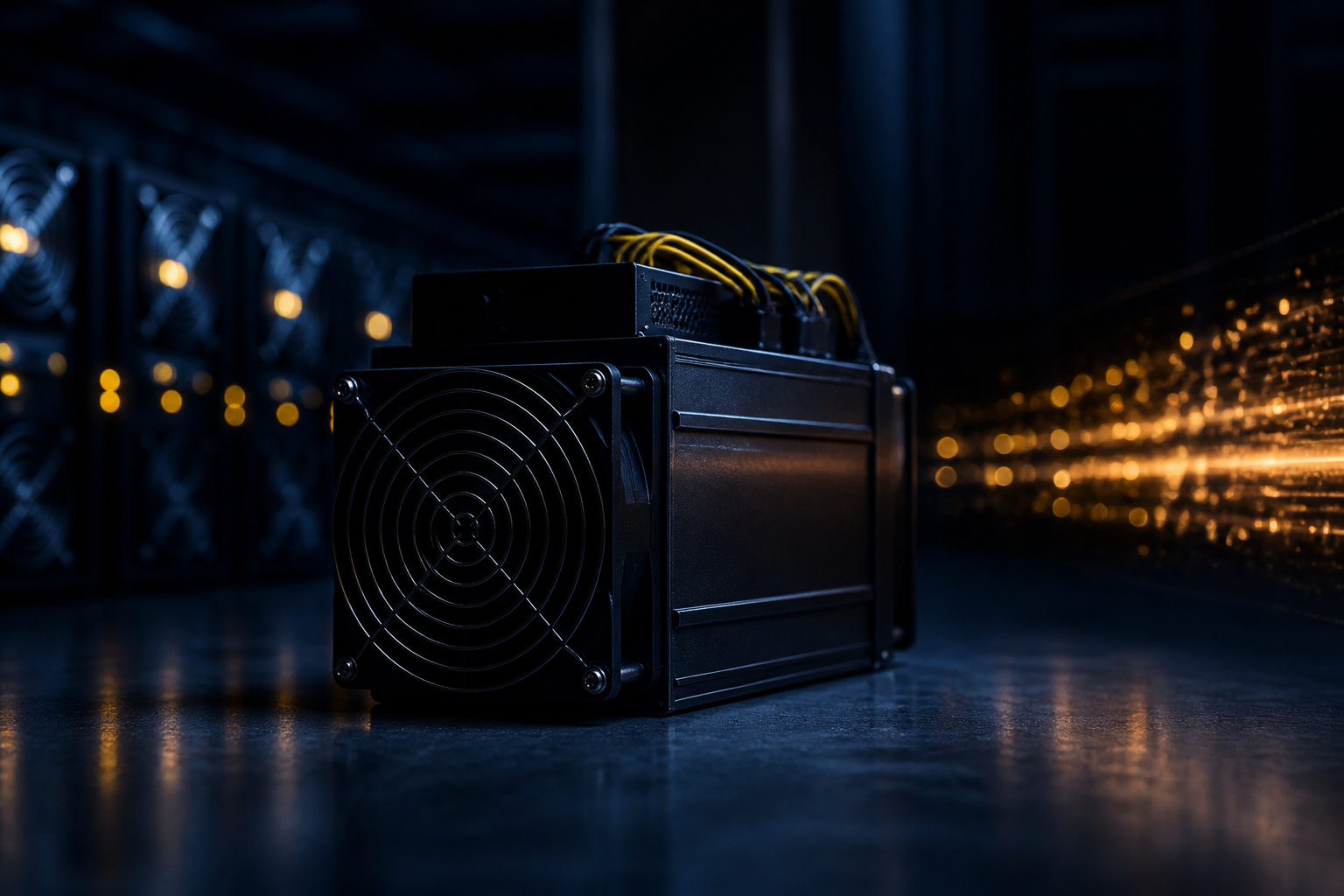
Bitcoin mining does not end in one sudden moment. A better answer is that new bitcoin issuance keeps shrinking through halving cycles until supply nears the 21 million cap, while miners can still keep producing blocks and earning transaction fees after new issuance fades.
What people usually mean by “mining ends”
The phrase can point to different things, and mixing them up causes most of the confusion. Some people mean the point when no meaningful amount of new bitcoin is left to be issued. Others mean a future where miners stop running machines because costs are too high. A third group is really asking whether the Bitcoin network itself can continue without block rewards playing the same role they do today.
A simple way to picture Bitcoin is as an ongoing bookkeeping contest. Miners compete for the right to add the next page to a public ledger. The winner gets to package transactions into a block, broadcast that block to the network, and receive compensation under the network rules. That compensation has two parts: block rewards and transaction fees. Over time, the first part shrinks. The second part does not disappear.
| Common question | What it actually means | Does it mean Bitcoin stops? |
|---|---|---|
| When does mining end? | When new issuance gets close to the supply cap | No |
| Will miners quit? | Some miners may leave if costs are too high | Not necessarily |
| Will the network stop? | Blocks would have to stop being produced and validated | That is a different issue |
So the clean answer is this: mining does not end in the same way a factory shuts down at closing time. Bitcoin changes gradually. New issuance becomes smaller, while the role of fees becomes more important.
Why Bitcoin issuance slows instead of stopping at once
Bitcoin was designed with a fixed supply schedule. The maximum supply is 21 million coins. New blocks are produced about every 10 minutes on average. The block subsidy is cut in half about every 4 years, or every 210,000 blocks. Those rules are the reason the answer to “when does bitcoin mining end” is more about a long transition than a single finish line.
The known halving years are 2012, 2016, 2020, and 2024. Each halving reduces the amount of newly issued bitcoin that miners receive for adding a block. The issuance curve gets flatter over time. In practice, that means the network moves from an era where newly created bitcoin is a larger share of miner revenue toward one where fees matter more.
Bitcoin did not appear without a plan. Satoshi Nakamoto published the 2008 white paper, Bitcoin: A Peer-to-Peer Electronic Cash System, and the genesis block was created in January 2009. The supply cap, the halving cycle, and the block cadence are all part of that original framework.
| Rule | What it does | Why it matters for “mining end” questions |
|---|---|---|
| 21 million cap | Limits total issuance | Explains why new coin creation declines toward a ceiling |
| About 10 minutes per block | Sets the rough pace of block production | Shows that mining is tied to ongoing block creation |
| Halving every 210,000 blocks | Reduces new issuance on a schedule | Turns the process into a long taper, not a sudden stop |
What miners are actually doing
The word “mining” can be misleading because it sounds like digging something out of the ground. In Bitcoin, miners are performing computational work. They gather pending transactions, build candidate blocks, and repeatedly attempt to produce a valid result under the network rules. When one miner succeeds, that block is shared with the rest of the network, which checks whether it follows the consensus rules.
This process matters for more than coin issuance. It orders transactions, gives users a path toward confirmation, and helps secure the chain against revision. The work miners perform is part of the system’s defense. Rewriting accepted history becomes expensive because the network is built around proof of work.
That distinction matters a lot. If you think mining only exists to create new coins, the end of new issuance sounds like the end of mining. But mining also exists to keep the ledger moving forward. As long as users want transactions confirmed and the network needs blocks, there is still a job to do.
| Stage | What miners do | Why it matters |
|---|---|---|
| Collect transactions | Select pending transactions for a block | Moves transactions toward confirmation |
| Build a candidate block | Assemble the block data | Prepares the next ledger entry |
| Perform proof of work | Keep trying valid outcomes | Creates competition for block production |
| Broadcast the block | Send the winning block to the network | Keeps the ledger synchronized |
What happens after most new bitcoin has been issued
The short answer is fees. Users usually attach transaction fees, and miners tend to prioritize transactions that make economic sense to include. As block rewards get smaller, fees are expected to carry more weight in miner incentives. That does not guarantee easy economics for every participant, but it explains why the network can keep operating after the block subsidy becomes much smaller.
This is where protocol rules and business reality split apart. At the protocol level, Bitcoin can keep producing blocks as long as miners continue competing to add them. At the operator level, each miner has to deal with power costs, machine efficiency, cooling, maintenance, downtime, and pool rules. Some participants may leave when conditions get worse. Others with better equipment or lower costs may stay.
That is why “when does bitcoin mining end” has no useful one-line answer unless you define the layer you care about. If you mean new issuance, the process tapers toward the supply cap. If you mean whether every miner can stay profitable, that depends on conditions outside the fixed supply schedule.
| Question | Protocol answer | Operator answer |
|---|---|---|
| When does new coin creation run out? | It declines toward the 21 million cap through halvings | No individual miner controls that |
| When does mining stop? | The network can still produce blocks | Each miner decides based on costs and expected revenue |
| What keeps miners interested later on? | Transaction fees can remain part of the incentive | Only if costs are manageable |
Can regular people still participate in Bitcoin mining?
They can, but participation and suitability are different questions. The era when a normal home computer could compete seriously is long gone. Modern Bitcoin mining is associated with specialized hardware, stable power, heat management, noise issues, and constant operational attention. People often underestimate this because the word “mining” sounds simple.
There are also different ways to participate. Someone can mine independently, join a mining pool, run a node without mining, or simply study how blocks and transactions are validated before spending money on equipment. Those choices serve different goals. One path is about competing for block production. Another is about verifying the network and learning how Bitcoin really works.
| Approach | Who it fits | Main challenge | Main benefit |
|---|---|---|---|
| Solo mining | People with infrastructure and operating experience | Hardware, power, maintenance, variance | Direct participation in block competition |
| Mining pool | People who want smoother results | Still requires cost control and rule awareness | Shared contribution with pool-based payouts |
| Running a node | People focused on validation and learning | Software setup and system maintenance | Direct understanding of consensus checks |
| Research first | Beginners | Time and discipline to learn | Fewer bad assumptions before spending money |
If your starting question is only about when mining ends, do not jump straight to equipment. Learn how the block subsidy works, how fees fit in, how pools distribute results, and how costs shape miner behavior. Those basics are what keep the topic grounded in reality.
FAQ
Will Bitcoin still work after all coins are issued?
Yes. The network still needs blocks, transaction ordering, and validation even when new issuance becomes very small.
The key question then is whether fees provide enough incentive for miners to keep competing to produce blocks.
Can I mine Bitcoin with a regular PC today?
You can try in theory, but that is very different from having a realistic chance to compete. Bitcoin mining today is tied much more closely to specialized hardware and operational efficiency.
If your goal is education, studying nodes, blocks, and fee selection is often more useful than buying equipment too early.
Does joining a mining pool solve the problem of high costs?
No. A pool can smooth out how results are distributed across participants, but it does not remove your power bill, machine limits, heat, or maintenance needs.
It changes the payout pattern more than the underlying economics.
Does halving make mining unworkable right away?
Not in a uniform way. A halving reduces the block subsidy, but miners respond differently depending on hardware quality, electricity costs, and fee conditions.
Some leave, some stay, and the network adjusts as participants react.
Where should I check the live Bitcoin price?
Use major market data sites, exchange price pages, or blockchain data services that show current trading information. This article does not include a live price because that figure changes constantly.
If you are asking because you want to judge mining economics, remember that price is only one input beside hardware, energy, maintenance, and downtime risk.
The most useful way to think about the topic is to separate issuance from operation. Bitcoin mining does not “end” as a single event; new coin creation keeps shrinking, while the decision to keep mining always comes back to fees, costs, and the need to keep blocks moving.
Disclaimer: This article is for informational and educational purposes only and is not investment, financial, or legal advice. Crypto assets are highly volatile and you could lose your entire investment. Do your own research and decide carefully.