
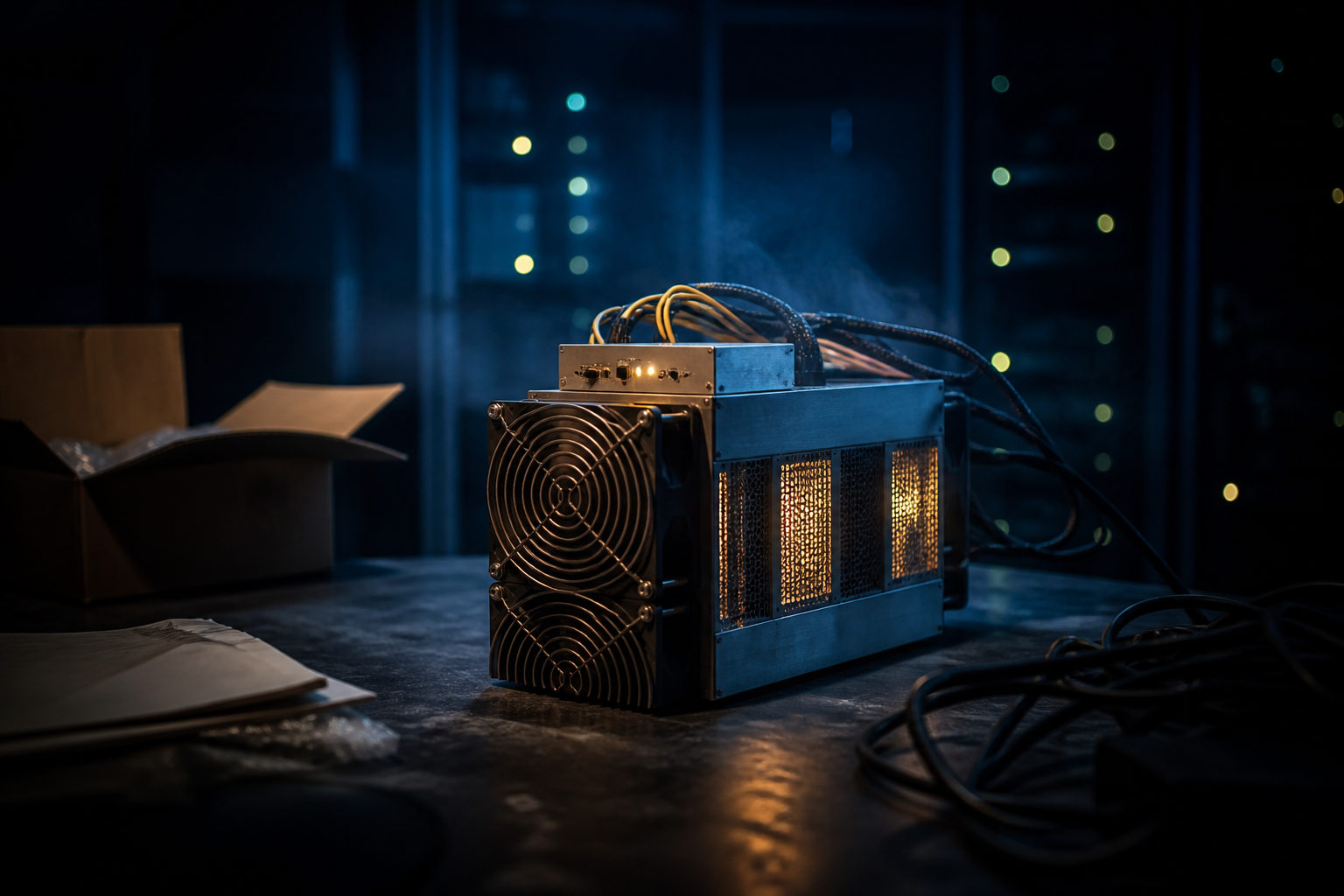
Bitcoin mining itself is not a scam. It is the process that helps the Bitcoin network confirm transactions and issue new coins, while many scams appear when sellers wrap that process in fixed-return contracts, fake cloud mining, or vague hosting deals.
What bitcoin mining actually does
A simple way to picture mining is to treat it like a public bookkeeping contest. Transactions wait to be confirmed, miners use specialized machines to compete for the right to add a new block, and the winner receives the block reward plus transaction fees under the network rules.
This is not an informal side feature. Satoshi Nakamoto published the white paper, Bitcoin: A Peer-to-Peer Electronic Cash System, on 2008-10-31, and the genesis block followed on 2009-01-03. Bitcoin aims for roughly one block every 10 minutes. The block subsidy halves every 210,000 blocks, and after the 2024-04-19 halving, the current block reward is 3.125 BTC, with the next halving expected around 2028.
That structure matters because it shows where mining fits in. Miners are not pressing a button that creates money out of nowhere. They are participating in a rules-based system that secures transaction history and distributes new bitcoin according to known issuance rules, all within the hard cap of 21,000,000 BTC that will be reached around 2140.
| Point | How bitcoin mining works | Common misunderstanding |
|---|---|---|
| Purpose | Compete to add blocks and confirm transactions | A machine that prints money automatically |
| Reward source | Block reward and fees | A platform paying fixed interest |
| Rules | Public network rules and protocol | A company can change numbers at will |
| Outcome | Depends on hardware, costs, and competition | Buying a miner guarantees profit |
Why people still connect mining with scams
The confusion usually starts when people do not meet mining directly. They meet a sales pitch. That pitch may use terms like cloud mining, managed mining, hosted machines, guaranteed contracts, passive daily income, or referral bonuses. Once the technical process gets buried under marketing language, the scam risk rises fast.
Real bitcoin mining has moving parts that no honest operator can erase. Hardware efficiency matters. Power costs matter. Downtime matters. Pool payout rules matter. Maintenance matters. Bitcoin price moves. Network conditions change. If a seller removes all of those variables and leaves only a smooth line of daily rewards, you are no longer hearing a realistic description of mining.
Another source of confusion is the phrase “bitcoin mining is real,” which some people misread as “every mining offer is legitimate.” Those are different claims. Bitcoin mining is a real network activity. A hosted mining contract, a cloud mining dashboard, or a private mining club can still be misleading, overpriced, or fully fraudulent.
| Offer type | What a normal offer looks like | Red flag |
|---|---|---|
| Miner purchase | Clear machine model, power use, delivery terms, warranty | Talks only about payback and ignores operating details |
| Mining pool | Published fee structure and payout method | Opaque calculations that users cannot check |
| Hosting | Explains electricity, downtime, repairs, and service terms | Promises safety, certainty, or fixed returns |
| Cloud mining | Specific contract terms and clear risk disclosures | Polished dashboard with weak proof of real hardware |
Where the real costs and limits show up
In theory, anyone can participate in bitcoin mining. In practice, mining is highly specialized. Standard home computers are not the main tool anymore; dedicated ASIC miners dominate because the network is competitive and efficiency matters. That changes the question from “Can I mine?” to “Can I mine under conditions that make sense for me?”
The first limit is hardware. The second is everything around it: electricity, cooling, noise, stable internet, dust control, repairs, and the ability to handle downtime. If you place machines with a third-party host, a new layer appears: contract quality, operational transparency, and what happens when service breaks down or the business relationship ends.
New miners also mix up network-wide issuance with personal output. Bitcoin currently adds about 450 BTC per day across the entire network, based on the 3.125 BTC block reward and about 144 blocks per day. That figure is not what one miner, one machine, or one hosting farm receives. Your own result depends on a much narrower share of total network hashpower and on your actual operating costs.
| Way to take part | Who it may fit | Main difficulty | Typical mistake |
|---|---|---|---|
| Run your own miners | People who can handle equipment and a suitable site | Power, cooling, noise, maintenance | Underestimating daily operational work |
| Use a hosting provider | People who do not want to build a site themselves | Trust, contract terms, service visibility | Assuming hosting removes most risk |
| Buy cloud mining | People who want remote exposure | Hard to verify, often complex terms | Treating dashboard numbers as cash in hand |
| Buy bitcoin directly | People whose goal is simply to hold BTC | No participation in mining operations | Thinking mining is required to own bitcoin |
How to judge whether a mining offer is honest or suspect
Start with the product itself. Are you buying a machine, a hosting service, pool access, or just a promise? If the answer stays fuzzy after direct questions, that is already a warning sign. A legitimate business should be able to explain what you own, what you do not own, and how the arrangement works when something goes wrong.
Then check what can be verified. A serious offer should be able to describe the machine type, where it runs, who pays for power, how payouts are calculated, who handles repairs, and what happens if you want to stop. If all you receive is an app screen, a chat group, and repeated claims about easy income, you are being asked to trust what should be checked.
Pay close attention to how returns are described. Honest mining businesses talk about costs, volatility, uptime, and uncertainty because those are built into the activity. Scam-heavy offers often avoid operational language and switch to emotional triggers instead: limited seats, special internal access, guaranteed growth, or referral rewards for bringing in more buyers.
- Ask what you are actually purchasing. Ownership of a machine is different from a service contract or a revenue-sharing promise.
- Break down the cost structure. Electricity, hosting, maintenance, and downtime rules should be stated plainly.
- Check whether payouts are explainable. If you cannot understand the payout method, you cannot judge the result.
- Read the exit terms. Early termination, transfer rights, and fault handling should not be hidden.
- Treat guaranteed income as a danger sign. Fixed-return language does not fit the economics of real bitcoin mining.
FAQ
Is bitcoin mining legal, or is it automatically a scam?
Mining is a real technical activity, not an automatic scam. The legal and practical risk depends on your local rules and on the specific company, contract, or solicitation you are dealing with.
Can I mine bitcoin with a normal PC?
You can technically run software, but that does not mean you can compete effectively. Modern bitcoin mining is built around specialized ASIC hardware, so ordinary home computers are not realistic tools for serious participation.
Why does cloud mining get so much suspicion?
Because users often cannot verify the machines, the operating conditions, or the source of the displayed output. The less visibility you have into the physical setup, the more careful you should be with prepayment and long contracts.
Does joining a mining pool make mining safe or guaranteed?
No. A pool can smooth payouts compared with solo mining, but it does not remove hardware costs, service interruptions, or price swings. Pool participation changes distribution, not the underlying business risk.
If I only want bitcoin, do I need to learn mining first?
Not at all. Holding bitcoin and operating a mining setup are separate decisions. If your goal is ownership rather than running equipment, buying and securing bitcoin is a different path from entering the mining business.
If you are evaluating a mining deal, the most useful next step is simple: read the contract, map every ongoing cost, confirm what you actually own, and walk away from any offer that replaces operational detail with guaranteed income language.
Disclaimer: This article is for informational and educational purposes only and is not investment, financial, or legal advice. Crypto assets are highly volatile and you could lose your entire investment. Do your own research and decide carefully.