
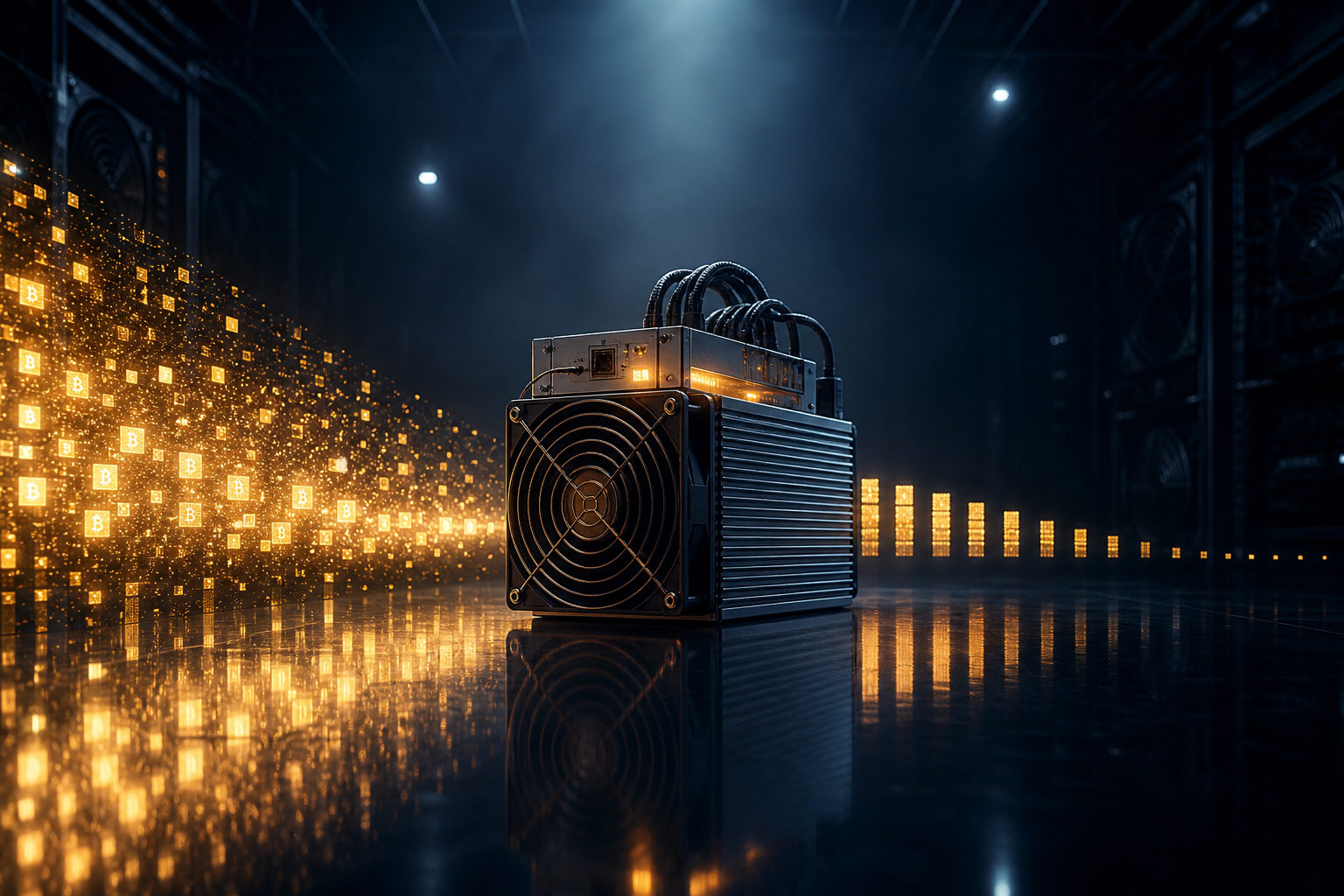
How long will it take to mine all bitcoins? A very long time, because bitcoin issuance slows over time and the remaining supply is released at an increasingly gradual pace.
Bitcoin mining is a bookkeeping race, not a treasure hunt
The word mining makes many beginners picture machines digging something out of the ground. That image is catchy, but it hides the real mechanism. Bitcoin mining is better understood as an open competition to win the right to add the next block of transactions to the chain.
People across the network send transactions. Those transactions need to be grouped, checked, and placed into blocks. Miners compete by performing the proof-of-work process required by the protocol. The winner gets to publish the next block and receives the block reward plus transaction fees.
This framing matters because it explains why the answer to “how long will it take to mine all bitcoins” is not simply “faster if more miners join.” More miners do not mean the network starts issuing coins at any speed participants want. Bitcoin adjusts mining difficulty so block production stays close to its intended rhythm over time. When more computing power arrives, competition rises. The pace of issuance does not suddenly break free.
That is the first key idea: mining secures the network first and distributes new coins as part of that process. If you treat mining only as coin creation, the timeline becomes confusing. If you see it as a security system with a built-in issuance schedule, the long horizon makes much more sense.
Why all bitcoins are not mined quickly
The short answer is simple: bitcoin does not release new supply at a constant pace forever. The protocol reduces the block subsidy over time through halvings. Each reduction slows the rate at which new bitcoin enters circulation. That is why the tail of issuance stretches out instead of ending in a rush.
In practical terms, the remaining supply is not mined under a “first come, first served until it runs out tomorrow” model. It is released under rules that become tighter over time. Earlier periods distributed more new bitcoin than later periods. As the subsidy keeps shrinking, newly issued bitcoin becomes a smaller piece of miner revenue, while transaction fees remain part of the picture.
There are two common mistakes here. One is assuming that “almost all coins are mined” means bitcoin will soon become impossible to buy on the market. That does not follow. Market availability depends on existing holders, trading activity, and liquidity, not only on how much fresh supply is created. The second mistake is thinking a big jump in total hashrate can force the network to finish issuance early. Difficulty adjustment is there to prevent that from becoming a lasting outcome.
So when people ask how long will it take to mine all bitcoins, the useful answer is not just “a long time.” The useful answer is that the release schedule becomes slower and slower, making the final stretch extended by design. That long tail is a feature of the system, not an accident.
How people can participate in bitcoin mining today
If you are asking the timeline question because you are also wondering whether you should mine, it helps to separate curiosity from action. There are several ways people approach bitcoin mining, and they do not carry the same demands.
The direct route is solo operation with dedicated hardware. That means buying ASIC miners, arranging power, managing heat, setting up software, monitoring uptime, and handling maintenance. The advantage is control. The downside is obvious: the setup is technical, noisy, heat-intensive, and demanding to maintain over time.
A more common path is joining a mining pool. A pool combines the work of many miners and distributes rewards according to contribution. This does not remove competition, but it changes how rewards arrive. Instead of waiting a long time for a rare win, participants usually receive a steadier allocation based on the pool’s payout structure.
Still, joining a pool does not turn a bad setup into a good one. Hardware efficiency, power cost, uptime, connection stability, firmware management, and account security still matter. Pool mining smooths variability. It does not erase operating realities.
For many readers, the best option may be not to mine at all. That is not a negative conclusion. It is simply a realistic one. Bitcoin mining today is a specialized hardware activity rather than something most people can do competitively with ordinary consumer devices.
Questions to ask before getting involved
- Hardware: Bitcoin mining typically requires dedicated ASIC machines rather than general-purpose computers.
- Electricity: Reliable power and manageable energy costs are central to any long-term setup.
- Heat and noise: Mining equipment runs hot and loud, which can make home operation impractical.
- Maintenance: Downtime, connectivity issues, firmware updates, and hardware faults need ongoing attention.
- Rules and reporting: Local legal, tax, and hosting requirements vary and should be reviewed before any commitment.
If you do not have clear answers to those points, the next step is usually more research, not a rushed hardware purchase.
“Can it still be mined?” is different from “Is mining worth doing for me?”
This distinction is where many discussions go off track. People search for how long will it take to mine all bitcoins, but the hidden question is often whether they are too late. Being early or late is not the right framework on its own. Bitcoin can still be mined, and new supply still enters the system over time, but that does not mean mining is suitable for every participant.
Mining is shaped by operating conditions. A strong setup is not defined by enthusiasm. It is defined by efficient hardware, manageable power economics, reliable cooling, low downtime, operational discipline, and an understanding of how payouts work. Without those, the fact that the issuance schedule is still ongoing does not help much.
Price expectations also need careful handling. Public forecasts from major institutions can show how divided the market is, but they should never be treated as a promise of mining viability. As of August 2, 2026, Bernstein, in a report published on 2026-06-15, gave a target of 150,000 美元 for the end of 2026. Standard Chartered, in a view published on 2026-02-12, gave a target of 100,000 美元 for the end of 2026.
JPMorgan, in a forecast published on 2026-02-01, gave a 2026 target range of 150,000-170,000 美元. Galaxy Digital CEO Mike Novogratz, in comments published on 2026-07-10, pointed to a 60,000-80,000 美元 trading range for the whole of 2026. Fidelity's Jurrien Timmer, in a view published on 2026-06-01, described 2026 as a 65,000-75,000 美元 consolidation zone.
Those calls do not point in one direction. Some are bullish, some are more cautious, and some expect a broad consolidation period. For miners, that spread is the real lesson. If well-known institutions disagree so widely, a single forecast should not be used as the basis for buying machines or making long-lived operating commitments.
The smarter way to use market forecasts is to treat them as context, not as instruction. Mining decisions still come back to physical constraints and operating discipline. Electricity, cooling, maintenance, uptime, and location risk remain real even when the market mood improves.
FAQ
What happens to miners after all bitcoins are mined?
Miners do not exist only to receive newly issued bitcoin. They also process transactions and help secure the network, which means transaction fees remain part of the incentive structure.
Can I mine bitcoin with a home computer today?
You may be able to run software, but that is very different from being competitive. Bitcoin mining is dominated by specialized hardware, so ordinary consumer computers are generally not effective for this role.
Does joining a mining pool make bitcoin mining easy?
It makes reward distribution smoother, not the business itself easy. Pool participation does not solve poor hardware efficiency, expensive electricity, unstable internet, or maintenance problems.
If fewer new coins are issued over time, will bitcoin become impossible to buy?
Not necessarily. New issuance affects fresh supply, while market availability depends on liquidity, trading activity, and whether existing holders are willing to sell.
Should I focus on price forecasts before deciding to mine?
They can help you understand sentiment, but they should not be your main filter. Your setup quality, operating costs, and ability to manage equipment matter far more in day-to-day mining decisions.
If you are trying to decide whether to participate, start with a checklist for power, cooling, noise, space, maintenance, hosting terms, and reporting obligations; if those basics are not solid, “there are still bitcoins left to mine” is not a strong reason to proceed.
Disclaimer: This article is for informational purposes only and does not constitute investment advice. Cryptocurrency prices are highly volatile. Always do your own research.